
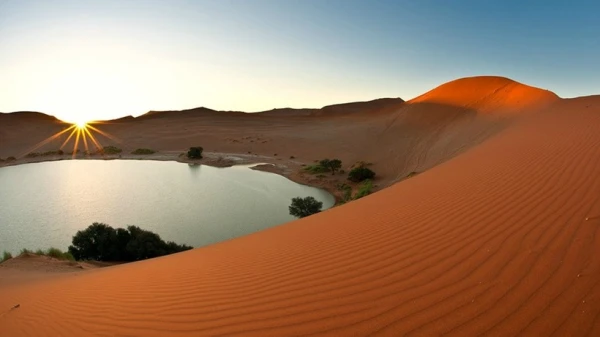
The volume of deep sources is approximately 100 times greater than that of Lake Baikal.
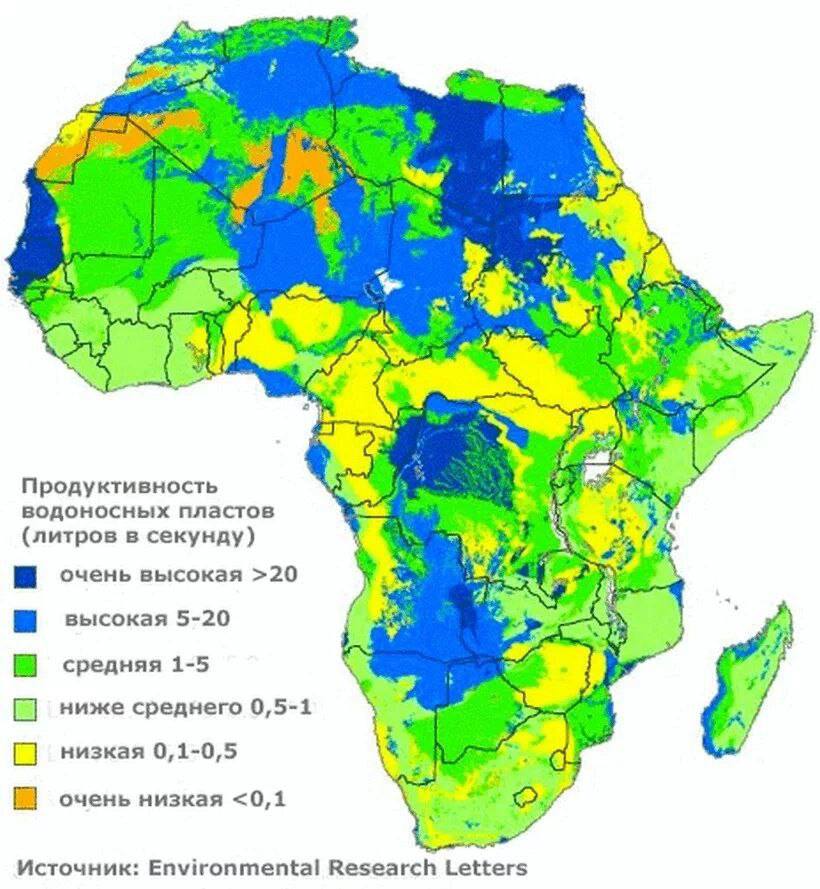
Beneath the sands of the Sahara, there are indeed vast reserves of fresh water. The main water resources of the Sahara are concentrated in several enormous underground reservoirs. The largest of these are the Northwest Sahara Aquifer System, which Algeria relies on, and the transboundary Nubian Sandstone Aquifer System.
These resources are not actually a recent discovery. Locals have been using them since ancient times, employing the principles of physics for extraction. The primary technology used here for centuries is the foggara.
This method allows water to be extracted without the use of mechanical pumps. The system operates on the principle of gravity flow: underground, a tunnel is dug from a source (for example, the slope of a plateau where the aquifer is located close to the surface) with a very slight incline towards the oasis. Water from the aquifer seeps into the tunnel and flows directly into the oasis. Vertical shafts are brought to the surface at regular intervals for ventilation and maintenance.
When the water reaches the oasis, it is distributed across the fields through a special division system called kasria, in accordance with historically established user rights. Today, despite technological advancements, about 800 such systems are still functioning in Algeria.
The Northwest Sahara Aquifer System is truly vast. It covers an area of 1 million square kilometers, and its volume is not fully studied. It lies within the territories of Algeria, Tunisia, and Libya. The water accumulated there during epochs when the climate in the Sahara was much wetter (yes, that was the case, just thousands of years ago). Of all the aquifer systems in the Sahara, this one is currently the most utilized for economic purposes.
The Nubian Sandstone Aquifer System, on the other hand, is twice the size of its Saharan neighbor—about 2 million square kilometers. The volume of water (by various estimates) ranges from 150,000 to 370,000 cubic kilometers. For comparison, Lake Baikal has only 23.6 thousand cubic kilometers of water. So the volumes are unimaginable. Since this basin lies within the territories of Egypt, Libya, Chad, and Sudan, there remains an unresolved dispute over water usage. Currently, active development is not underway, and this water serves as a strategic reserve for the owner countries. This water issue, like many others in the world, requires the conclusion of international treaties.
Theoretically, the water volumes are immense and could meet the needs of all of Africa for centuries to come. The Libyan project from the time of Gaddafi, the "Great Man-Made River," which was supposed to draw water from the Nubian Aquifer, demonstrates the technical feasibility of this idea.
However, key questions regarding the technical implementation of the project and the political stability of the participating countries remain unresolved.












Leave a comment