The analysis showed that the plain served as a true transport corridor.
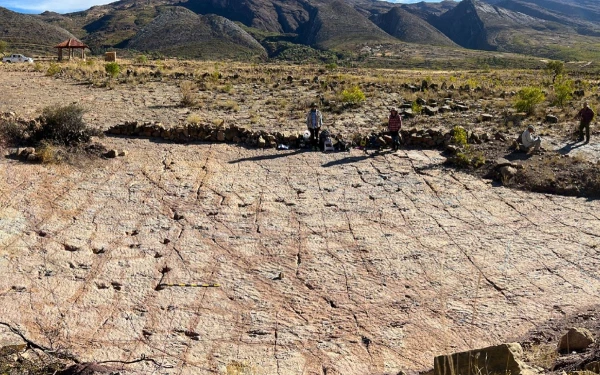
Paleontologists have described the largest dinosaur track site in the world: more than 16,000 impressions covering an area of 7,500 square meters. Scientists believe that this area was not just a place for random strolls, but a bustling corridor where dinosaurs migrated in an organized manner along the shore of an ancient lake.
Bolivia is known for its paleontological landmarks, but the Carreras Pampa site in the Torotoro National Park has long remained a "white spot" for science. The situation was complicated by the fact that there are virtually no bones in the local geological layers, yet the density of tracks on the surface reaches record levels. The researchers faced a "trampled field" where hundreds of trails intersected and overlapped. To make sense of this chaos, an unconventional approach had to be applied.
The authors of the study, published in the journal PLOS One, used drones and 3D scanning to create three-dimensional models of the tracks. They also took colorful yarn: crawling over the rocky surface, the researchers connected consecutive impressions with threads to visualize the movement trajectories of specific animals. This allowed them to "untangle" a tangle of 1,321 track chains (the largest number of tracks in the world) and identify 11 different walking styles—from cautious steps through sticky mud to confident running. The scientists observed sharp 45-degree turns, sudden stops, tail dragging, and limping of injured animals.
The analysis showed that the plain served as a true transport corridor. The tracks have a clear bimodal orientation: thousands of predatory theropods moved in organized streams strictly in two opposite directions—northwest and southeast, likely following the shoreline of the ancient lake.
Particular attention was drawn to the tracks of swimming dinosaurs. The scientists documented the longest continuous swimming track in the world, measuring 130 meters: the animals, barely touching the bottom with their claws, left characteristic scratches resembling a ballerina's mark on pointe shoes. Additionally, for the first time in the Southern Hemisphere, mass evidence of tail dragging was found—deep grooves indicate that the sticky ground forced predators to lower their tails for balance or that they touched the ground when their paws sank too deep.
The authors of the scientific paper established the status of Carreras Pampa as the richest theropod track site on the planet. The study also proves that the behavior of predatory dinosaurs was complex and adaptive: they not only felt confident in the water but also adjusted their gait depending on the ground, moving along unified routes.