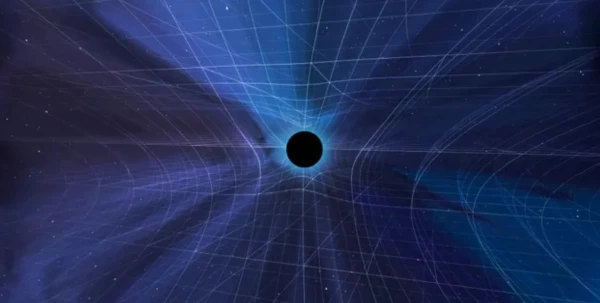
The authors of the theory believe that hidden dimensions may create mass. This proposed invisible structure of spacetime could also explain some of the unresolved questions about the accelerated expansion of the universe, writes Focus.
Modern theories suggest that W and Z bosons acquire mass through interactions with the Higgs field, but new research proposes that the true reason for mass acquisition may be that the structure of spacetime has more dimensions. The study is published in the journal Nuclear Physics B, writes Popular Mechanics.
Currently, physicists believe that fundamental particles, such as W and Z bosons, gain their mass as a result of interactions with the Higgs field. This invisible field permeates the entire universe and underlies the Standard Model of particle physics. This is a well-studied theory of mass emergence in the universe, but some physicists consider it incorrect.
- W and Z bosons are fundamental particles that mediate the weak interaction. Their discovery in 1983 was one of the main confirmations of the correctness of the Standard Model of particle physics.
- The weak interaction is one of the four fundamental forces of nature, alongside the strong interaction, electromagnetism, and gravity. The weak interaction is responsible for processes such as the decay of atomic nuclei and weak decays of elementary particles. This interaction is much stronger than gravity.
The authors of the new study proposed a theory in which the very geometry of spacetime plays a more significant role in the forces and particles in the universe than merely serving as an inert backdrop. In particular, physicists suggest that hidden additional dimensions of spacetime create so-called G2 manifolds, which, if they evolve over time, could provide explanations for some of the most important questions in physics.
- It is important to note that the structure of spacetime consists of three spatial dimensions (height, length, width) and one dimension of time. However, the authors of the study believe that there are more such dimensions.
According to physicists, similar to organic systems such as the twisting of DNA or the chirality of amino acids, these structures with additional dimensions may possess twisting, a kind of internal torsion. If the dimensions evolve over time, it may be found that they can stabilize in certain configurations called solitons. These solitons could provide a purely geometric explanation for phenomena such as spontaneous symmetry breaking.
- Symmetry breaking in physics is the transition of a system from a symmetric state to a less symmetric one, leading to the emergence of complexity and mass in particles. It can be spontaneous when the equations are symmetric, but the system "chooses" a non-symmetric configuration, as in the Higgs mechanism. This mechanism shows that W and Z bosons acquire mass, while the photon (light particle) remains massless because the vacuum has "frozen" in a non-symmetric state. Symmetry breaking is a key mechanism for explaining particle masses and the asymmetry of matter and antimatter in the universe.
In addition to explaining symmetry breaking, the idea that hidden geometry of spacetime could create mass, which is believed to be imparted to particles by the Higgs field, poses a significant challenge to traditional physics. Instead of relying on a field, these masses would arise from twisting within the geometry of space, consisting of at least seven spatial dimensions, physicists believe.
According to scientists, it is possible that the masses of W and Z bosons do not originate from the Higgs field, but directly from the geometry of seven-dimensional space.
This theory may also help explain some of the unresolved questions about the accelerated expansion of the universe. Scientists believe that a particle associated with the twisting of spacetime may be responsible for this.
But this theory still needs to be proven.