A traditional archaeological team will not be able to cope with such challenges.
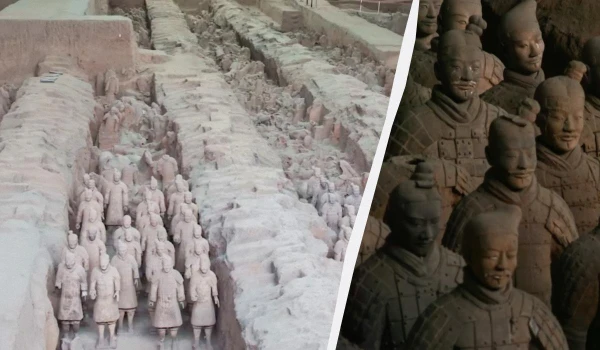
In 1974, a group of farmers in Shaanxi province, China, stumbled upon what became one of the most significant historical discoveries in China's history. It is the tomb that houses the world-famous Terracotta Army.
Approximately 8,000 unique and quite realistic figures were revealed to the world for the first time in over 2,200 years. That is how long they have been buried in the tomb of the first Chinese emperor, Qin Shi Huangdi, reports Interesting Engineering.
Some historical records claim that the tomb is part of a vast complex the size of a city. It has not been opened since 208 BC, and there are reasons for that.
"Officially named the Mausoleum of Qin Shi Huangdi, the complex is located in the modern-day Lintong District of Xi'an, Shaanxi Province. Reports suggest that the construction of the complex lasted about 38 years and was completed (and the complex itself buried under a 76-meter layer of earth) around 208 BC. Although this has not yet been confirmed, the complex was built in the style of Xianyang, the then-capital of the Qin dynasty. According to UNESCO, the total area of the complex is approximately 56.25 square kilometers," the article states.
One ancient historian, Sima Qian, described the tomb as a vast underground palace with "mercury rivers" flowing mechanically through channels. Geophysical studies show that the concentration of mercury around the complex is 20 to 50 times higher than the natural level. This may indicate either mercury contamination or that there are airtight reservoirs of mercury inside the tomb.
Although some parts of the mausoleum have been excavated, the part that contains the burial chamber of Qin Shi Huangdi has never been opened. If the integrity of the tomb is compromised, changes in temperature and humidity, the influx of oxygen, and the presence of microbes could cause irreparable harm to its contents.
"Lacquered coffins, silk flags, painted sculptures, documents, weapons, tapestries, and other organic materials inside would be subjected to unacceptable risk. Moreover, this is not just a precaution; it is a conclusion drawn from hard-earned experience," the authors explain.
When the excavation of the Terracotta Army began, the bright pigments covering the warriors' armor flaked off within minutes of exposure to air. The central tomb is a completely airtight microenvironment created over 2,200 years ago. Therefore, the State Administration of Cultural Heritage of China prohibits excavations if the object cannot be preserved.
In addition to the issues of maintaining the integrity of the object, there is a safety concern. The leakage of mercury vapors already poses an environmental hazard on the surface, and if the tomb indeed contains rivers of mercury, excavating it without the appropriate technology could expose workers and the surrounding area to toxic vapors.
A traditional archaeological team will not be able to cope with such challenges. Chemists, ventilation specialists will need to be involved, and real-time atmospheric monitoring will have to be conducted.
Emperor Qin Shi Huangdi was not just a historical figure. For China, he is a foundational figure in national history, as a unifier and autocrat. Therefore, the actual site of his burial is a state monument.
"An unsuccessful excavation or catastrophic preservation error, as one might expect, would provoke outrage in the country. Allowing time for technology to improve also protects the government's reputation. China is known for its deep conservatism in making decisions regarding archaeological research, especially concerning politically symbolic sites," the article notes.
Currently, this tomb is one of the most researched undisclosed structures on Earth thanks to modern technology. But the resting place of the first emperor of China serves as a time capsule of over 2,200 years. And perhaps the world will never know what treasures and wonders this tomb contains.