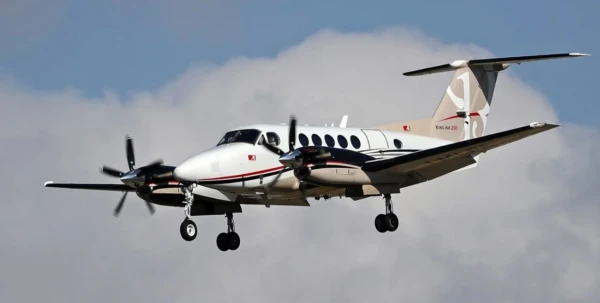
The aircraft made an autonomous landing after an emergency situation in flight when cabin pressure dropped.
Two people were unharmed after an incident involving a Beechcraft Super King Air 200 aircraft. They were able to safely land on the runway at Rocky Mountain Metropolitan Airport near Denver with the help of the autopilot. The autopilot system took control of the aircraft and made a fully autonomous emergency landing for the first time in history, reports Futurism.
On December 20, the cabin pressure of the twin-engine turboprop Beechcraft Super King Air 200 suddenly dropped during flight over Colorado. The Autoland emergency automatic landing system from Garmin then took control, managed the aircraft, communicated with air traffic controllers, and landed at the airport.
According to a statement from Garmin, this was the first use of the Autoland automatic landing system from start to finish in a real emergency situation. The charter airline Buffalo River Aviation, which operated the aircraft, stated that the Autoland system activated automatically during a flight from Aspen with no passengers on board.
<script async src="https://platform.twitter.com/widgets.js" charset="utf-8"></script>On Saturday, Dec. 20 at approximately 2 p.m., North Metro Fire responded to an Alert II airplane incident at Rocky Mountain Metropolitan Airport in Jefferson County with ARFF65, BC61, E61, E64, E65, E68 and M61.
— North Metro Fire (@NMFirePIO) December 22, 2025
From Westminster Fire Department, SAM11, WFDBC1, WFDM4 and WFDTRK5… pic.twitter.com/7hgQrwVen2
Various automatic landing systems are regularly used to land aircraft in challenging weather conditions with poor visibility, but not in emergency situations. However, Garmin's Autoland system, which is installed on approximately 1,700 aircraft, belongs to a new line of automatic landing systems designed specifically for emergency use and is developed to take full control of the flight to land the aircraft in situations where the pilot cannot operate the aircraft. The fact that the system handled a real emergency situation effortlessly is an important milestone in ensuring flight safety.
In this case, the Autoland system activated automatically due to a rapid and uncontrolled loss of cabin pressure, according to a statement from Buffalo River Aviation. The pilots donned oxygen masks and then decided to keep the automatic landing system activated.
Once control was transferred to Autoland, the autopilot independently selected a landing site based on criteria such as distance and runway length, and communicated its intentions to ground controllers. The aircraft then landed autonomously. In footage released by emergency services, the two pilots can be seen exiting the aircraft on the runway.
In this case, the pilots voluntarily decided to allow the Autoland system to take control and did not lose consciousness, contrary to initial assumptions. The automated voice of the system mistakenly informed controllers that control had been transferred to it after the pilot's incapacitation, which led to confusion.
Although the system operated exactly as expected, the pilots were prepared to resume manual control of the aircraft if the system had failed. The pilots consciously decided to retain and use all available tools in an unpredictable emergency situation, according to the airline's statement.
The Federal Aviation Administration (FAA) stated that it is investigating the incident.