Some researchers searched for signs of alien technologies in the interstellar comet 3I/ATLAS and found 9 strange "events". Others studied its non-gravitational acceleration, which helped obtain a more accurate size of this object.
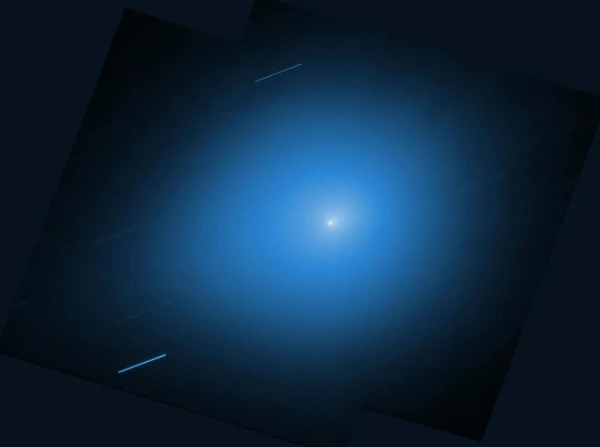
During the closest approach of the interstellar comet 3I/ATLAS to Earth, scientists from the Breakthrough Listen project searched for signs of technosignatures, or evidence that potential aliens are sending messages. Meanwhile, other scientists studied the non-gravitational acceleration of 3I/ATLAS, or acceleration not solely caused by gravitational interactions with other bodies in the Solar System, and were able to obtain data on the size of the interstellar comet. Two studies have been published on the arXiv preprint server, reports IFLScience.
It is worth noting that astronomers first discovered only the third interstellar object in the Solar System, named 3I/ATLAS, on July 1, 2025. Scientists suggested that it is a comet arriving from another part of our galaxy.
There was a hypothesis that 3I/ATLAS could be an alien spacecraft, but numerous data indicate that it is a comet from another star system. Despite this, when comet 3I/ATLAS was at its closest distance to Earth, 270 million km, on December 19, scientists from the Breakthrough Listen project decided to check for signs of potential alien technologies from this interstellar object, just in case.
The study showed that 3I/ATLAS mainly exhibits characteristics typical of comets. So far, there is no evidence that it is an alien spacecraft sending signals. Still, scientists believe that further observations are needed to completely rule out the possibility that 3I/ATLAS is an artificial object. No possible signals from aliens have been detected yet. Nevertheless, astronomers discovered 9 strange "events" that require more thorough investigation using radio telescopes to confirm or refute that these radio signals are related to natural phenomena on the comet.
Another group of scientists attempted to determine the size of the interstellar comet 3I/ATLAS by studying its non-gravitational acceleration. While this may sound like signs of an artificial engine, it is not.
As the comet approaches the Sun, the increase in temperature causes the release of materials from its surface. This can impart non-gravitational acceleration to comets. Measuring this acceleration along with measuring the mass loss rate of the object can provide information about its size.
Using data from ground-based telescopes as well as spacecraft, astronomers found that the size of the nucleus of the interstellar comet 3I/ATLAS corresponds to the sizes of the nuclei of comets from the Solar System. According to scientists' estimates, the nucleus of 3I/ATLAS is between 820 and 1050 meters in size.