
Scientists built an experimental setup with diamond anvils equipped with laser heating.
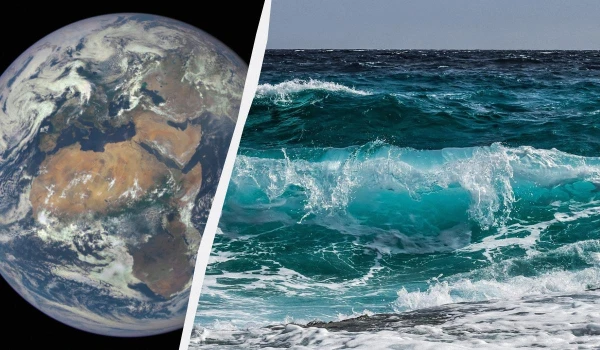
Once, our Earth was a hot planet where magma flowed in one huge ocean. At the same time, when our planet appeared 4.6 billion years ago, space was not the most hospitable place. As Wionews writes, the chaotic environment and constant bombardments caused the surface and the inner part of the planet to remain almost in a constant molten state.
This raises the question, if magma was spread everywhere, where was the water? Research shows that Earth hid it deep within a mineral in the mantle. This was a time when molten magma turned the planet into a blazing furnace.
"For millions of years, Earth transformed from a hot cosmic body in a molten state into a cool and calm solid planet. Oceans filled with water that was hidden somewhere on the planet," the material noted.
At the same time, Professor Zhixue Du from the Guangzhou Institute of Geochemistry of the Chinese Academy of Sciences (GIGCAS) attempted to unravel the mystery of the water stash on Earth. Researchers from his team reported that a large amount of water was actually "locked" deep within the Earth's mantle. The mineral that is present in the mantle in large quantities acted as a microscopic "water container" during the planet's solidification. The results of the scientists' research were published in the journal Science.
Therefore, it was this reservoir that helped Earth transform from a fiery planet into a habitable world in which we live today.
"The team decided to test the previous theory that bridgmanite (the lower mantle of the Earth - UNIAN) had a limited capacity to retain water under low-temperature conditions. They built an experimental setup with diamond anvils equipped with laser heating and high-temperature visualization to understand the extreme conditions at depths of over 660 kilometers and detect water signals in bridgmanite samples. They gradually increased the temperature to about 4100 degrees Celsius, which helped them learn how this affects the ability of minerals to absorb water," Wionews added.
Such simulation showed that the ability of bridgmanite to "hold water" increased with rising temperature. This means that during the hottest phase of Earth's "magma ocean," it changed to retain much more water.
"After the solidification of the magma ocean, the lower mantle became the largest reservoir of water in the solid mantle. Gradually, this water reached the surface due to magmatic activity," the publication explained.















Leave a comment