
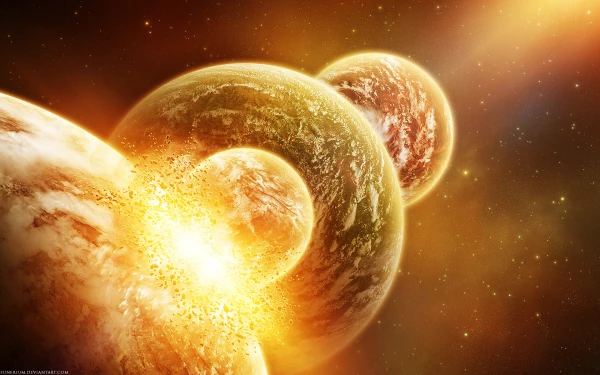
Astronomers are closely observing with the Hubble telescope.
For a long time, some astronomers mistook a bright object near the star Fomalhaut for an exoplanet. Now, it turns out that it has disappeared, and a new source has appeared next to the star. This is not a technical issue or a play of light: astronomers have directly observed for the first time the consequences of collisions between two planetesimals, which left behind clouds of dust. This discovery will allow us to learn more about the early stages of the formation of our Solar System.
Fomalhaut is one of the brightest stars in the night sky. It is located about 25 light-years from Earth in the constellation Piscis Austrinus. This star is nearly twice as massive as the Sun and much younger: its age is estimated at 440 million years.
In the 1980s, astronomers discovered extensive dust disks around Fomalhaut (identified by infrared radiation). These structures are considered remnants of planet formation or debris from planetesimal collisions. The discovery clearly indicated that processes of planet formation were still ongoing there.
In 2008, a group of astronomers led by Paul Kalas from the University of California, Berkeley (USA) saw a small glowing point in the images from the Hubble Space Telescope, right in the midst of Fomalhaut's dust disk. At that time, scientists took it for the exoplanet Fomalhaut b and announced that they had captured such an object in visible light for the first time in history.
However, over the years, the mysteries surrounding Fomalhaut b only increased. Subsequent observations made with Hubble in 2010, 2012, and 2013 showed that the object's orbit did not resemble that of a typical planet located in the same plane as the dust disk, but rather appeared very eccentric, crossing the plane of this disk. Additionally, the brightness of Fomalhaut b often changed, and the object emitted almost no infrared radiation, as ordinary planets do due to their temperature.
In 2014, Fomalhaut b completely ceased to be visible. Opinions in the scientific community were divided. Some researchers continued to insist that it was an exoplanet, while others suggested that Fomalhaut b was actually a cloud of dust. The dispute was resolved only by a new, even more unexpected discovery.
Now, Kalas and his colleagues pointed Hubble back at the star Fomalhaut to try to find the mysteriously vanished object again. In the new images of the same area of the dust disk, the scientists did not see Fomalhaut b, but a new bright point appeared, designated as Fomalhaut cs2 (circumstellar source 2).
The initial "exoplanet" was renamed Fomalhaut cs1. It became clear to astronomers that cs1 was definitely not an exoplanet. Since the same object cannot simultaneously disappear and appear in another location without corresponding physics of motion, and its orbit does not align with planetary nature, the researchers explained both sources cs1 and cs2 as separate giant glowing clouds of dust and debris. According to Kalas's team, cs1 and cs2 formed after collisions between two massive bodies, known as planetesimals—rocky or icy building blocks of planets.
Using special algorithms and modeling, Kalas and his colleagues estimated the sizes of the colliding bodies: their diameter ranged from 30 to 60 kilometers. In comparison, the asteroid believed to have caused the extinction of the dinosaurs had a diameter of 10 to 15 kilometers. This means that the planetesimals were significantly larger than most ordinary asteroids, but still much smaller than planets.
When the planetesimals collided, the material they were made of scattered through space and was illuminated by the bright light of Fomalhaut. Thus, the debris now reflects the light of the star and appears as a point in the images, which can easily be mistaken for an exoplanet.
The most interesting aspect of the discovery was not the nature of the events, but their frequency. Theoretical models predicted that collisions of planetesimals of this size in such systems should be extremely rare—one event every 100,000 years. The reason lies in the typical "old" residual disks. According to calculations, "cosmic accidents" should not occur there often.
However, the analysis of space images showed the opposite. Over the past 20 years, astronomers have observed the aftermath of two collisions. Either the specialists were incredibly lucky to witness two unique events in a row, or such cataclysms in young systems like Fomalhaut occur much more frequently than previously thought.
According to estimates by co-author of the study Mark Wyatt from the University of Cambridge in the UK, there may be nearly 300 million objects in the Fomalhaut system comparable in size to the colliding ones, indicating a very high density of "population" in the dust disk. It is this number of bodies that makes "cosmic accidents" like those observed statistically more likely. If there are so many "targets," then collisions should occur much more often than once every 100,000 years. This confirms that the Fomalhaut system is likely experiencing an extremely turbulent phase of formation.









Leave a comment