
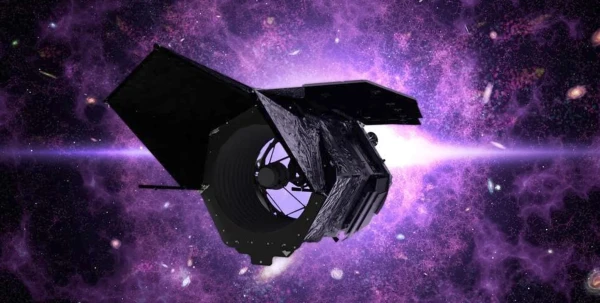
NASA has completed the assembly of a next-generation telescope, and it is expected to be launched into space in 2027. The Roman Space Telescope has scientific instruments that will help unravel the mystery of dark energy and discover habitable Earth-like planets, writes Focus.
The assembly of the new Roman Space Telescope, named after astronomer Nancy Grace Roman, has been completed at NASA's Goddard Space Flight Center. Two main scientific instruments have been installed, and the telescope is now being prepared for launch. It is estimated that around $4 billion was spent on the creation of the Roman Space Telescope. But it was worth it, scientists believe, as this observatory will help uncover some of the universe's most important mysteries, writes ScienceAlert.
The Roman Space Telescope is an infrared observatory equipped with two main scientific instruments:
- Wide-Field Instrument (WFI) — a wide-angle 288-megapixel multispectral camera;
- Coronagraphic Instrument (CGI) — a high-contrast coronagraph designed to block starlight while searching for planets outside the solar system.
The primary mission of the Roman telescope is to study the mysterious dark energy, search for new stars, planets beyond the solar system, and the first black holes. The telescope will also search for Earth-like planets that may be habitable. In this way, scientists hope to learn whether we are alone in the universe.
The launch of the Roman telescope is scheduled for May 2027, although it could take place in the fall of 2026. The Roman telescope will be sent into space by a Falcon Heavy rocket from SpaceX. After that, the telescope will be moved to the L2 Lagrange point of the Sun-Earth system, which is located about 1.5 million km from Earth.
The wide-angle camera of the Roman telescope provides a field of view 100 times larger than that of the Hubble Space Telescope, and the coronagraph will effectively block starlight while searching for other planets.
The main mission of the telescope is designed for 5 years, and if it has enough fuel to maintain a stable orbit, the mission may be extended. In the first five years, scientists expect to discover thousands of new planets, hundreds of millions of stars, and billions of galaxies.
One of the most important tasks of the Roman telescope is to unravel the mystery of dark energy, which drives the expansion of the universe. A comprehensive survey of the cosmos is necessary for a deeper understanding of this force, and the telescope's camera allows for that.
Other telescopes would take decades or even centuries to do what the Roman telescope will accomplish in just five years. During this time, it will capture images of the same area of space that the Hubble telescope studied over its first 30 years of operation. In five years of its main mission, the new NASA telescope is expected to collect 20,000 terabytes of data.













Leave a comment