
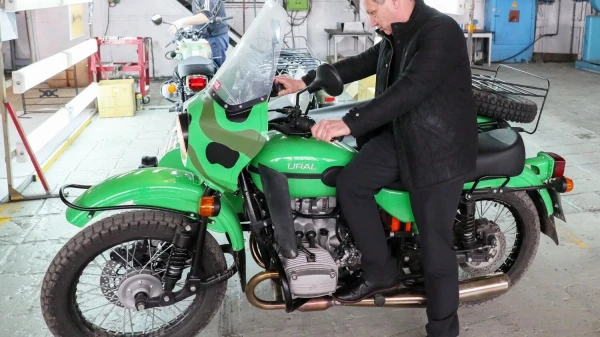
The production of the legendary brand involved Kazakhstan and China.
The Ural motorcycle is a Russian legend, American property, and production is planned to be moved to China. How long will the factory in Irbit continue to produce classic models of motorcycles with sidecars, and who needs them today in Russia and abroad?
It all comes down to demand for the product. Classic motorcycles are a niche product, if not a bespoke item. Even in the best times, before 2022, the factory in the town of Irbit in the Sverdlovsk region produced 500-700 motorcycles a year.
The overwhelming majority of Urals were exported. The main markets were the USA and Australia, countries where motorcycle culture is well-developed, and the climate is suitable for motorcycle travel.
In Russia, no more than 50 units remained. Today, it is a sought-after gift among the wealthy and officials: legendary retro at the price of a domestic SUV, the Niva. Experts believe so.
"Previously, Harleys were gifted to officials, now they give Urals. I have several acquaintances, and they all say that the Ural is good. They bought a Ural, updated it, rode it, and now it stands in collections," said Sergey Maltsev, holder of the speed record set on a Ural at the Bonneville Speedway (USA) and owner of the custom workshop FCM, to Novye Izvestia.
With the onset of the conflict in Ukraine, to circumvent Western sanctions, the company was forced to move part of its production to Kazakhstan. The scheme worked until President Trump imposed additional 27% tariffs on goods from that country.
Since April 2025, exporting Urals through Kazakhstan has become unprofitable. And the demand for the factory's products in Russia is clearly insufficient to keep the enterprise afloat. The factory in Irbit has focused on producing spare parts and warranty service. It is now operating in a limited mode. Simply put, it is idle most of the time.
Another anti-crisis measure — the launch of a new line of Ural Neo motorcycles in collaboration with the Chinese company Yingang — is failing even at the start. The motorcycles have not even begun to be assembled, and fans of the brand are already rejecting them, rightly believing that a "native" badge on a foreign model will not turn a Chinese "iron horse" into a true Ural. And it can only become mass-produced if priced below 500,000 rubles, not the stated 1.2 million.
For comparison: classic Urals can today be purchased for 1.5–2 million rubles. Fans are willing to pay extra for authenticity. They acknowledge that there are motorcycles in the world that surpass the Ural in both specifications and appearance, but they buy our brand because of its nearly century-long history.
"In mass production, it should cost like a Chinese Enduro on a marketplace, that is, just over 150,000 rubles. It was precisely because of the low cost of production (the design is elementary, like a buggy — an engine on a welded frame of steel tubes) that it became so widely spread in the USSR. Accordingly, no one will buy these motorcycles just to 'ride around.' Unfortunately, the price/comfort ratio is not in favor of the current Urals, so I predict the factory's fate will slide down to a large workshop where individual pieces of legendary motorcycles will be assembled by hand," commented Yuri Kiselev, a member of the motorcycle community.
Vladimir Kurmachev, acting director of the Irbit Motorcycle Plant, also describes the current situation as difficult. However, he does not lose hope. The mood is to wait out the crisis and hold on until better times.
"The situation is complicated due to sanctions. We were an export-oriented enterprise by 90%. There is a problem with importing components. It is impossible to bring kits to Russia. Therefore, we organized an assembly area for motorcycles for export supplies in Kazakhstan, in Petropavlovsk. But it has become even more expensive to export, shipments have stopped. We ship spare parts, but we do not assemble motorcycles. Only for the Russian market. It feels like the difficulties will last for another year, perhaps. For some reason, we have this optimistic mindset that this is not forever," shared Vladimir Kurmachev.
The head of the enterprise assured that they will do everything possible to preserve the two-wheeled legend — to produce limited series of classic models, while cooperation with the Chinese is for "keeping afloat."
"We have been cooperating with the Chinese on components for about 20 years. We have changed five dealers. But China restricts the entry of foreign equipment into its market, so assembling there is fine, but importing is difficult. Hence the idea of Chinese assembly for Ural Neo was born. And at the same time, they are producing their own motorcycle with a sidecar in small volumes, to which we attached the Ural badge. It is intended for the Chinese market, it is not suitable for the Russian one, it needs modifications. A lot of Chinese motorcycles are imported into Russia, mainly through gray schemes. The motorcycles are not certified; they are brought in as motorcycle kits. They were brought in as parts, sold as parts. A person bought these parts, went to register them, but no one registers anything for him. And what is he supposed to do with such a motorcycle? He cannot ride it on public roads."
"We will try to bring in the first batch, we will see. If there are sales — good. If not, we will have to think of something else," he confirmed the previously mentioned figure: 50–60 classic Urals are sold in Russia each year. According to the acting director, this figure has not changed for a couple of decades. There is no division of motorcycles into export and domestic options. The same motorcycles go both abroad and to our regions.
The legendary brand already belongs to an American
The Soviet motorcycle Ural has long been loved by Americans. It is in the collection of Brad Pitt, and Tom Cruise and Keanu Reeves have ridden it. Even King Abdullah II of Jordan. The Russian off-road motorcycle with a sidecar was recently sold in the USA for prices starting from $20,000.
In the early 2000s, the bankrupt factory of the notorious oligarch Kaha Bendukidze was purchased by American citizen Ilya Khait. The enterprise was renamed LLC "PC Irbit Motorcycle Plant" (Ural Motorcycles), with headquarters located in Washington. In 2003, the owner moved across the ocean to develop distribution. Thus, the focus on the American market is understandable.
Now Ilya Khait lives in Seattle and observes the crisis of Ural from afar. At the enterprise itself, they try not to mention the ownership of the trademark by a U.S. citizen.
Fans of Urals whisper about the nationalization of the factory as a desired measure and a return to roots.
"The collapse in Irbit began with the sale of the factory into private hands to an American. Then they fired the person who was the creator and custodian of the factory's history. They violated the commandment: 'Whoever tries to forget the past has no future.' The borders opened, a flow of imported motorcycles began, and demand for Russian ones sharply fell. In general, the tale is fresh, but it is hard to believe," commented the potentially possible nationalization vice-president of the Russian motorcycle club Ural (URAL Owners Group) Andrey Kozak.
Experts consider the sale of Ural to a U.S. citizen purely a commercial story. Moreover, it allowed, in one way or another, to save the enterprise during the era of total closure of motorcycle factories across the post-Soviet space — in Tula, Izhevsk, Kovrov, Kyiv, albeit by reorienting it to export.
"He does everything like a businessman. But now he has such losses. I believe that it should be bought out if someone wants to save the factory and feels capable. But I cannot imagine who would covet a knowingly unprofitable business. If nationalized, production will definitely die even faster. Or it will need to be injected with huge amounts of money. We cannot even cope with AvtoVAZ. And here it is even more complicated. Dealer centers with American lawyers will definitely not allow selling Urals in the American market. 90% of motorcycles will accumulate in warehouses. But if 90% were sold in our country... Where were we looking before when we were giving them to Americans!" said Sergey Maltsev, owner of the custom workshop FCM.
"Urals," orthodox Russian motorcycles, technically modified in Maltsev's workshop, are now displayed in the "Motor Legends" exhibition at the Garage Museum of Special Purpose at VDNH. It is on them that speed records in their class were set on the salt flats of Bonneville in Utah (USA) and on the ice of Baikal, the deepest lake on the planet.
Has the time for mass production irretrievably passed?
It is enough to have a few workshops that would adapt the designs of Soviet engineers to specific needs: a limited series for athletes, the same for security forces and agencies, and another dozen motorcycles "to order" for fans of the brand.
A large defense order will surely help save the legendary brand. Novye Izvestia has already reported that Urals perform excellently on the front, used by fighters for transporting the wounded, delivering ammunition, medications, and food, and mail. The experience of the war in Ukraine, where combat drones dominate the air, has shown: the simpler and smaller the transport for a fighter, the greater the chances of survival and completing a combat mission. Motorcycle units have appeared in both the Russian army and the enemy.
According to Andrey Kozak, the factory has already had such experience. During the Chechen campaigns, the Ministry of Defense ordered a batch of Urals from the Irbit factory. It was sent to the troops, but not all motorcycles reached their destination: some ended up on the market, while others were used by commanders as personal means of transportation. It would be good to take into account mistakes and eliminate the corruption component! But the military department is still not paying attention to the forgotten by the state Ural.
Or will the Chinese novelty Ural Neo finally take off, allowing the factory to continue producing "old-school" models with sidecars on the assembly line? We will find out the answers to this question very soon. The release of the "Chinese" on the market is scheduled for March 2026.









Leave a comment