
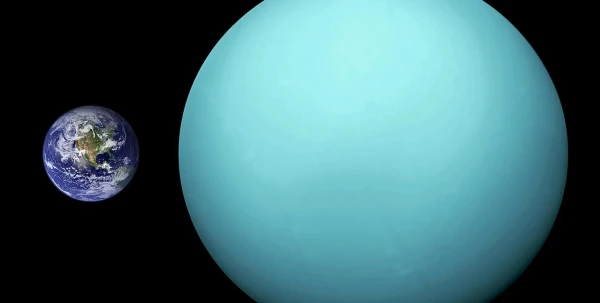
39 years ago, the spacecraft "Voyager 2" photographed the planet Uranus from close range and presented the world with a new mystery. But scientists believe they have solved it, and it is related to the influence of the Sun, writes Focus.
39 years ago, the spacecraft "Voyager 2" photographed the planet Uranus from close range and presented the world with a new mystery. But scientists believe they have solved it, and it is related to the influence of the Sun.
Scientists say that the planet Uranus is not as strange as the data from the "Voyager 2" spacecraft suggested. The NASA probe simply studied the seventh planet of the Solar System on a less than ideal day. The authors of the study published in the journal Geophysical Research Letters offer their solution to the 39-year mystery of Uranus, writes IFLScience.
"Voyager 2" remains the only spacecraft to have photographed the planet Uranus from close range in January 1986. "Voyager 2" conducted the first measurements of Uranus's magnetosphere, which is the protective area around the planet influenced by its magnetic field, shielding Uranus from the plasma of the solar wind.
Inside the magnetosphere, the NASA spacecraft discovered electron radiation belts (similar to those around Earth). However, the energy levels in these belts were off the charts, second only to the energy levels of the most intense radiation belts in the Solar System, which are found around Jupiter. Scientists did not find a clear source of the energy increase that should have been associated with Uranus's radiation. They concluded that the answer to this mystery is that the elevated energy levels of Uranus's electron radiation belts were caused by an unusual surge of salty wind. In other words, "Voyager 2" just studied Uranus on a day when the planet was subjected to particularly strong solar influence.
Currently, Earth is experiencing a constant influence of solar storms due to the Sun being in an active phase, and the magnetic field of our planet is feeling this impact. Powerful plasma ejections and solar winds can significantly disrupt the stability of radiation levels and Earth's magnetic field. The same, scientists believe, can be said for Uranus.
Astronomers believe that Uranus's magnetosphere was severely deformed by the solar wind, which combined with high-speed plasma ejections from the Sun. This likely led to the accumulation of high-energy particles in Uranus's electron radiation belts.
Scientists gathered data from a 2019 event when Earth's radiation belts experienced elevated energy levels caused by powerful solar storms. The similarity between this event and what "Voyager 2" discovered in Uranus's radiation belts was striking.
According to the authors of the study, if a similar mechanism interacted with the Uranus system, it explains why "Voyager 2" recorded an unexpected energy level in the radiation belts.
Astronomers believe that the so-called chorus waves may be to blame. These are plasma waves that are regularly observed near Earth. They play a key role in the formation of our planet's radiation belts. It was previously thought that chorus waves dissipate electrons, which are then lost in Uranus's atmosphere. But scientists have found that under certain conditions, they can accelerate electrons and supply them with greater energy.












Leave a comment