
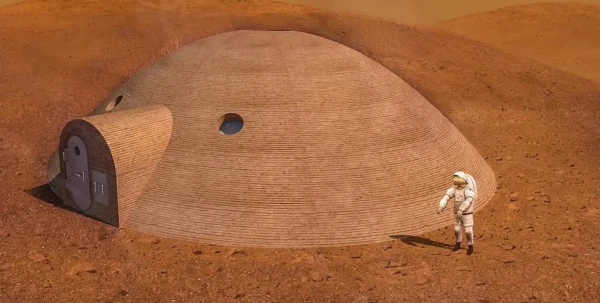
Scientists have proposed a construction technology on Mars based on the biocementation method, in which bacteria turn loose Martian soil into a durable, concrete-like substance, reports Focus.
Colonizing Mars has been a relevant topic for many years due to its proximity to Earth. Although it is a hostile planet for humans, if the necessary conditions are created, people could live on Mars. Scientists propose using local soil and Earth bacteria for building homes and infrastructure on Mars. The research was published in the journal Frontiers, reports Space.
To create a colony on Mars, a huge amount of building materials needs to be delivered there, which is extremely expensive. Therefore, scientists are looking for ways to reduce the cost of this process. One solution is to use local regolith, that is, the rocks and dust on the surface of Mars, for building homes. However, it is necessary to make this material solid and durable so that it can be used for 3D printing homes on the Red Planet.
Scientists suggest growing building materials on Mars with the help of Earth bacteria. According to the researchers, biomineralization—a process that allows living organisms to produce minerals—can be used to create building materials once humans reach Mars.
Based on data about the composition of Martian regolith, scientists evaluated various biomineralization methods for creating durable building materials.
The authors of the study found that biocementation is the most effective method. This microbial process allows for the efficient production of natural cement, calcium carbonate. The process is based on the interaction of two bacteria: Sporosarcina pasteurii and Chroococcidiopsis.
By crossbreeding these bacteria, a binding agent can be created that can be mixed with Martian regolith. Thus, a building material similar to concrete should be produced, the scientists say.
Chroococcidiopsis is a very resilient bacterium. It survives well in conditions similar to those on Mars. The bacterium Sporosarcina pasteurii is the main builder. It releases an enzyme that causes the crystallization of calcium carbonate, thereby binding the particles of Martian regolith into a solid, monolithic block.
According to the scientists, Sporosarcina pasteurii releases natural polymers that promote mineral growth and strengthen the regolith, turning loose soil into a solid, concrete-like material. Thus, a co-culture of the two bacteria mixed with soil on Mars will become the raw material for 3D printing homes.
Scientists say that future settlers on Mars will be able to grow building materials on-site. At the same time, the bacterium Chroococcidiopsis, due to its ability to produce oxygen, can support not only the integrity of the habitat but also life support systems. Ammonia, which is formed as a byproduct of the metabolism of Sporosarcina pasteurii, can be used to develop closed agricultural systems.













Leave a comment