Different collision scenarios can yield the same consequences.
Researchers from the Max Planck Institute and the University of Chicago have accurately determined the likely composition of Theia - the celestial body that collided with Earth 4.5 billion years ago and caused the formation of the Moon.
For the first time, scientists were able to accurately reproduce the chemical composition of Theia - an ancient protoplanet that collided with Earth about 4.5 billion years ago and triggered the formation of the Moon. The new study, conducted by scientists from the Max Planck Institute for Solar System Research and the University of Chicago, was published in the journal Science.
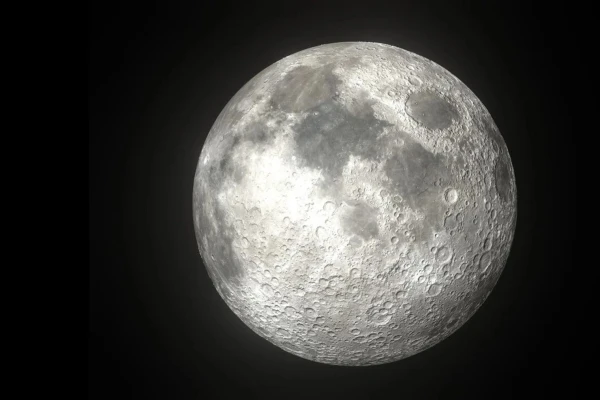
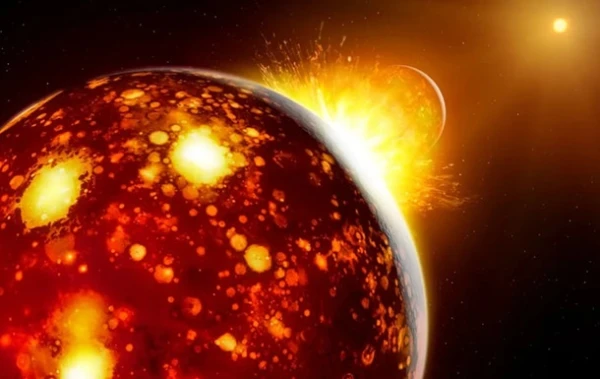
At that time, young Earth had to endure a catastrophic collision: a giant celestial body, named Theia, crashed into the planet, altering its shape, structure, and orbit. This impact marked the beginning of the Moon's history. Although Theia did not survive as a separate body, its chemical traces are still present in terrestrial and lunar rocks.
To understand what Theia was made of and where it originated, scientists analyzed the isotopic composition of iron in 15 terrestrial and six lunar samples brought back by the Apollo missions. The results confirmed previous findings: there is almost no difference in the isotopes of chromium, calcium, titanium, and zirconium between Earth and the Moon. At the same time, this similarity does not fully determine the nature of Theia, as different collision scenarios can yield the same consequences.
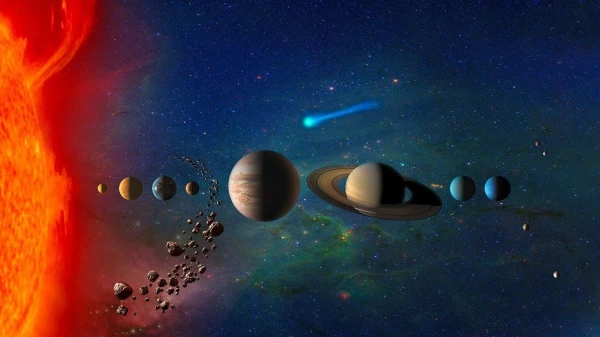
By comparing all possible origin models, scientists established that the most likely scenario is that Earth and Theia formed from material in the inner part of the Solar System and were "cosmic neighbors." The composition of early Earth can be explained by a mixture of known types of meteorites, but Theia, it turns out, had a different composition. Part of its material likely comes from an area even closer to the Sun.
According to the research team's conclusions, Theia most likely formed within Earth's orbit and later collided with our planet, forever changing its history.