Being outdoors became risky: skin burned in minutes, and there was a threat of blindness.
About 41,000 years ago, humans faced a harsh challenge. The planet's shield – its magnetic field – weakened sharply, barely reaching one-tenth of today's strength. This period, known as the Laschamp-Carrington excursion, left the planet virtually defenseless against solar radiation, writes Science.
The invisible barrier protecting life from deadly radiation was severely damaged. The level of ultraviolet radiation at the surface soared to dangerous values. Auroras, which now only illuminate polar regions, flared up all over the globe. Being outdoors became risky: skin burned in minutes, and there was a threat of blindness.
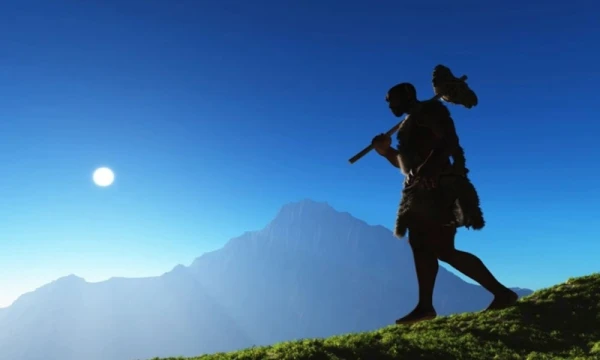
Archaeological findings show how people adapted to the new conditions. To survive, they began to seek shelter in caves more often, and their clothing became more covering. The use of ochre became widespread during that period. Scientists believe that this natural pigment was used by ancient people not only for rituals but also as a sunscreen.
This event did not cause a global extinction but served as a catalyst for change. It forced Homo sapiens to demonstrate ingenuity, which ultimately strengthened their position on the planet and possibly even influenced the outcome of competition with other species, such as Neanderthals.
Useful to Know
Some researchers link the Laschamp-Carrington excursion to the partial disappearance of megafauna and the final extinction of Neanderthals, although this hypothesis remains a subject of scientific debate.
The Laschamp event was the first known geomagnetic excursion and remains the most studied among known geomagnetic excursions.
Data from studies on the magnetization of sediments in the Black Sea provide a complete picture of the variability of the geomagnetic field at high temporal resolution. The recent observed decrease in the Earth's magnetic field (by 9% over the last 170 years), according to the authors of the hypothesis, may be a precursor to a new reversal of the Earth's magnetic poles. A pole reversal could lead to a sharp acceleration of the ongoing climate crisis caused by human activity, as well as to failures in power grids, satellites, and other electronic devices.
The increase in radiation levels, which made the visibility of auroras possible all over the Earth, and the need for shelter could have led to the emergence of cave paintings and myths.
However, petroglyphs (rock carvings) are primarily found on open southern-exposed rocks on patina.