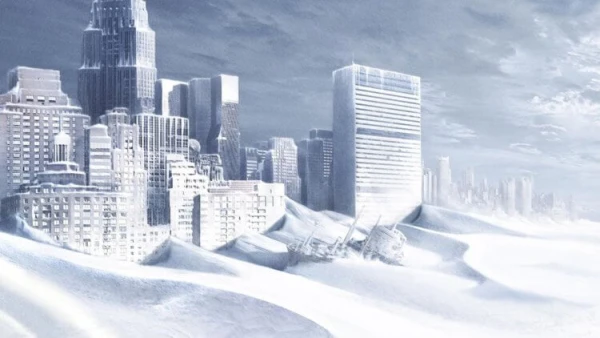
A new ice age is becoming a reality.
The weakening of an important ocean current for the Northern Hemisphere, caused by climate change, threatens the arrival of a second Little Ice Age in Europe, scientists warn. This has happened in the region before, from 1300 to 1850, when average annual temperatures were 2°C lower, leading to frequent extremely harsh winters, crop failures, and mass famine. Research results conducted by oceanographer Beatriz Arellano Nava from the University of Exeter (UK) show that the North Atlantic Current is 'losing stability' and the 'point of no return' is already near.
This current, which includes the Gulf Stream, is involved in transporting warm waters from the tropics northward and warming Europe. Signs of its destabilization first appeared in the 1950s. This is evidenced by the study of mollusk shells collected from the bottom of the North Atlantic. The growth rings on the shells indicate their age and the climatic conditions during those years: the wider the ring, the more comfortable the conditions were. These rings indicated a deterioration in the state of the current starting around the mid-20th century. However, scientists cannot yet specify when exactly the Little Ice Age may begin.
Scientists from various countries, led by Stephen Barker from Cardiff University (UK), applied a different method to solve the '100,000-year problem.' They based their work on the idea that precession and axial tilt play different roles in glacier retreat. In this case, the phase shifts relative to each other will be reflected in the graphs of glaciations and interglacials. An article on this was published in the journal Science.
Information about ocean temperatures in prehistoric periods is derived from the shells of small animals—foraminifera. These shells accumulate and store the heavy isotope of oxygen—18O—for millions of years. The warmer the ocean, the more isotope is found in the shells. The authors tracked fluctuations of oxygen-18 across three independent datasets over the last 800,000 years. They overlaid the constructed graphs with the graphs of axial tilt and precession phases.
Peaks on the 18O graphs indicated turning points in glacial periods—when glaciers were confidently retreating. This coincided with peaks in the phases of precession (minima) and axial tilt. Moreover, the first factor is the main one for the onset of glacier retreat, while the second is more significant for the climate of interglacials and the initiation of new glaciation. It was also found that the end of a glacial period follows the decrease in the eccentricity of the Earth's orbit.