
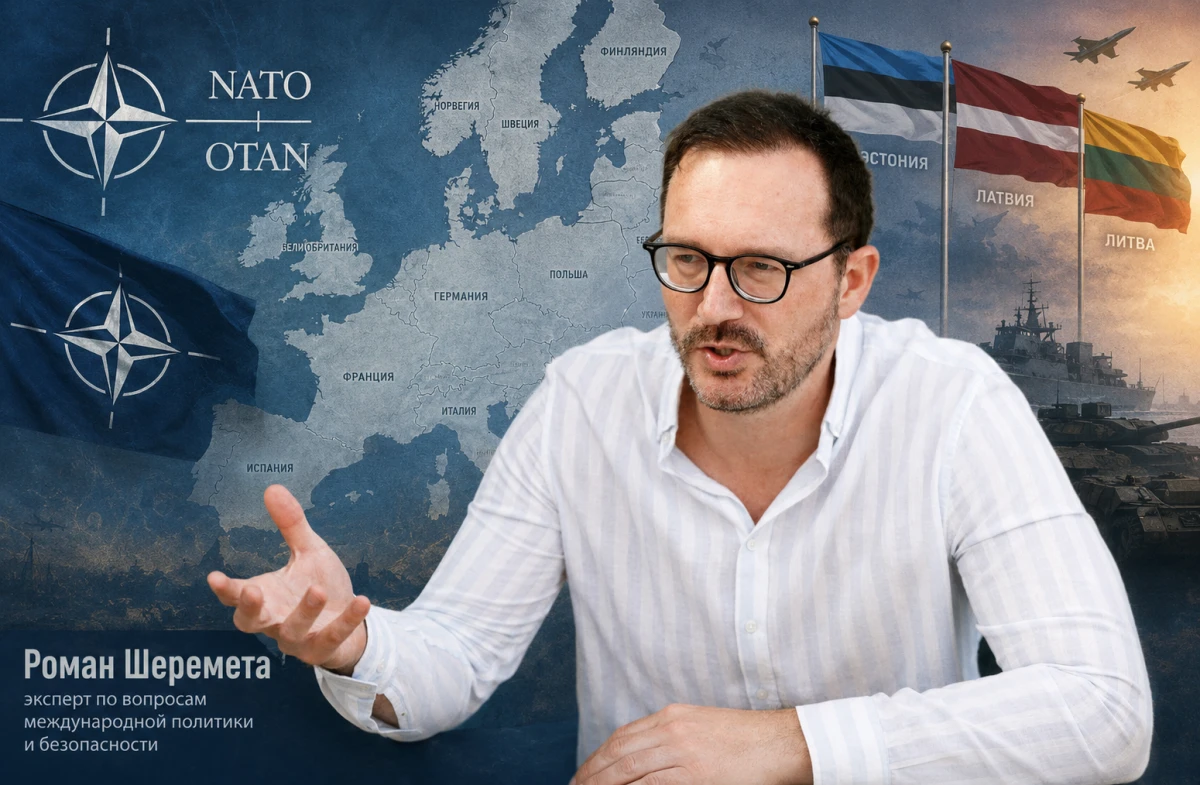
The Baltic States should actively discuss possible scenarios of Russian aggression and prepare for them in advance, believes economics professor Roman Sheremeta. In his opinion, the risk of an attack is low, but it cannot be ignored, as this is precisely the mistake Ukraine made earlier.
The Baltic States are generally responding correctly to threats from Russia; however, they do not speak openly enough about the possibility of direct military aggression. This opinion was expressed in an interview with the LETA agency at the "Riga StratCom Dialogue 2026" conference by Roman Sheremeta, a professor of economics at Case Western Reserve University.
According to him, Latvia, Lithuania, and Estonia consistently support Ukraine, strengthen their defense, and urge allies to pay more attention to the security of the region.
"I think the Baltic States are doing almost everything right. However, there is a lack of narrative about the Russian threat," Sheremeta stated.
He noted that the absence of signs of an immediate threat does not mean that the situation cannot change rapidly.
"Intelligence agencies say it won’t happen right now, but that doesn’t mean it will never happen," the expert emphasized.
In the professor's opinion, one of the reasons for the potential risk is that Russia's ability to achieve new significant results in Ukraine is limited.
"I believe they are vulnerable. The reason is that Ukraine is no longer an achievable goal for the Russians. Putin has gotten almost everything he could from Ukraine. He cannot gain anything more. But he can from the Baltic States," Sheremeta said.
He also pointed out the rhetoric of Russian propaganda resources.
"If you look at Russian propaganda channels, they openly say that Russia is already at war with the Baltic States. They are already fighting with Poland and other European countries. So why not turn all this into a real war? The Russian people will easily accept it. Russians will be glad. That’s all Putin needs," the professor noted.
According to his assessment, one of the potential risks could be the redeployment of Russian troops from the Ukrainian front. Sheremeta believes that if the front line in Ukraine is frozen, Russia could theoretically free up significant forces for other directions.
At the same time, he emphasized that he does not consider such a scenario to be the most likely.
"When I say this is possible, I’m not claiming the probability is 90%. It’s more like 10%," he explained.
What is important to know: the professor considers the next two and a half years, while Donald Trump remains president of the United States, to be the most risky period. In his opinion, further political changes in Washington could significantly limit the Kremlin's capabilities.
"The fact that Trump and the Republican Party are likely to suffer serious losses in the coming years will significantly weaken Putin's position. Therefore, everything he is capable of and wants to do, he will do in the next couple of years," Sheremeta explained.
Sheremeta acknowledged that many Ukrainians also did not believe in the possibility of a full-scale invasion before February 2022.
"Please do not dismiss the narratives that Russia is seriously considering or may consider the possibility of attacking the Baltic States," he urged.
"Many Ukrainians acted exactly like that. Members of the Ukrainian parliament, who had access to the same information as the foreign minister or President Volodymyr Zelensky, did not believe it was possible. They were wrong," the professor added.
According to him, this is why it is necessary for the Baltic States to regularly discuss such scenarios both at the political level and in the public space.
Separately, Sheremeta expressed doubts about NATO's readiness to respond quickly to hypothetical aggression against the Baltic States.
"We magically hope that NATO Article 5 will be invoked immediately after an attack on the Baltic States. But let’s just play out this scenario. What does that even mean? Does it mean that France will suddenly send, say, 20,000 soldiers to the Baltic States? The U.S. might not intervene at all, but just remind that Europe supposedly betrayed Americans in the war against Iran. If Europe did nothing then, why should we send troops now? So forget about the U.S. But Europe has already spent so many resources on Ukraine that there is not much left. So what does Article 5 even mean? Right now, it resembles a paper tiger more," he stated.
At the same time, the professor emphasized that this is his personal assessment of the situation, not a prediction of inevitable developments.
Despite the criticism of certain approaches, Sheremeta praised the support for Ukraine from Latvia and other Baltic States and emphasized that his warnings are driven by the desire to prevent a repeat of the Ukrainian scenario.






Leave a comment