
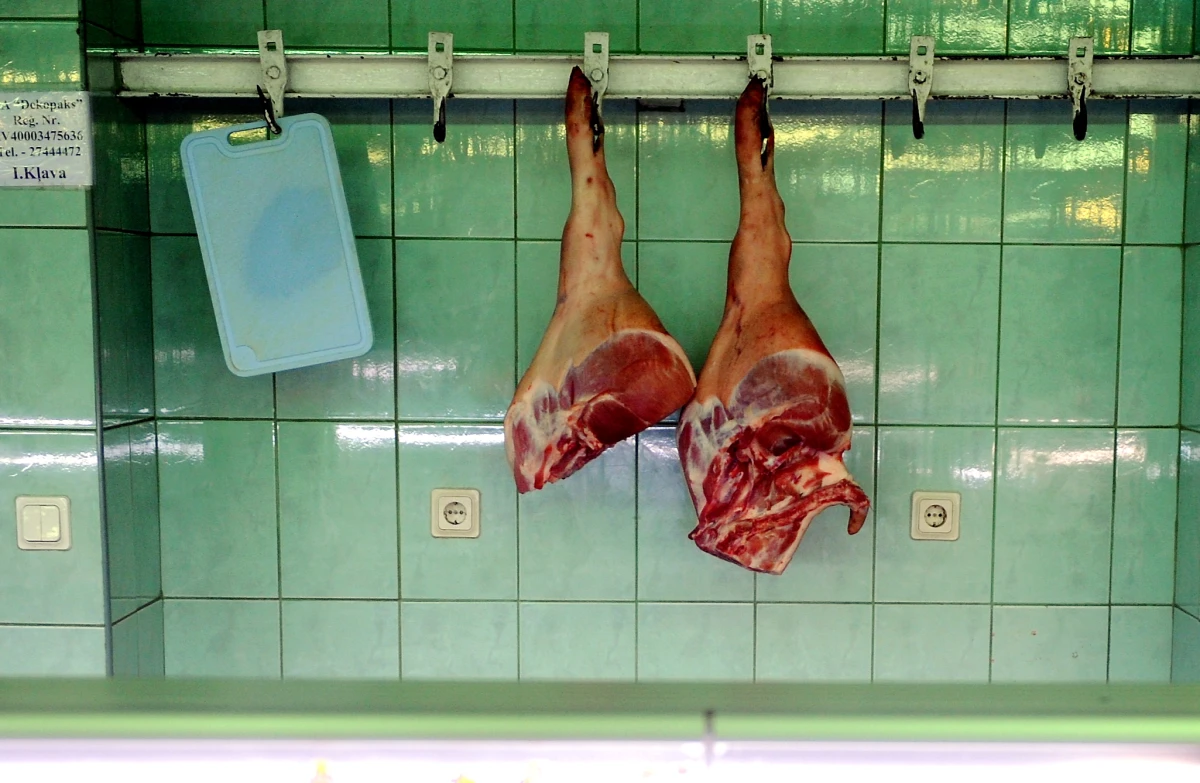
After the closure of the Meat Pavilion at the Riga Central Market, the capital's mayor Viesturs Kleinbergs ordered an inspection of the actions of the management of the company "Rīgas nami." In his opinion, the managers had enough time to prepare a solution for dozens of traders, but this was not done.
The situation surrounding the sudden closure of the Meat Pavilion at the Riga Central Market has continued at the city leadership level. Chairman of the Riga City Council Viesturs Kleinbergs has instructed Riga's executive director Janis Lange to assess the actions of the management of the municipal company "Rīgas nami," which manages the market.
After visiting the Central Market, the mayor stated that he was dissatisfied with how the operations were organized after receiving the warning about the pavilion's closure. According to Kleinbergs, it was known as early as Wednesday about the decision of the State Construction Control Bureau to prohibit the operation of the building. However, by the weekend, an effective action plan for the traders had not yet emerged.
The most difficult situation has arisen for meat product vendors. Many of them were forced to urgently remove their goods, seek new sales points, and figure out how to avoid losses. The situation was particularly painful on the eve of the Ligo holiday — one of the busiest periods for food trading in the year.
According to the mayor's assessment, the problem affected more than 50 enterprises. For some traders, this is not only about loss of income but also the risk of spoilage of products.
Kleinbergs believes that temporary solutions could have been sought within the market itself. In particular, he mentioned the possibility of relocating traders to the Fish Pavilion or other premises with the involvement of the Food and Veterinary Service.
Separately, the mayor demanded to find out how the funds allocated in recent years for the repair and development of the Central Market were used.
This issue is particularly relevant because serious problems with the structures of the Meat Pavilion were identified during a technical inspection in 2020. At that time, specialists pointed out the need for repairs; however, subsequent inspections showed that the condition of the building continued to deteriorate.
This circumstance may become one of the key questions of the inspection: why, after five years, the facility still had to be closed in an emergency manner.
The decision to prohibit operation was made by the State Construction Control Bureau after assessing the technical condition of the building. Experts discovered serious corrosion damage to the load-bearing metal structures of the roof, cracks, and deformations of individual elements.
Specialists characterized the condition of some structures as pre-emergency. According to their conclusion, there is a difficult-to-predict risk of destruction of individual nodes, which may pose a threat to visitors and market workers.
Therefore, the operation of the pavilion is prohibited until dangerous defects are eliminated and the safe condition of the building is restored.
Now, city authorities face two tasks simultaneously — to seek temporary options for continuing trade and to find out why the market was unprepared for a situation that was known in advance.











Leave a comment