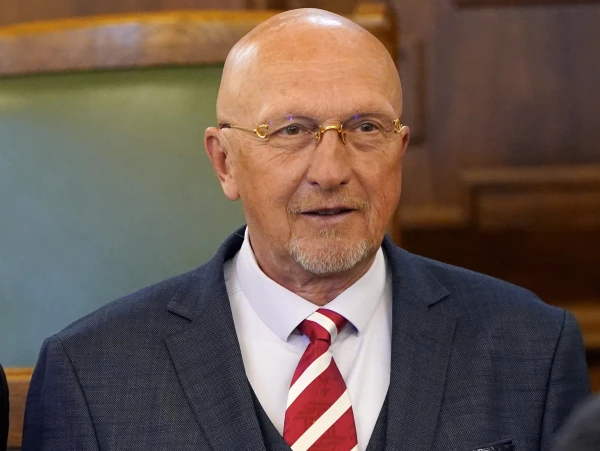
"A quick victory for Russia can only be promised by an invasion of the Baltics," such an assumption was made in his article for Latvijas Avīze by former member of the Supreme Council of the Republic of Latvia Rolands Repša.
"At this moment, no one is able to predict under what circumstances and how Article 5 of NATO will be invoked if Russia decides to attack the Baltics – against logical considerations that seem to exclude this risky step... NATO is a well-educated and regulated military machine that is theoretically capable of delivering a devastating blow to Russia if it dares to undertake a military adventure in the Baltics. However, in practice, in my opinion, things are not so clear."
And where, excuse me, is our army?
R. Repša refutes the opinion that the Russian Federation is unable to strike because it is already occupied in Ukraine. But there, "along a 1200-km front, stands a well-equipped and battle-hardened Ukrainian army."
"And where, excuse me, do we have such an army in the Baltics? At best, each Baltic state could have armed forces numbering around 60,000 people. For now, we can comfort ourselves with the thought that there are no signs indicating Russia's readiness for an immediate ground invasion of the Baltics.
To carry it out, a significant concentration of Russian forces is needed both at the borders of the Baltics with Russia and Belarus, as well as at the Russian enclave of Kaliningrad. Such a concentration of forces cannot go unnoticed, requires time, which gives NATO the opportunity to take countermeasures."
NATO paralysis
"However, a Russian hybrid attack on NATO states is already happening," reveals the Kremlin's intentions, a veteran of Latvian politics. "We have experienced this ourselves from incidents with drones. Nowhere is it stated that any of these hybrid war incidents cannot quickly escalate and turn into Russian missile strikes on NATO territory, for example, in the Baltics. Will NATO strike back at power plants in Kaliningrad and St. Petersburg? Unlikely."
"What should the three Baltic states do in this situation? How to break out of this vicious circle of NATO paralysis? The first step that should be taken is to continuously emphasize at all high-level EU and NATO meetings that a Russian attack can only be against the Baltic states, not against some abstract 'NATO territory.' Russia will not attack either Finland or Poland, as it is unable to achieve quick successes in these countries in the form of a blitzkrieg."
What to do?
Furthermore, Mr. Repša proposes a solution – the creation of a separate alliance of the three Baltic states, possibly with the help of Poland and Scandinavia. Additionally, it is proposed:
-
"First of all, to finance and build a defensive line at the borders of the Baltics with Russia and Belarus.
-
Secondly, purely in military terms, to increase the contingents of foreign states in the Baltics and ensure air defense.
-
Thirdly, to participate in the development of the Baltic military industry, especially in the mass production of drones and robotic systems."
The leaders of the alliance could be the three presidents, in a rotational manner. "The creation of such an alliance would also be a signal for Russia to reconsider," believes R. Repša.