
The death of German treasure hunter Georg Stein caused particular resonance.
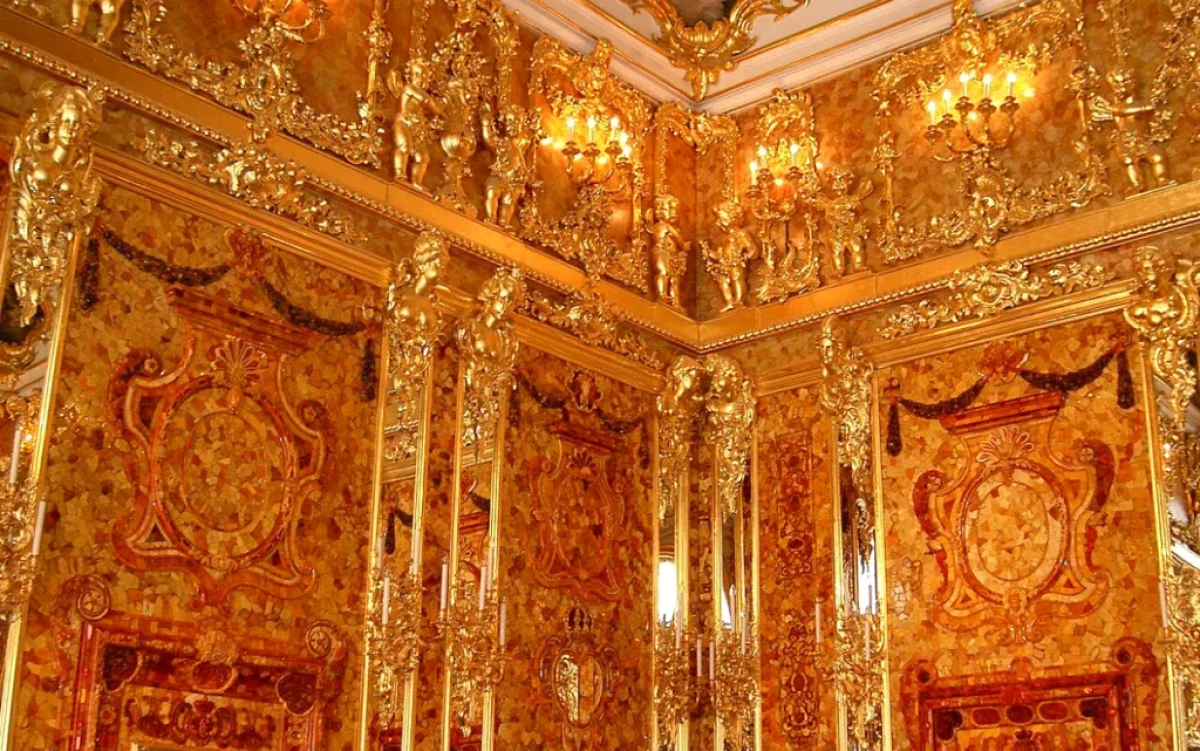
The story of the Amber Room, often referred to as the "eighth wonder of the world," has once again become the center of a loud investigation decades later and is surrounded by mysteries. Researchers agree: the closer search groups get to the possible location of the relic, the more strange events occur.
For example, documents disappear, witnesses die, and expeditions end in disasters. New versions have already sparked debates among historians and military archive specialists.
How the Main Masterpiece of the Russian Empire Came to Be
The history of the famous room began in the late 17th century when Prussian King Frederick I commissioned the creation of a unique interior entirely made of amber. The project was worked on by architect Andreas Schlüter and then his rival Eosander von Göthe. Later, the amber panels were gifted to Peter I as a diplomatic gesture and then transported to Russia.
According to open sources, dozens of carts were required for transportation. Even then, mysterious stories began to emerge around the relic: part of the decorative elements vanished without a trace during the transport. Later, architect Bartolomeo Rastrelli enhanced the interior with mirrors, gilding, and new panels, turning the study into a true gem of the Catherine Palace in Tsarskoye Selo.
Contemporaries called the room an incredible work of art. French poet Théophile Gautier wrote that the sunlight inside the amber walls created a feeling of "living gold."
Why the Room Was Not Evacuated in Time
With the onset of World War II, museum staff began an urgent evacuation of valuables; however, the Amber Room was decided to be left behind. The reason turned out to be simple and terrifying at the same time: the panels were too fragile. Any attempt to transport them could completely destroy them.
Museum workers covered the walls with paper, gauze, and cotton, hoping to protect the masterpiece from explosions. But after the occupation of Pushkin, German specialists dismantled the panels in just a few days. By 1941, the treasure was transported to the Königsberg Castle, located in present-day Kaliningrad.
There, the Amber Room was exhibited until 1944, when British aviation launched a massive strike on the city. After that, the trail of the relic was effectively lost.
The Curse That Is Still Talked About
The most mystical part of the story began after the war. People connected to the search for the room died one after another under mysterious circumstances.
For instance, the curator of the collection at the Royal Castle, Alfred Rode, considered the last person to know the location of the panels, unexpectedly died along with his wife. The official cause was said to be typhus, but historians still doubt this version.
Later, under strange circumstances, Major of State Security Ivan Kuritsa, who was investigating the disappearance of the relic in Königsberg, died in a car accident that decapitated him. Years later, similar stories occurred with other researchers who claimed they were close to solving the mystery.
The death of German treasure hunter Georg Stein, who had been searching for the valuable object for 20 years, caused particular resonance. Shortly before his death, he stated that the Amber Room could have been taken out of Europe, specifically to America.
Where the Traces of the Amber Room Lead Today
The search for the Amber Room has been ongoing for over half a century. In recent years, searches have resumed in several countries. The most likely locations include:
- underground tunnels in Kaliningrad;
- old mines in Germany;
- hiding places in Poland;
- the treasure is buried in the area of the village of Asaa in Denmark;
- in the Austrian city of Linz, where Adolf Hitler was born;
- sunken ships in the Baltic Sea.
In 2024, artificial intelligence specialists from Yandex and SberAI joined the search, according to the Zen channel "Platform." Neural networks analyzed archival documents, plans of German bunkers, and military routes. The algorithms identified three most likely points where the relic may be located:
- the waters of the Baltic Sea near the sunken ship "Wilhelm Gustloff";
- abandoned mines in Thuringia, Germany;
- tunnels under Kaliningrad.
However, even modern technologies faced inexplicable failures. Expedition participants reported signal loss, equipment malfunctions, and disappearance of digital data.
Why the Mystery Remains Unsolved
Historians believe there are several versions of the fate of the Amber Room. Some are convinced that the panels burned during the storming of Königsberg. Others suggest that the relic was hidden in a secret storage. There are also those who believe that part of the treasures has long been in private collections.
At the same time, the restored copy of the Amber Room, opened in Tsarskoye Selo in 2003, has only intensified interest in the original. Many researchers are convinced that if even part of the original panels survived, their value today could reach hundreds of millions of dollars.
The main mystery remains the same – why, after eight decades, has no one been able to prove where one of the most famous treasures of the 20th century disappeared to.











Leave a comment