
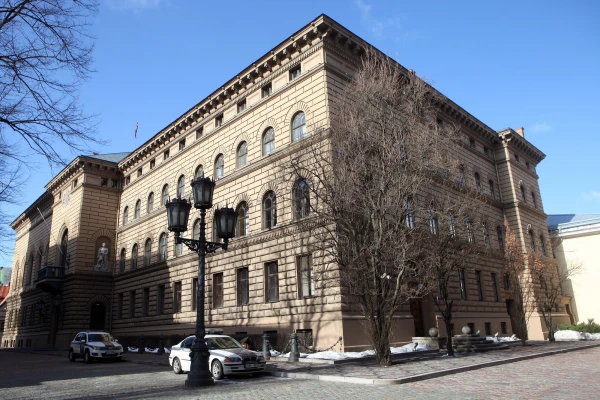
If we look at all parliamentary elections since the 5th Saeima, that is, since 1993, there has only been one instance where elections were held without newcomers or, more precisely — without the creation of a new major political force genuinely contending for power.
It was 20 years ago — in 2006. But, as they say, the exception proves the rule. And another trend — from election to election, again with rare exceptions, voter turnout has been steadily decreasing.
Let’s recall how it was!
Saeima Number 5: The Record of "Latvijas Ceļš"
In the distant 1993, elections were held for the 5th Saeima — these were the first elections after the restoration of independence de facto and de jure, when the Saeima replaced the Supreme Council.
For these elections, the party "Latvijas Ceļš" was created, which was meant to replace the People's Front that had fulfilled its mission. The NFL was a revolutionary political force that was supposed to ensure the restoration of independence.
The replacement of one ruling force with another was triumphant — the turnout was enormous (89.9% of eligible voters!) and "Latvijas Ceļš" received a record number of seats in the Saeima — 36!
To jump ahead, no one has been able to repeat this record in the next 30 years. Only twice did parties come close to such a result — "Unity" once received as many as 33 mandates, and "Harmony" — 31.
Saeima Number 6: Who is the Master in the House?
For the elections to the 6th Saeima, in 1995, two major political forces were created to end the dominance of "Latvijas Ceļš". And they succeeded — the party "Saimnieks" ("The Master"), uniting the business elite of those years, received 18 seats. The protest party of Joachim Zigerist called "People's Movement for Latvia" received 16 seats. Zigerist went down in history as a well-known populist who handed out bananas to his voters. And it worked!
In turn, "Ceļš" lost more than half of its mandates as a result of the elections, receiving only 17 seats. And although "Latvijas Ceļš" retained a leading role in the next government, its influence noticeably diminished.
Saeima Number 7 and 8: A Star Named Škēle
By the next elections, the star Andris Škēle had risen, who created the People's Party. It won the elections to the 7th Saeima, receiving 24 mandates. Škēle became prime minister again.
It was 1998. Four years later, the era of Škēle would begin to decline, as voters rushed to support the next "savior" of the homeland, Einars Repše — many voters felt nostalgia for him since the early 90s, as Repše, being one of the first leaders of the Bank of Latvia, was considered the father of the national currency — the lats. Soon Repše headed the government. However, today there are no lats in wallets, nor is Repše in politics.
Saeima Number 9: Repše Was "Eaten" by His Own Allies
By inertia, Repše's party "New Era" was still represented in the next parliament, that is, in the 9th Saeima. In fact, this was the only parliamentary term in which there were no new major political forces.
However, by that time, Repše had already left active politics, handing over the reins of power to those he had once brought into politics, who, as often happens, then "undermined" him.
Saeima Number 10: Disbanded
For the elections to the 10th Saeima, there was a rebranding of "New Era" — the party changed its name and became "Unity". Voters believed again that new saviors had arrived — "Unity" received as many as 33 seats in the 10th Saeima!
Saeima Number 11: All Free
But the "Unity" members did not have much time to enjoy their success — a little over a year later, Zatlers issued the famous decree number 2, the parliament was dissolved, and elections for a new Saeima were held. Zatlers himself tried to play the role of the new savior of the homeland by creating his party — the Reform Party.
However, voters did not see any reforms — the party soon fell apart, and Zatlers could not even be elected as the speaker of the Saeima. The Reform Party became a typical one-election project. However, it gave birth to the current president — Edgars Rinkēvičs.
Saeima Number 12: The Heart Could Not Endure
Similarly, the party "From the Heart of Latvia" became a one-time project, led by the popular at the time former state auditor Inguna Sudraba.
The politicians recruited by Sudraba scattered during the work of the 12th Saeima, and by the next elections, there was no trace left of this political party.
Saeima Number 13: Kaimiņš, Gobzem and Others
But a holy place is never empty — the protest Latvian electorate was ready to "pick up" the party KPV.LV with the charismatic political populist and rogue Artuss Kaimiņš.
Alongside him was the jury lawyer Aldis Gobzem. In turn, on the right flank, the "old" nationalists faced competition — the New Conservative Party.
What happened next — I think our readers still remember well. KPV.LV began to fall apart just two months after the elections, and Kaimiņš and Gobzem, once political friends, became sworn enemies, ultimately both politicians left the political scene and, it seems, forever.
The New Conservative Party also suffered a fiasco in the elections to the current Saeima, practically unable to withstand competition with the National Alliance.
Saeima Number 14: United by a Millionaire
But in the elections to the current Saeima, a new "saving" force appeared in the form of the United List, created by veteran Latvian businessman, multimillionaire Uldis Pīlēns. It can be assumed that the "united" will not go down in history — judging by the ratings, they have a chance to enter the new Saeima.
However, it is probably excessive to say that they did not become the "saviors" of the homeland. It is also generally hard to imagine that in our political system one party can "determine the fate of the country."
Saeima Number 15: Who is New?
However, the elections to the next, 15th Saeima will not be unique — and for these elections, a new political force has already been created that will attempt to gather the protest, primarily Latvian, electorate.
This is the party "We Change the Rules." Although the political force is trying to "push" a new idea — about switching to single-member districts and effectively abandoning the party system, everyone who understands politics knows: such a revolution is unlikely to happen after the elections. Even if Hermanis' party is represented in the 15th Saeima, which is not a fact.
There simply will be no other supporters of such a radical reform in the new parliament!


Leave a comment