
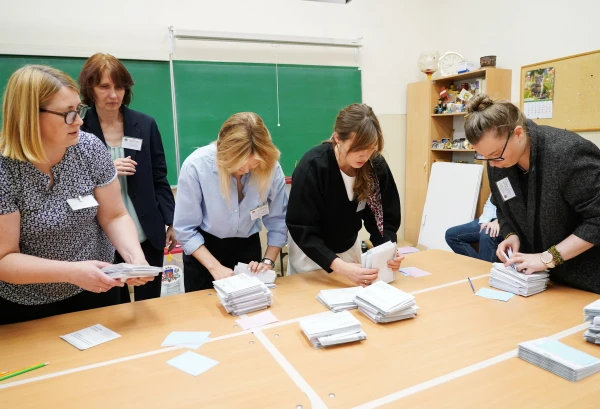
Votes will be counted as in the good old days.
As one experienced diplomat said, the best protection against cybercrime or, if you will, computer manipulations and data leaks, is... paper and a pen. That is, the less various computer systems are involved, the greater the guarantee of data preservation and the lower the risk of fraud. This same rule applies to the electoral process! In other words, if votes are counted manually, the likelihood of forgery is minimized or even, perhaps, reduced to zero.
Intrigues, Scandals, Investigations
And last week, the president first and then ALL members of the Saeima came to the same conclusion. This was facilitated by a grand scandal that occurred at the beginning of last week: law enforcement agencies, at the initiative of the European Prosecutor's Office, conducted searches, detentions, and arrests — several officials and entrepreneurs are suspected of corruption in organizing procurement for information system services, including for elections.
The dramatic nature of the situation is underscored by the fact that the day after these "mask shows," President Edgars Rinkēvičs met with the European Prosecutor from Latvia to get firsthand information about what happened. Apparently, the scale of the disaster was so great that the head of state immediately called on parliament to restore voters' trust in the elections, stating that the vote counting in the upcoming Saeima elections on October 3 of this year should be conducted manually! Rinkēvičs also acknowledged the validity of the investigation initiated by the European Prosecutor's Office and indicated that the circle of suspects is so wide that analyzing the situation will be quite difficult, as dozens of IT experts are involved!
Lessons from Last Year
In any case, just two days later, the Saeima unanimously supported the amendment to the law on manual vote counting in parliamentary elections. This was also done with a memory of the, forgive me, mess and chaos that reigned during the municipal elections last year! Let us remind you: the vote counting in those elections was "entrusted" to a computer system that was supposed to automatically process the ballots — the format of the ballots was changed specifically for this purpose. However, the system "froze" almost immediately after the vote counting process began, giving rise to numerous rumors and speculations. Initially, local electoral commissions did not know what to do and waited for instructions from the Central Election Commission. However, the leadership of the CEC also experienced a paralysis, and for almost the entire night, the precinct electoral commissions were not given the go-ahead to start counting votes manually. As a result, the counting process resumed closer to dawn, when the observers had already left the polling stations and gone to sleep. This scandal cost the chairman of the CEC his position, and the Minister of Smart Administration and Regional Development I. Berziņa ("New Unity") also resigned. However, the opposition's attempts to challenge the election results — primarily in the Riga City Council — were unsuccessful, but the main question remained: will a similar situation repeat itself in the elections this October?
Now it is at least clear that we are returning to the good old days, that is, when members of the electoral commission manually count the votes. How does this happen in practice? Let's consider it step by step.
How Are Votes Counted?
The first step — immediately after the polling stations close, members of the electoral commission at each station verify the number of envelopes issued against the register of voters — that is, the number of envelopes and the number of voters must match. All envelopes must have the stamp of the specific polling station.
The second step — they open the ballot boxes and check if the number of envelopes matches. All this is done in accordance with the "four eyes" principle — that is, at least two people participate in this process. Moreover, in most cases, observers are present at each polling station to monitor the process.
The third step. After the verification procedure is completed, they proceed to the actual counting of votes — the envelopes are opened, and the ballots are sorted into stacks: one for each party.
The fourth step. Upon completion of the distribution procedure of the votes cast for the parties (associations), the members of the electoral commission begin counting the plus signs and crosses on the ballots themselves.
After all counts are completed, the data is entered into protocols — both for the number of votes cast for specific parties (associations) and for the number of points scored by candidates for deputies. Only then is all this data entered into the computer system and sent to the CEC's database. The entry into the computer database is done in accordance with the four eyes principle and again in the presence of observers.
Of course, there is always the possibility of some human errors, but manual counting minimizes the risk of any abuses.
In recent weeks, opposition members of the Saeima have attempted several times to pass amendments to the law through parliament that would require the CEC to store ballots for an additional 6 months after the elections. However, the ruling majority rejected these amendments. What are the ruling parties afraid of? What would happen if the ballots were kept for 6 months instead of one?
Forget About Electronic Voting
The level of trust in elections, in politicians, and in the political system in Latvia is critically low, and if a return to manual counting allows even a little to restore this trust, then, you must agree, that is already something...
I remember that even before COVID, discussions about whether to switch to an electronic voting system, that is, when voters vote without leaving their homes — through an electronic signature system — flared up with enviable regularity. However, the current corruption scandals seem to have long dampened the desire to involve a "mediator" in the voting process in the form of a computer, as the election results could become completely unpredictable and easily contested in court.











Leave a comment