
The Saeima on Thursday adopted a law in the final reading to limit fuel price increases, providing for temporary measures to reduce the impact of rising fuel prices on the economy and residents, LETA reports.
The amendments were adopted in one day — first conceptually, with a proposal submission period of only five minutes, which caused outrage among opposition deputies. Before the second reading, an urgent meeting of the budget and finance (tax) commission of the Saeima was convened to consider the submitted proposals.
One opposition deputy proposed to lower the tax to the minimum allowable level — 330 euros per 1000 liters, which, according to him, would reduce the price of diesel fuel by about 16 cents. However, a representative of the Ministry of Finance emphasized at the commission meeting that the decision must be fiscally neutral, and the minimum rate does not guarantee this. The commission rejected the proposal, after which Petraviča left the meeting.
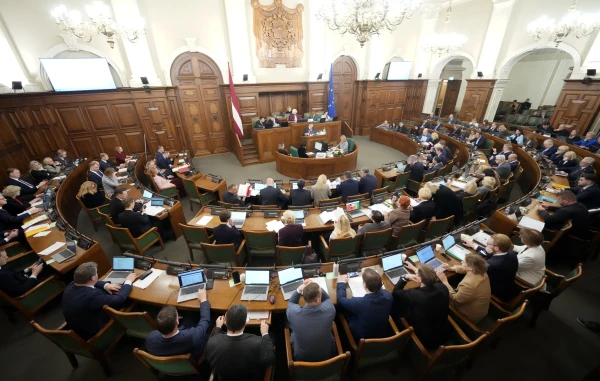
Despite the opposition's criticism, the changes in the second and final reading were supported by all 94 deputies present at the meeting.
The law provides for a temporary reduction of the excise tax on diesel fuel — from the previous 467 euros to 396 euros per 1000 liters. For marked diesel fuel used in agriculture, the rate is set at 21 euros per 1000 liters. The reduced rates will be in effect from April 1 to June 30.
The aim of the adopted regulation is to mitigate the negative impact of rising fuel prices on household expenses, business costs, and the overall inflation rate. The increase in fuel prices significantly affects transport, logistics, and other sectors, causing further price increases for goods and services.
The adoption of the law is associated with a significant rise in fuel prices in global markets, driven by geopolitical events and disruptions in oil supply chains. In recent weeks, there has been a sharp increase in oil and diesel fuel prices, which directly reflects on the Latvian market due to its high dependence on imports.
Considering the development of the situation, the Cabinet of Ministers has developed a temporary solution that allows for a rapid response to price fluctuations while maintaining the balance of the state budget. The reduction of the excise tax partially compensates for the price increase and will help stabilize the economic situation.







Leave a comment