

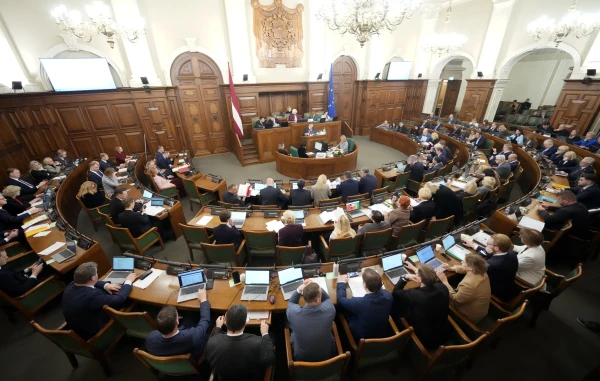
The Central Election Commission (CEC) is considering the possibility of appealing to the Saeima with a proposal to amend the law so that the decision on manual vote counting in the Saeima elections is made by the parliament itself, CEC Chairman Maris Zviēdris told reporters, LETA reports.
Zviēdris noted that the Central Election Commission (CEC) is currently considering several options: either involving the legislator or making a decision at the level of the commission itself.
"As I mentioned earlier, we do not plan to make this decision in haste. There are several options, and the president of the state also mentioned two possible paths yesterday — either the involvement of the legislator or a decision by the CEC. We will consider both," Zviēdris said.
According to him, current forecasts indicate that the CEC may initiate a proposal to the Saeima and send a letter today to the Saeima's Commission on State Administration and Local Governments regarding the necessary changes in legislation.
In response to a question about why the involvement of the legislator might be the best solution, Zviēdris explained that it would reduce speculation about the motives of the CEC.
"If the decision is made by the legislator, it significantly reduces the possibility of various speculations about why the CEC chose this particular option. The CEC is not one person; it is a collegial body where opinions and votes may differ," he emphasized.
In his opinion, after the highest state officials publicly called for an assessment of the possibility of manual vote counting, the logical next step should be a response from the Saeima.
"In our view, the parliament should react, so we will ask it to evaluate this," said the chairman of the CEC.
Responding to a remark that such actions might appear as shifting responsibility to the Saeima, Zviēdris stated that the CEC acts responsibly and in good faith: "This can be interpreted in different ways, but we are sufficiently responsible and make decisions as far as the situation allows. It is necessary to make a quick and rational decision now so that we cannot be held accountable later."
He also emphasized that the goal of the CEC is to avoid any speculation about the commission's work as much as possible and to ensure voter trust in the electoral process.
As reported, the President of Latvia, Edgars Rinkēvičs, after reviewing information from the European Public Prosecutor's Office (EPPO) about possible violations in IT procurement and their impact on the 2026 Saeima elections, emphasized on Monday that state power is legitimate only when it is based on free and fair elections. According to the president, a quality and transparent organization of the electoral process is a fundamental requirement of democracy that should not be shadowed by doubts about security and reliability.
Rinkēvičs pointed out that the information released by the EPPO raises questions about the security of the elections and the reliability of vote counting. He emphasized that society must be assured of the honest and safe conduct of the 2026 elections and called for a decision on manual vote counting to be made now, without relying on IT systems.
CEC Chairman Zviēdris informed the LETA agency on Monday that the commission learned about the president's call from the media, and the decision still needs to be carefully evaluated. He emphasized that the commission does not intend to make hasty or ill-considered decisions.
According to Zviēdris, the CEC is ready to ensure manual vote counting if a corresponding decision is made. He noted that additional funding for such a decision would not be required, as this scenario was initially anticipated and would not require additional funds from the state budget.
Zviēdris acknowledged that the CEC is currently also awaiting responses from certain law enforcement agencies regarding the process of developing the system and possible legal risks. He emphasized that the commission will make a timely decision.
At the same time, he noted that the process of forming precinct commissions has already begun in more than 20 municipalities, and a timely decision on the procedure for counting votes would bring greater clarity both to the work of the commissions and to the preparatory process. Zviēdris also reported that a significant number of precinct commission staff are ready to work with manual vote counting if the rules are clear and unambiguous.
Meanwhile, the Bureau for the Protection of the Constitution (BPC) continues to assess potential security risks associated with possible fraud in IT procurement, including evaluating the security of the Saeima election platform.
A decision on the full use of the platform, including vote counting capabilities, can be made after risk assessment. Processing information of this kind and volume takes time. After the assessment is completed, the BPC will inform the institutions responsible for the electoral process and the highest state officials.
In turn, most of the political forces represented in parliament have already indicated to the LETA agency that they are inclined to support the president's call.
It was also reported that law enforcement agencies uncovered possible fraud in state IT procurements amounting to 1.5 million euros, during which 21 individuals were detained, including state officials. The investigation established suspicions of collusion aimed at ensuring the victory of certain participants in at least six projects funded by European Union funds and the distribution of illegal profits.
The EPPO press release notes that the implementation of some projects may pose potential risks to state security, as they may affect elections and democratic procedures.










Leave a comment