
March 17 is the official Day of National Resistance for Latvia. In the Small Aula of the University of Latvia, hearings were held in memory of the professor of law who died in Nazi captivity, one of the founding fathers of the Latvian Central Council, Konstantins Čakste.
The Principle of National Resistance – Survive Until Better Times
The Dean of the University of Latvia, Professor Edvins Danovskis, reminded that 72 years ago, the Memorandum of the Latvian Central Council (LCC) was signed by 188 people – and the largest group was indeed university associate professors.
– The signing became a symbol of the national resistance movement, – stated Mr. Danovskis. However, in a broader sense, resistance took place in families, workplaces, and underground circles. "I would like to highlight one fact – in the autumn of 1943, the theater director Eduards Smilgis was visited by the social democrat Felix Cielens. Despite this, Smilgis' signature is not on the memorandum. But one should not draw incorrect conclusions from this. The goal of the national resistance movement is to survive until better times."
– It makes no sense to preserve emptiness, – explained E. Danovskis regarding Smilgis continuing to stage his plays during both the German and Soviet times. The authorities of the time did not understand the subtext – for example, in the legendary production based on Rainis' work "I Played, I Danced". The last words in it call for "building a new Latvia in the sun".
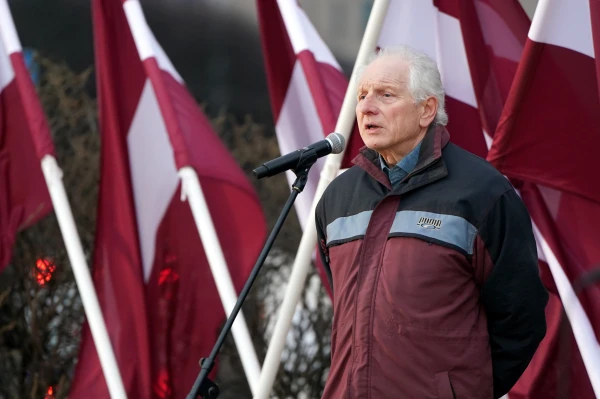
As a fighter for the future, the professor named the one who began to defend the Daugava, the main river of the republic: "The pen became stronger than the bulldozer." And here he is – Dainis Ivans on the podium!
How Latvians Wanted to Be Translated into Cyrillic
As noted by the well-known publicist and first chairman of the National Front, Ivans, the first manifestation of the enlightenment of the Latvian people occurred 500 years ago when a book was printed in the Latvian language.
"Publishing is the foundation of every European nation, making us one of the most literate nations." The first popular books, written by priests, told peasants about the benefits of vaccinations. This truth should still be remembered today, added the speaker.
However, D. Ivans emphasized that the Russian Empire attempted to translate the Latvian language into Cyrillic; after the first Song Festival, the governor intended to burn songbooks in Latvian; during the Soviet era, banned books were placed in special storage. Nevertheless, within Latvians matured the "gene of resistance," which led to, for example, the Kauguri uprising.
Today, bridging to current politics, there are 56 deputies in the Saeima who wanted to withdraw Latvia from the convention protecting women from violence. They are pushing our country towards Putin, Lukashenko, and the "Georgian Dream," claims Dainis Ivans.
As an example of how to respond to contemporary events, the Atmoda activist cited the book "The Great Gopnik," in which the situation is interpreted by the writer Viktor Erofeev, who lives in exile.
Why to Thank the SS Gruppenführer
In the early 1990s, Dainis Ivans became the deputy chairman of the Supreme Council of the Latvian SSR and stated that he opposed awarding the Nobel Prize to the "Moscow Tsar" Mikhail Gorbachev.
On the contrary, as a former delegate of the XIX Party Conference of the Central Committee of the Communist Party of the Soviet Union, D. Ivans praised the "letter of 17 Latvian communists," who protested against the Russification of Latvia in the 1970s – as well as representatives of Latvians in exile who supported the idea of continuing statehood.
Among other supporters of independence, Mr. Ivans mentioned the SS Gruppenführer and Lieutenant General of the SS troops Rudolf Bangerkis – such status in his words was acquired because on April 9, 1945, he liberated all Latvian servicemen from obligations to the Third Reich.
Today, it is very important for Latvia to have geopolitical allies – and against this backdrop, one cannot descend to populist demagoguery about non-binary toilets.
National resistance after World War II, emphasized Dainis Ivans, manifested itself in the slogan: "With the strength of spirit against the force of war." Figures such as Knuts Skujiņieks, Ints Cālītis, Lidija Doronina-Lasmane, and Gunars Astra acted as opposition to the era of conformity during Brezhnev's years.
Dainis Ivans himself, by his own admission, wrote a "curious obituary" for the general secretary – but this was necessary to stop the construction of the Daugavpils HPP. At that time, in 1982, his thoughts were summarized in the book of journalistic essays "In the Morning Drizzle"...
– We achieved what the national communists could not in 1959, when they failed to stop the construction of the Plavinas HPP, nor the arrival of thousands of migrants.
At that time, all that was left was for Maris Čaklais to write sad poems – about the lost water artery of the republic.
"The Freedom Monument was defended"
On February 23, 1989, Dainis Ivans claimed, a mass demonstration gathered in Riga, where the "militarists" of the Baltic Military District and representatives of the "Russian world" united. They intended to march from the "Occupational Monument" beyond the Dvina to the Freedom Monument, but they were managed to be turned back.
– Latvia was a territory with the highest concentration of foreign troops in the world – 100,000 soldiers and sailors on 300 military bases, including nuclear missiles, – reminded the head of the NFL.
The creator of the Academy of Culture, Peteris Lakis, was already demanding to separate from "rashka," as D. Ivans called the neighboring state.
It is very important that at that time a leader like Anatolijs Gorbunovs came to the head of the state – and there could have been a Putin or Lukashenko of our own... But now no one calls the Latvian language a "dog's language," a "language of subhumans," emphasized Dainis Ivans.
Statements and Reality
The first memorandum of the Latvian Central Council (LCC) was intended for submission to the governments of Western countries, but was formally addressed to the General Inspector of the Latvian SS Legion, General Rudolf Bangerkis. On April 29, 1944, the Gestapo arrested the first chairman of the LCC, Konstantins Čakste, and the General Secretary, Ludvigs Seijus.
Before the leadership of the LCC moved to Sweden, it organized its last meeting in Riga on September 8, 1944, which was attended by its second chairman, Verners Tepfers, his assistant Janis Breikšs, Mintauts Čakste, Pauls Kalniņš, Bishop Jozefs Rancāns, and others. The participants of the meeting planned to take power and declare the restoration of Latvia's independence at the moment of the withdrawal of German troops. The name of a possible head of government was not included in this document, however, a separate protocol of the meeting indicated that the Prime Minister should be invited Professor Konstantins Čakste, and if he were not in Latvia, his brother – Senator Mintauts Čakste.
The declaration of the Central Council on the restoration of the Latvian state was signed shortly before the retreat of the Wehrmacht from Riga by the chairman of the IV Saeima, Pauls Kalniņš. It stated: "The people of Latvia have taken sovereign power over the territory of the Latvian state liberated from foreign rule and restored the Latvian Republic as a sovereign state. Based on the Satversme of the Latvian Republic (Article 52), the execution of the office of the President of the state has passed to me as the chairman of the last legally elected and still legally authorized Saeima. From this day, I have begun to perform the duties of president until a new president of the country is elected in the manner prescribed by the Constitution."
However, against the backdrop of leaving Riga in September-October 1944, the LCC was unable to utilize the potential of Latvian military units and publicize the declaration. In turn, the Nazi Reichskommissar for the Eastern Territories, Alfred Rosenberg, signed a conclusion on November 30, 1944, regarding the expediency of creating the Latvian National Committee, which was convened on February 20, 1945, in Potsdam.



Leave a comment