
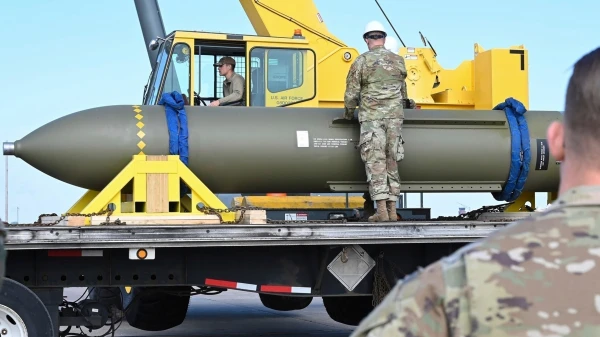
Such a rhetorical question is posed in the headline of her commentary in Neatkarīgā by Elita Veidemane.
The head of the Ministry of Foreign Affairs of the neighboring NATO ally country, Magnus Tsahkna, confirmed the official Tallinn's intention for a nuclear response to the Russian Federation. Here’s what Latvian politicians think about this:
Chairman of the Saeima Commission on Citizenship, Migration and Social Cohesion Gunars Kutris (New Unity): "It is one thing to declare that a state is ready to host nuclear weapons on its territory, but quite another to consider who will provide those weapons to the state. It’s not that simple. It can only be goodwill, so to speak, that we are ready to host nuclear weapons.
But as a person — not as a politician — I would be a bit scared of such a possibility. If nuclear weapons were placed in Latvia, Latvia would become a target for enemy nuclear missiles. At the same time, I cannot entertain the thought that our head of state would have the ability to press the nuclear button. This would most likely be under the control of the USA. But overall, I think that placing nuclear weapons in Latvia is not a good idea. We would be even more exposed to danger."
Chairman of the National Security Commission Ainars Latkovskis (New Unity): "I view positively the fact that Margus Tsahkna has allowed the possibility of hosting nuclear weapons from its allies on Estonian territory. This means — to protect one’s state from an aggressor. An example of this is Ukraine: this state was deceived into giving up its nuclear weapons, which were returned to Russia, and its security was guaranteed. Where is that security now?
Thus, if nuclear weapons are hosted in a state, the enemy will think twice before striking such a state. Hosting nuclear weapons benefits the state. Poland has also stated that it is ready to do this. The likelihood of nuclear weapons being hosted in Latvia is very low.
Are we not becoming a target ourselves? Of course not. No one targets those states that have nuclear weapons in their arsenal. But we have neither the means nor the capabilities to develop nuclear weapons and maintain them ourselves. The Estonians also speak not about development, but about hosting. It should be remembered that the issue of hosting is a joint NATO decision, and a political statement from one country is not enough. The Estonians just have very good public relations specialists..."
Chairman of the Subcommittee on Universal Defense Igors Raevs (non-affiliated): "The Poles made similar statements earlier. There are not many states where nuclear weapons are hosted. In Europe, these are France and the United Kingdom. Other states refrain from hosting nuclear weapons.
The plus is that this hosting provides a certain sense of security. And it is clear that the Americans will not abandon their nuclear weapons. But on the other hand, there are significant risks. It is clear that storage facilities for such weapons will not go unnoticed, and they will become targets for Russia's attacks. Data collection on a specific country will be intensified, and hybrid warfare methods will be strengthened. Therefore, it is impossible to say definitively — whether this is good or bad.
At the same time, it is necessary to distinguish: how much of such statements about hosting nuclear weapons is PR action, how much is information warfare tactics, and how much is real security.




Leave a comment