
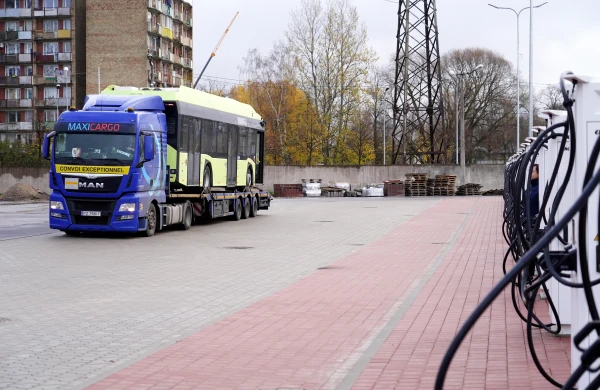
When conducting purchases of electric buses, it is important to consider the individual specific needs of each municipality, explained the State Secretary of the Ministry of Environmental Protection and Regional Development (MEPRD) Edvins Balševics in an interview with Latvian Radio, responding to the auditors' complaints from the State Audit Office regarding the decentralization of electric bus purchases, reports LETA.
After reviewing the purchases of electric buses in municipalities using European funds, the State Audit Office concluded that they were carried out inefficiently, including that the purchases were decentralized, which increased administrative burden, narrowed competition, and ultimately led to higher costs.
Balševics acknowledged in an interview that the State Audit Office did a significant and useful job in reviewing these purchases; however, it should be noted that the decentralization of purchases is justified by the specific needs of each municipality, including the number of students, the condition of roads, and other characteristics.
"Each municipality knows its needs best," said the State Secretary of the Ministry of Environmental Protection and Regional Development (MEPRD).
In his opinion, it is necessary to maintain an open discussion in the future about whether such vehicle purchases should be carried out centrally or separately in each municipality. About 15 years ago, when a similar purchase of school buses was conducted centrally, it faced a number of other problems, including endless appeals and deadline extensions, the official recalled.
In response to the auditors' remark that in some municipalities the purchased buses are used less than planned, Balševics stated that the most important thing is that the bus fulfills its primary function — transporting students.
Evaluating the complaints that some of the purchased buses were assembled from parts of different models, the MEPRD representative explained that in this situation, municipalities apparently saw an opportunity to take advantage of offers from local entrepreneurs. If as a result, vehicles with defects were obtained, they must be rectified under warranty obligations, Balševics noted.
When asked whether there are plans to evaluate and hold accountable the municipalities that acted most unscrupulously in this procurement, the State Secretary of MEPRD replied that this will need to be assessed in the future together with supervisory institutions.
As reported, the State Audit Office found that 14 municipalities purchased 19 electric buses for 8.4 million euros with significant limitations on their use, said Gunta Krevica, head of the communication department of the State Audit Office.
Some of the buses were of inadequate quality; moreover, not all of them were fully zero-emission, therefore the goal of the initiative was not fully achieved. The buses are heated with diesel fuel, so the reduction in emissions turned out to be less than planned. Overall, the reduction in emissions is insignificant compared to the state funding invested.
Due to the limitations, the electric buses are idle for an average of 53% of the year. The average annual mileage of the buses is 43% or 13,400 kilometers less than planned, the auditors established. In some cases, the buses were not used for extended periods for other reasons. For example, in the Ogre region, an electric bus was idle for more than four months because there was no driver for a vehicle costing around 665,000 euros. In the Preili region, the bus was in repair for a long time due to defects.
The State Audit Office also points out that the purchases were carried out in a decentralized manner, with insufficient competition ensured and state funds not spent economically.
Municipalities conducted about 33 separate procurements, which increased administrative burden, narrowed competition, caused significant price differences, and led to higher expenses.
If all municipalities had purchased minibuses at the lowest price, the savings could have amounted to 677,000 euros, calculated the State Audit Office.
Some of the new electric buses already had significant quality defects upon delivery — rust, cracks in the ceiling lining, and an inability to provide adequate heating in the cabin were discovered. Nine out of 12 delivered minibuses were built by combining two bases of cargo minibuses.
"The initiative was implemented to utilize available funding rather than achieve the best outcome. Although the set goals were justified, the result achieved is expensive and has limited practical applicability, and the invested state funds did not bring proportional benefits," assessed State Audit Office board member Mārtiņš Aboliņš.
He noted that during the audit, it was repeatedly expressed that without European Union (EU) funding, municipalities would not have purchased such vehicles. According to the State Audit Office, this approach is incorrect, and it is time to change the attitude towards the unreasonable use of European funds.
"EU funds are state funds, and they should be treated just like one’s own money," emphasized Aboliņš.
The average price of the purchased minibuses was 277,000 euros, and buses — 581,000 euros. There were significant price differences for the same models of buses and charging stations. For example, the price difference for identical buses purchased in Jelgava and Preili regions is about 43,000 euros, while the same model was purchased in Lithuania in 2022 for an average of 37% or 168,000 euros less.
The construction of charging infrastructure also often did not meet the goal of the initiative. In some cases, extensive asphalted areas were built, and expensive landscaping zones were equipped.
As a result of the audit, the State Audit Office made five recommendations, three to the MEPRD, one to the municipalities, and one to the Ministry of Transport.
Wider use of electric buses will reduce their idleness and increase the benefits from their acquisition. In turn, improved oversight of similar initiatives and strengthening internal control procedures in municipalities will help prevent the recurrence of identified violations, emphasizes the State Audit Office.
At the same time, in the field of student transportation, the introduction of unified quality requirements for transportation and the vehicles used is planned, with primary responsibility placed on the Ministry of Transport.








Leave a comment