
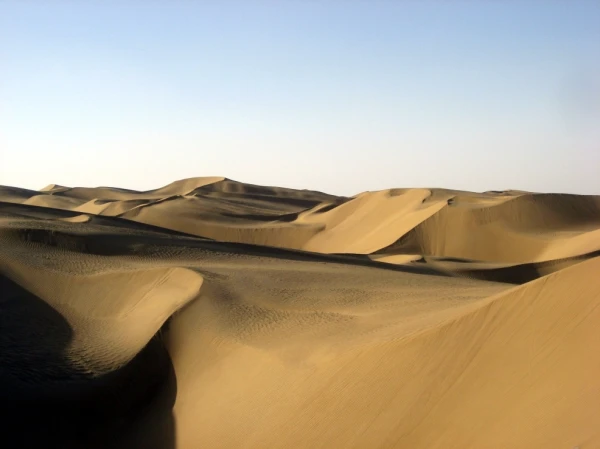
New research shows that Chinese scientists have managed to transform the Taklamakan Desert into something special — from a "biological void," the region has turned into an efficient carbon sink.
The Taklamakan Desert is one of the largest and driest deserts in the world, covering an area of about 337,000 square kilometers. The desert is surrounded by high mountains that block moist air for most of the year, creating extremely arid conditions that are too harsh for most plants on the planet, writes Focus citing Live Science.
Yet, despite the harsh conditions, over the past few decades, China has planted forests along the edges of the Taklamakan Desert, and new research shows that this approach has likely been quite effective. Analysis results indicate that large-scale ecological engineering along the perimeter of the Taklamakan Desert has turned it into a carbon sink capable of absorbing more than it emits.
According to co-author of the study, planetary scientist at the California Institute of Technology and senior researcher at NASA's Jet Propulsion Laboratory, Yuka Young, he and his colleagues have discovered for the first time that human intervention can effectively enhance carbon absorption even in the most extremely arid landscapes. In simple terms, humans can indeed transform one of the driest places on Earth into an efficient carbon sink.
The study's results indicate that over 95% of the Taklamakan Desert is covered by shifting sands — as a result, it has long been considered "biologically barren." According to scientists, the desert has been expanding since the 1950s, when large-scale urbanization and agricultural expansion occurred in China. This transformation of natural lands created conditions for increased sandstorms, which typically blow away soil and deposit sand instead, causing land degradation and desertification.
In 1978, China launched a large-scale ecological project called "Protective Forest Belts of the Three Northern Regions," aimed at slowing the desert's expansion. The project involved planting billions of trees along the perimeters of the Taklamakan and Gobi deserts by 2050. It is known that as of today, more than 66 million trees have already been planted in northern China, but until now, scientists did not know whether the project had reduced the frequency of sandstorms.
It is known that China completed the greening of the Taklamakan in 2024, and scientists believe this has helped stabilize sand dunes and increase forest cover in the country from 10% of its area in 1949 to more than 25% today. Now, the study's results indicate that the expanded vegetation is capable of absorbing more carbon dioxide than it emits. This suggests that the Chinese desert has effectively turned into a fully functional and efficient carbon sink.















Leave a comment