
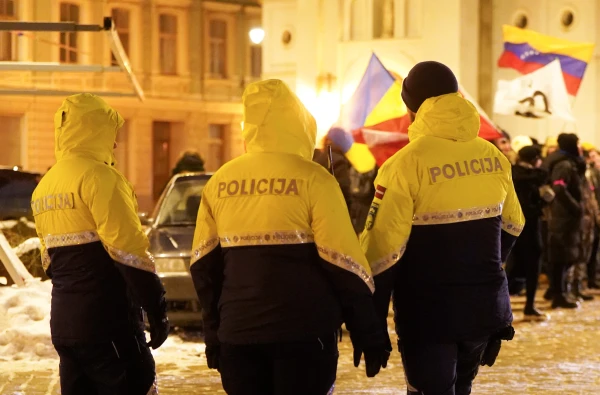
In words, the authorities are extremely concerned about the country's security. In reality, however, the police patrol has long turned into an endangered species. At best, a marked car will drive by. Or without markings – especially if it needs to stand on the roadside and take speed readings.
The Inspector is Coming to the Law Enforcement
Thank God, if respected readers have not had to deal with law enforcement for years. Your author last interacted with the police – filling out a report and such – when, upon waking up, I looked out the window and found no headlights on my own car. The matter ended with the relevant documents being drawn up by the State Police. This was three years ago – and there has been no movement on this issue. Apparently, the thief has proven elusive.
When my wife had her car radio stolen, a district officer also came – and ten years later, a hefty envelope arrived by mail… about the termination of the criminal case.
Gatis Litvins, the director of the Second Audit Department of the State Control, reported to the parliament – what’s going on with the police, and – "are there effective solutions to prevent the shortage of police officers?"
A "long-standing trend" for Latvia is the reduction in the number of law enforcement officers. Thus, at the end of 2019, there were 6,530 full-time law enforcers in the country, of which 5,238 positions were filled. By the autumn of 2025, there were 5,531 positions in the staffing table, but only 4,204 people were actually working. "More officials are leaving than are being hired," states the State Control.
How Much They Earn in the Ministry of Interior
Although the ministry led by Rihards Kozlovskis ("New Unity") honestly has no reason to complain about salaries. The payroll fund reached 197 million euros (increased by 80 million), resulting in an average salary increase for law enforcement officers of 78 percent.
Just consider – if the average gross salary in the public sector of Latvia is 1,820 euros, then among police investigators, an inspector earns 2,387 euros, a senior inspector 2,766 euros, and a chief inspector 3,212 euros. The operational staff, respectively, earns slightly more for these same positions – 2,767, 3,027, 3,517 euros. Salaries for "responding police officers" – that is, the very personnel who work, so to speak, on the ground: a junior inspector – 2,374 euros, an inspector – 2,728 euros, a senior inspector – 3,039 euros, a chief inspector – 3,547 euros.
Already as a police cadet, a future law enforcer receives 1,120 euros from the state – which exceeds the established minimum wage in Latvia by 51%.
Nevertheless, the State Control believes that "salaries are not entirely fair, considering the workload of police officers." 25% of the money relates to the variable part, i.e., payment for overtime work.
Provincial Detective
The most difficult situation with personnel has developed in regional departments, which provide 90% of direct police functions – while they only have 63% of the necessary number of employees. The capital is the worst off, with less than half of what is needed, and the workload is colossal – in Riga, there are 8.5 times more criminal cases per investigator than in the provinces.
At the same time, only 48% of those who have received the police specialty are willing to work in Riga. And 18% of law enforcement officers leave the service after the first three years of work!
If an employee works until retirement age as prescribed by law – they will receive almost their full salary, 93%. No other professional group has such advantageous conditions. Nevertheless, for 25 years, the existence of such a system has not contributed to personnel loyalty.
The conclusion of the State Control: the system of pension payments for years of service – "does not correspond to the overall pension policy, the systems of other EU countries, and the burden on the budget."
Paper Cops
Currently, 79% of police officers and 21% of so-called hired personnel work in the Ministry of Interior. Meanwhile, according to the State Control, individuals with special ranks continue to perform "non-characteristic tasks." For example, 700 officers are engaged in administrative work, and 280 police officers are responsible for the security of various facilities (including the Saeima!).
Recommendations from the auditors:
- delegate bureaucratic functions to workers in a different legal status;
- use police officers in positions where there is a shortage of personnel;
- transfer the security of facilities to private enterprises.
Of course, questions may arise immediately. What kind of efficiency can be expected, for example, from a lady over 40 who has spent twenty years in uniform merely shuffling papers and Excel tables, now sent out into the field to eradicate crime? Naturally, no one will voluntarily wish to part with their approaching retirement benefits, but such individuals will not be burning with enthusiasm at work.
And as for involving commercial entities in the security of important facilities – there will clearly be difficulties regarding access to state secrets and other nuances of service…
What About Hiring Foreigners?
In the future, police officers need to undergo health checks – not by position, but by risk. The level of physical fitness should also be made "elastic." Balance the duration of disciplinary punishment, aligning it with the time for returning to service.
Overall, all this looks like a conscious lowering of criteria for employees of the Ministry of Interior with special ranks, who, let us remind you, earn 56% more than the average workers in the public sector. Another paradoxical proposal made by our auditors to improve the staffing problem is the requirement for police officers to have a Latvian passport. Specifically: "it is necessary to assess the possibility of easing this requirement for citizens of allied states." Here, of course, it would be necessary to determine who falls under the category of allies. If by EU standards, we would certainly welcome our Bulgarian brothers with their historically minimal salaries compared to the Union as a whole. Although since the times of Ottoman rule, as well as during tsarism and socialism, they know a thing or two about a police state. As for the possibility of extending service in the Latvian police to NATO allies – this would mean we would have law enforcement officers from Montenegro, North Macedonia, and Albania. It will be interesting to see how they will fare in the assessment of our state language!
And the cherry on top would be recruiting employees from the Independent into the Ministry of Interior. Thus, the staffing policy of local law enforcement would take a full turn back to the situation 40 years ago…
Volunteer People's Patrol
Naturally, local resources are primarily being sought. As preliminary recommendations, the State Control suggested introducing the institution of "volunteer police assistants." Here come our brave patrol members!
And since we do live in the age of high technology, law enforcement can also have virtual communication with accountable individuals, using cameras with facial recognition systems. This, of course, does not apply to real criminals – but to law-abiding residents, for example, merchants.






Leave a comment