
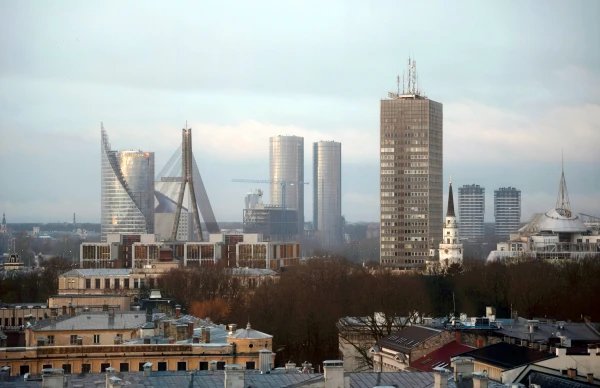
"To implement the investment project of strategic importance 'Reconstruction of the Cable-Stayed Bridge' (hereinafter referred to as the project) in the medium term with total expenses up to 84,461,628 euros," – this decision was made by the capital's council after three hours of debate last Friday. But in reality, the main decision-makers will be the officials.
Deadlines that are pleasant to face
Of course, the aforementioned amounts can be considered significant progress compared to the initial cost estimate for the 2024 competition – 100 million euros, which was quite normally perceived by the former leadership of the Riga City Council (RDC) headed by Mayor Vilnis Kirsis (New Unity). However, the current leadership has recognized it as exceeding the city’s capabilities.
However, considering that some RDC deputies over the age of 60 voted for the draft resolution, their civic courage is still commendable – after all, the return of funds intended for construction hovers on the edge of the longest lifespan, even taking into account medical advancements.
Let’s see what point 3 implies: "To take a loan from the State Treasury or another lender in the medium term… with the following deadlines for fulfilling obligations:
3.1. the loan repayment period is up to 30 years;
3.2. the deferred principal payment period is up to three years."
In general, the aforementioned deadlines seem astronomical not only from the perspective of the physiological cycles of elected representatives but also in comparison with the fluctuations of economic cycles inherent to our challenging times, the rise and fall of global structures, and – against this backdrop – the future of Latvia itself. One way or another, the money for the bridge is lost somewhere in the financial fog….
City Icon
It is worth noting that the Vanšu tilts Association won the competition on January 5 of this year, but the decision was contested.
– I want to inform you and the residents of Riga about the work that has already been done, which will allow us to start this historic project, – addressed her colleagues Marta Kotello (Progressives), Chair of the RDC Committee on Communications and Transport. – On January 15, we received a decision from the Procurement Monitoring Bureau, which deemed the complaints of the second applicant unfounded and allowed the Department of Environment and Mobility to conclude a contract with the procurement winner. The very next day, on January 16, the municipality signed a contract with the Vanšu tilts suppliers' association. By revising the requirements of the regulations, we achieved real competition. While the only offer in the first competition was for 100 million euros, we have now concluded a contract for 69.8 million euros (excluding VAT). This is a huge saving for the city budget.
"The work plan is as follows, – continued Ms. Kotello. – This year, we plan to start the design phase, which will last for 12 months. And next year, in 2027, we will begin actual construction work, which will last for 24 months. That is, in 2028, the residents of Riga will have a fully restored and reliable bridge."
– This project is not just about concrete, asphalt, and cables, – the politician stated polemically. – It’s about a modern and safe urban environment. A major bridge for all road users. Everyone will benefit: pedestrians will have new wide sidewalks restored, cyclists will have a wide bike lane, motorists will have a quality roadway without potholes, and our public transport will have an autonomous lane. This is a transition from plans to work. I urge everyone to be responsible and support the restoration of Riga’s iconic panoramic engineering structure.
"A New Bridge Can Be Built"
Such an outraged remark about the repair budget initiated the debate from the opposition. But then Andris Urtaņs, Director of the Infrastructure Management Office of the Department of Environment and Mobility, joined in:
– The project involves a significant reconstruction of the Cable-Stayed Bridge, which includes: repairing the pylon; repairing the moorings on the embankment on both sides of the Daugava; repairing the underwater structures of the pylon.
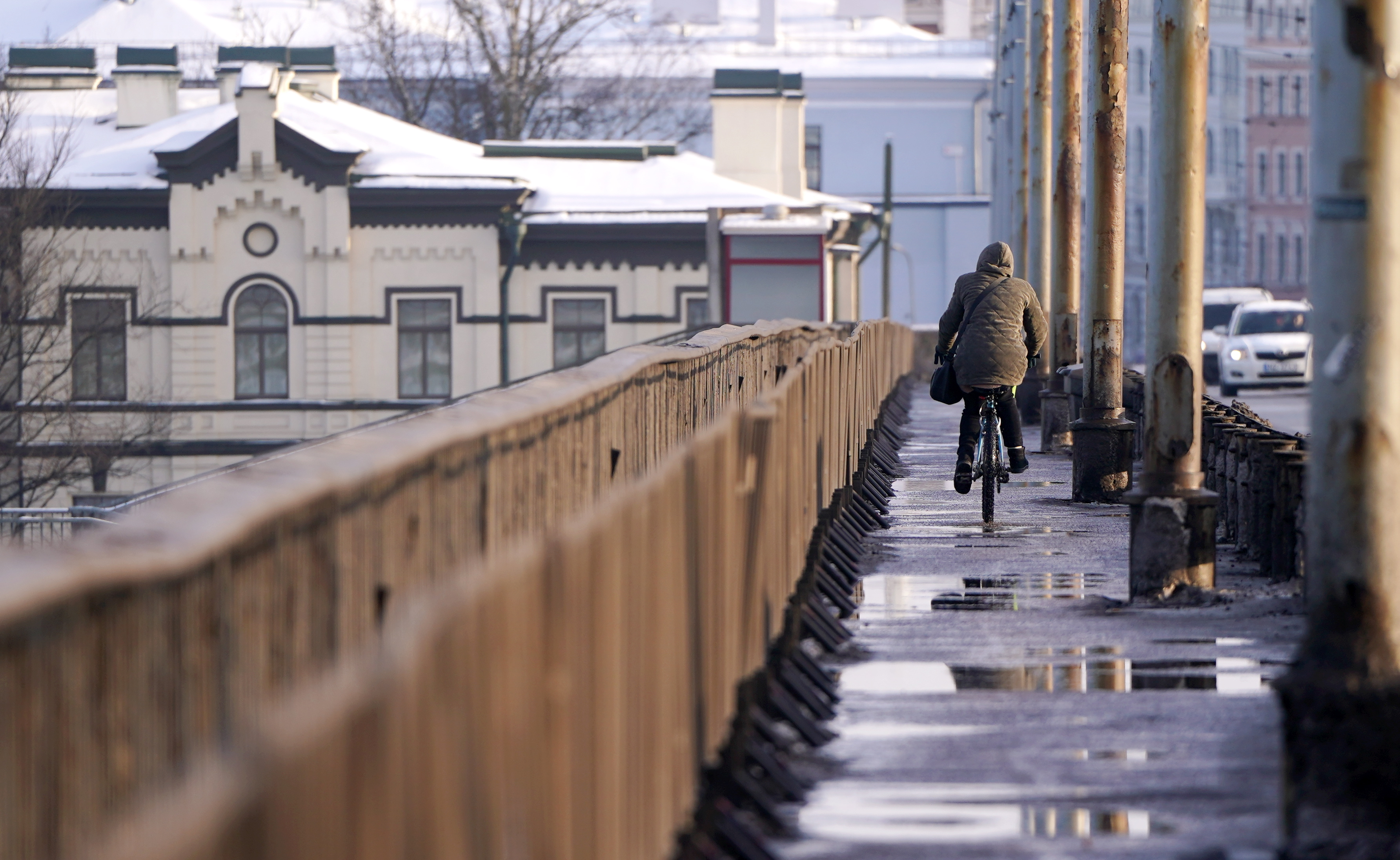
You can ride a bike now – if you are careful. Photo LETA.
"The Cable-Stayed Bridge, – reminded Mr. Urtaņs, – is a bridge of quite a unique design. A typical reinforced concrete bridge has many supports, while the Cable-Stayed Bridge has a single support, and the bridge itself is of a steel structure. The steel frame itself will be repaired. In simple terms, it is a big iron box, on which asphalt and all devices are laid. All this covering will be dismantled to strengthen the entire structure so that the Cable-Stayed Bridge can be reinforced and ensure environmental accessibility according to modern requirements. For both pedestrians and cyclists, while maintaining vehicle traffic."
– The structures will be strengthened, the bridge itself will be widened, this steel structure will be repaired, and all cables will be replaced in full. And all these works are planned to be carried out while maintaining traffic across the bridge.
The opposition insisted that the bridge repair could be significantly cheaper if the bike lane were not included. In response, A. Urtaņs had prepared complaints from residents about the lack of mobility options on the Cable-Stayed Bridge for wheelchair users and micro-mobility devices: "Considering that the Riga Technical University is nearby in Kipsala, and the Stradiņš University is also not far away, today’s sidewalk width of 1-1.5 meters is absolutely insufficient."
One Lane for Two Years
Another deputy inquired about the organization of vehicle traffic on the Cable-Stayed Bridge during the repairs – and its subsequent changes. To this, Mr. Urtaņs pointed out that after the reconstruction, the bridge will still have 2 lanes; only the intersection with Citadeles Street will undergo changes, where a traffic light will be installed for the convenience and safety of pedestrians and drivers when turning onto the bridge (i.e., an inevitable traffic jam will form at the very entrance to the bridge towards Pardaugava).
As for the two-year reconstruction period – during this time, traffic will be conducted in 1 lane in each direction. "We need to see how to replace these cables, – the head of the office noted. – Considering that the span of the bridge, if I’m not mistaken, is about 300 meters (other bridges range from 20 to 40), these cables need to be replaced one by one. Temporary cables will be installed, old ones removed, new ones installed, and so we will move forward. Throughout this time, monitoring will occur to ensure that the bridge is safe, with no deviations."
However, the aforementioned order is currently "indicative," and it is quite possible that sometimes (at night, for example), the Cable-Stayed Bridge will still be completely closed.
– When the construction contractor understands what technology they will use, say, for replacing the cables, and what width will be needed for that.
On Foot
Next, a dialogue took place between M. Kotello and a representative of the opposition, during which the latter reiterated the idea of building a new bridge for the same money. The Cable-Stayed Bridge could be repaired with a "minimal repair," without expanding the non-automotive part, and so on. "So that it wouldn’t need to be closed."
The Chair of the Committee on Communications and Transport, for her part, stated that in the case of a parallel bridge, a "new street network" would be required, which is fundamentally impossible. Moreover, the interests of the residents of Imanta and Zolitūde must be taken into account, "who also use this bridge on foot."
– Are you suggesting just painting the cables and calling it a day?, – asked M. Kotello rhetorically. – I think your voter also likes to cross the bridge in a human way.
Here, your author agrees with the authorities – especially during the COVID times when regular swimming pools were banned, and public transport was full of viruses, I greatly enjoyed walking from Purvciems to Agenskalns and back – it turned out to be 15-16 km. On this incredible journey, the most outstanding part was crossing our "iconic" bridge – the view of the ice floes and breathing deeply. And yes, for pedestrians, it is indeed a bit cramped there – especially near the pylon.
As for the condition of the bridge, corrosion was already visible in places in 2020-22, revealing the waters of our beautiful Daugava.
Corporate Scandal in Full Swing
The debates about bridge construction were accompanied by unprecedented personal attacks.
"Nervous, aggressive type" at the very beginning of the meeting was designated by Deputy R. Bremanis by Deputy G. Lapinš (National Alliance), who called for the presidium to deprive him of the floor. A rather serious accusation, considering that it came from the head of the Committee on Security, Order, and Corruption Prevention.
Later, Mayor V. Kleinbergs personally stated that he would turn to the State Security Service with a list of requests that were sent by members of the opposition faction to the council’s records – regarding the technical specifications of the bridge, including its drawings. The Chair of the RDC repeatedly mentioned the opposition political force in the connotation of a foreign agent of influence. He also mentioned the acquaintance and presence of its deputies in the same party with the recently convicted former Saeima deputy Janis Adamsons on charges of espionage in favor of the Russian Federation. In this regard, it is worth recalling that the political star of this figure shone in the distant 1994-95, when he was the Minister of the Interior in the cabinet of Maris Gailis and subsequently became one of the locomotives of the "Latvian Way" party.
The accused opposition member did not remain silent either, as she announced from the podium of the council a list of deputies who participated in a corporate party at V. Kleinbergs’ office the night before the decision on the Cable-Stayed Bridge was made. In the video, it is visible that the mayor and his close associates are drinking alcoholic beverages right within the walls of the Riga City Council. The question of who paid for the banquet – politicians or taxpayers – remains unanswered.
Thus, theoretically, the possibility of contesting the important decision on the reconstruction of the bridge and the loan arises – as it was made in a state of intoxication.





Leave a comment