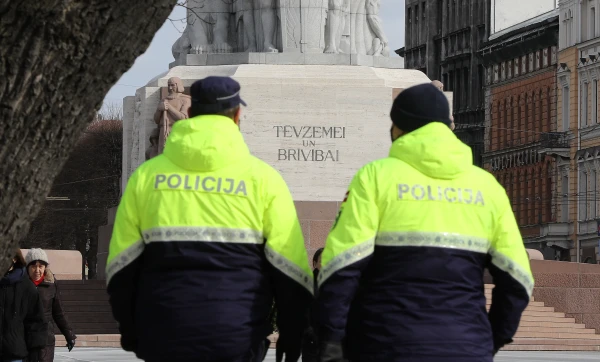
The main reason for the shortage of personnel in the State Police (SP) is no longer the level of remuneration, but human resource management and task prioritization, concluded the State Audit following the audit, emphasizing that police resources can be alleviated and the remuneration system should be made fairer, writes LETA.
During the audit, it was revealed that over the past five years, the number of police officers has decreased by more than a thousand. Currently, about a quarter of positions remain vacant, which have long been difficult to fill, and the number of police officers per capita in Latvia is 58% lower than the average in the European Union.
Gatis Litvin, a member of the State Audit Council, points out that over the past ten years, more police officers have left the service than have been hired.
"Salaries have increased, however, without targeted human resource management, fair distribution of workload, and assessment of what tasks the police should actually perform, we continue to overload existing staff and risk them leaving the service prematurely," emphasizes Litvin.
He acknowledges that the ability to compensate for the shortage of personnel by attracting new police officers is limited, as the labor shortage in Latvia is felt in almost all sectors.
"The audit shows that improvements are possible even with the existing resources, but this requires bold decisions," explains the council member.
According to the State Audit, it can no longer be claimed that the remuneration of State Police employees remains low. Over the past five years, significant progress has been made in ensuring competitive salaries: more than 80 million euros have been allocated for their increase, and the average salary of police officers has risen by approximately 78%. Currently, the average salary of a police officer exceeds the average gross salary in the public sector by 56%.
Positive changes are also observed at the beginning of service — the minimum salary set for cadets at 1120 euros per month is significantly higher than the established minimum wage in the country and is comparable to the salary of a junior inspector, auditors note. Improvements are also evidenced by the increase in the number of cadets admitted to the State Police College, which will reach its highest level since the college's founding in September 2025.
However, in the opinion of the auditors, the remuneration system needs to be made fairer, taking into account the volume and intensity of work. In particular, the audit showed that the workload on employees of the Riga Regional Police Department is significantly higher, while their salaries are only slightly above those in other regions. This negatively affects the ability to attract and retain new employees in Riga. It is also noted that a significant part of the remuneration still consists of a variable component, including overtime pay.
The State Audit also established that the personnel shortage reflects a significant problem — existing resources are unevenly distributed, and the workload on police officers varies significantly across different regions. In regional departments, which provide about 90% of the police's core functions, only 63% of the necessary number of employees are working in the areas of investigation, response, and prevention. Moreover, the differences between regions are significant — in Kurzeme, Zemgale, Vidzeme, and Latgale, the staffing level is about 83%, while in the Riga region, where the largest number of residents is concentrated, it is only 44%.
Part of the shortage of police officers is compensated by overtime work — in 2024, it is equivalent to 296 full-time positions. According to the State Audit, this is the minimum necessary personnel resource to perform the functions of the State Police without constantly overloading employees. Funding for such an increase in the number of police officers is already available, and additional funds will not need to be requested, the auditors believe.
The audit also notes that the problem is exacerbated by the procedure for distributing cadets after graduating from the State Police College. The place of service is often determined by the cadet's place of residence and personal preferences, rather than by the needs of the service. As a result, less than half of the graduates end up in the Riga region, despite the fact that it is where the most acute personnel shortage is observed. According to the State Audit, the wishes of the cadets should be balanced with the needs and interests of the service, especially considering that cadets are being prepared for specific police tasks.
The audit also showed that a significant portion of State Police employees are engaged in positions that essentially do not require police status, increased risk, or specific physical training. Their work is mainly related to routine and administrative duties — for example, investigating administrative violations, forensics, licensing, or methodological work, involving more than 700 employees. This means that specially trained police officers are not engaged in areas where their presence is critically necessary, such as response, concludes the State Audit.
The audit also revealed that the current pension system for years of service encourages employees to leave the service. Such a pension almost completely — by 93% — replaces the remuneration received in service. Although the reform of the pension system will come into effect in 2027, the auditors estimate that it will not significantly change the situation for at least 25 years.
On average, 244 State Police employees retire annually after years of service, with an average age of 48. Recipients of pensions for years of service from the internal affairs sector account for more than 80% of all recipients of such pensions and exert the most pressure on the state budget. In 2024, 8844 former employees of internal affairs institutions received pensions for years of service, and the total annual payments amounted to about 72 million euros.
The planned increase in the years of service and the retirement age by five years will occur gradually over ten years and, according to the State Audit, will not solve the problem of personnel shortages in the near future. Furthermore, the reform may not affect a significant portion of officials who will still be able to retire for years of service at a relatively early age.
It is also noted that the Latvian pension system for years of service will continue to differ significantly from systems in other EU countries, where there are different retirement conditions or such pensions are completely abolished. To ensure a fair, proportional, and state-interest-aligned pension system for years of service, further reform is necessary, the auditors are convinced.
The State Audit emphasizes that ensuring public safety is not only the police's task; society and the private sector must also participate. Internal security policy should be implemented jointly — with clearly established police priorities and the creation of mechanisms that allow residents and businesses to fully play their role in maintaining law and order and ensuring safety.
"This approach corresponds to the principle of solidarity enshrined in the preamble to the Satversme — everyone cares for themselves, their loved ones, and the common good of society, showing responsibility towards others," says Litvin.
He argues that complete dependence solely on the police is unrealistic and undesirable, as it weakens the resilience of society and the personal responsibility of each individual.
"Today, there are various opportunities for individuals to protect their own property and participate in strengthening public order and safety," adds Litvin.
The State Audit believes that significant contributions can be made by volunteer police assistants, the effectiveness of which is confirmed by the experience of neighboring countries. Currently, there are only 27 police assistants in Latvia, and the development of this format and its significance are not adequately assessed. Therefore, the auditors believe that pilot projects are necessary to determine the most effective models.
The auditors also pointed out that police resources can be alleviated by more widely involving private security companies. Currently, 280 police officers provide security for various facilities. This is not the best way to utilize specially trained personnel, especially in conditions of personnel shortages, believes the State Audit.
The institution calls for special attention to be paid to cooperation with trade companies. In 2024, thefts, fraud, and embezzlement in small volumes accounted for 32% of all registered crimes. According to the State Audit, more effective prevention and investigation are hindered by the lack of a unified cooperation format and digital solutions for reporting, as well as an unclear legal framework for visual identification of individuals without processing biometric data.
To address the problem of police shortages and improve the efficiency of the State Police, the State Audit has put forward seven recommendations to the Ministry of the Interior and the State Police.
The State Audit is confident that their implementation will help balance the workload among employees, utilize police officers more effectively for critical functions, and promote the retention of experienced employees in service. Police officers will also be relieved from participating in less significant situations due to broader involvement of society and business.
At the same time, the State Audit calls on the Cabinet of Ministers to continue improving the pension system for years of service so that it aligns with the interests of national security, the needs of the service for personnel, budgetary capabilities, and the principle of fairness towards the rest of society.