
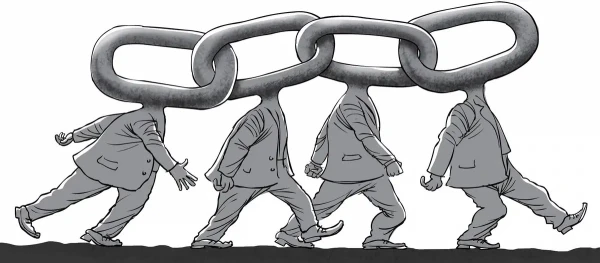
Political observers do not predict a governmental crisis — the ruling parties will quarrel, scandal, but will continue to work.
If during the saga surrounding the Istanbul Convention it seemed that the government was on the verge of collapse, now even the most pessimistic experts lean towards the idea that Silin's government will last for the remaining nine months until the elections.
The most that can be expected is a change of one or another weak minister. And even then, most likely, to genuinely reduce the risk of a governmental crisis, the prime minister will have to dismiss... three ministers at once — one from each ruling party. Yes, the coalition is torn apart by ideological contradictions, which will only intensify as the hour 'X', that is, the elections, approaches. However, the ruling parties — albeit with regular scandals and attacks on each other — will still stick together. And there are four main reasons for this.
The first reason is that those in power understand perfectly well that if the government collapses now, it will take at least a couple of months to form the next one. And that’s if they can relatively quickly agree on a candidate for prime minister. This means that the new government will effectively start working in the midst of the election campaign. With all the desire to show positive results, this government will not have time to do so. Unless those who will be in power can somehow attempt to use administrative resources. And even that is not a certainty.
The second reason is that it is obvious to everyone that of the three coalition partners, only the 'Green Farmers' can theoretically bring down the government. It is not in the interest of the 'Progressives' to collapse the government, as that would guarantee them a place in the opposition. 'New Unity' certainly has no need to destroy the government with their own prime minister. This leaves the 'Green Farmers', who, on one hand, would benefit from leaving an ideologically alien government, but on the other hand, they would then have to create a new government with their direct competitors. And that might be even less advantageous!
The third reason is that starting this year, the ruling parties in the Saeima have not 52, but 54 votes. This means that it is much easier to make decisions and there is practically no need to bow to the opposition. Any new coalitions, considering the fragmentation of the parliament, could turn out to be weaker — with a minimal majority, that is, 51 or 52 votes. As they say, why change a needle for soap?
And finally, the fourth reason is that the opposition itself has no desire to 'get into power' just a few months before the elections. The current situation is quite beneficial for the opposition: let this weak, ideologically unstable government continue its work, which is unlikely to make any sensitive decisions for voters and the country before the elections.
One can agree with political scientist Professor Juris Rosenvalds that the main intrigue is not whether Silin's government will hold (it is clear that it will), but what the results of the elections will be. Rosenvalds believes that the next parliament will be very fragmented and could even lead to a... stalemate situation.
"There could be conditionally three blocks. The first is a conditionally liberal block, consisting of 'New Unity' and 'Progressives'. The second is nationally conservative. And the third is conditionally Russian-speaking. And none of these three blocks will have a majority," painted the post-election scenario J. Rosenvalds, suggesting that the formation of a new government will be long and painful.







Leave a comment