At the last meeting of the city council in 2025, one of the most hotly debated issues was... trash.
The city authorities have developed a detailed strategy for what is now referred to in our new jargon as "household waste management." In any case, all of this affects our daily lives too much to sweep it under the rug.
In a Year, We'll Say Goodbye to Plastic Bags
Let me clarify that I try to be law-abiding; I collect biological compost in a separate bin, put packaging in a larger trash bin, and regularly take non-standard glass to a special recycling container. So I won’t loudly declare, like one opposition figure: "I don’t sort my trash." Well, that’s a kind of pride—he might as well admit that he doesn’t wash his hands after using the restroom.
Last year, according to data available to local government, 307,952.39 tons of household waste were collected in the administrative territory of Rīga, of which 43% was sorted.
A stack of documents about waste management was fortunately electronic—otherwise, it would itself be an object for trash collection. This was, so to speak, a packet for packets—officials from the Rīga City Council outlined what and how we are to throw away.
Let’s note that according to points 8.4.1 and 8.4.2, starting from March 1, 2027, it will be necessary to use biodegradable bags or reusable containers for collecting biological waste. Thus, the most common element of waste collection today—a worn plastic bag from the supermarket—will be declared illegal.
Oh, My Box Is Full
From the same date, the initial time for waste collection will be set from 5:00 AM to 11:00 PM. Personally, your author has been getting up around this time for several years, so it’s not critical for him, but I can imagine people who are disturbed from their sleep by the noise and howling of the garbage truck. I feel very sorry for the residents of the first floors.
A certain consolation should be the waste collection schedule, for which point 11 establishes a minimum limit:
- For unsorted household waste—at least once every 8 weeks;
- For separately collected biological waste—at least once every 4 weeks;
- For separately collected glass and lightweight materials—at least once every 8 weeks.
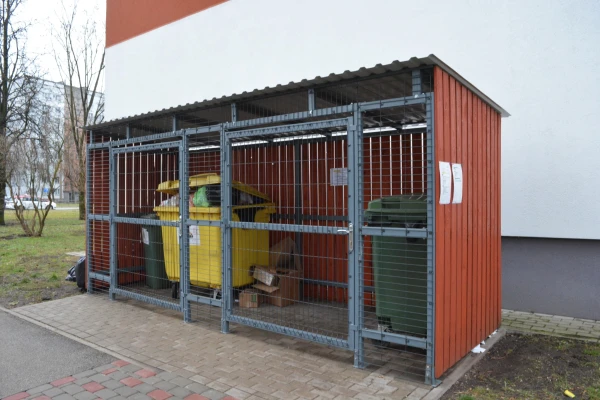
Of course, "at least" can be interpreted quite loosely, i.e., holding a full trash bin, for example, through July and August, will not formally be considered a violation. At the same time, paradoxically, containers are not allowed to be overfilled—and their contents compacted.
What to do with overflowing containers? See point 41:
"If a container for unsorted household waste is overfilled by more than 15 percent of the container's volume or additional household waste is placed near the container, the waste management entity establishes the additional volume of unsorted household waste, photographs it, and collects it for a fee..."
Regarding reporting to the Housing and Environment Department, the "Getlini" waste landfill is obliged to inform the Housing and Environment Department of the Rīga City Council about the state of waste management in the capital once a quarter. A special waste database has also been created under the beautiful name PARIS (Rīga, as we know, is a small Paris!)
What Else Is Prohibited?
The rules from the city council in point 7.1 suggest discussing waste issues at personal meetings of "interest groups (residents, property managers, non-governmental organizations, etc.)" as well as on social media. It seems that printed publications can also help in the current situation.
As for prohibitions, the waste rules now indicate the inadmissibility of:
- Burning waste;
- Pouring liquid waste into containers;
- Placing containers on roadways (except for the roadside);
- Disposing of construction debris, sand, car tires, and household electrical appliances (which fall into the category of hazardous waste).
Bulky waste must be collected within three days upon request. However, according to point 25.15, if "it is found that the containers for unsorted household waste are filled to less than 50 percent more than three times a month," the number of these bins may be reduced!
Containers are now, in themselves, high-tech objects. They are equipped with radio frequency identification (RFID) tags, allowing local authorities to monitor them via a GPS system. How far progress has come—space management of trash bins...
Is Food Coming to You or Are You Going to Food?
The Rīga rules also meticulously regulate the responsibilities of legal entities engaged in economic activities and thus producing waste. Our dear editorial office "SEGOYA," for example, is located in a modern business quarter created from an old factory in the capital's center. And it is regularly astonishing to see what mountains of waste—primarily cardboard—today's small businesses generate, primarily based on the constant shipping of goods.
Additionally, when transporting delicate products, such as electronics, foam is widely used—and it is, as we learned during the "waste" hearings in the Rīga City Council, the most harmful material, i.e., non-recyclable and even unsuitable for burning. By the way, millions of food packaging units made from it are produced and, without exaggeration, thrown away every year in the capital.
Listen, how did we manage without all this delivery at the beginning of the 21st century? Maybe we should stop feeding mice and cockroaches in offices and give local youth the opportunity to earn as bartenders and waiters instead of foreign couriers with boxes? Moreover, even going to the cafeteria is an opportunity to stretch and show oneself. It’s a pity, of course, that, again, millions of such human trips a year are limited by personal budget savings...
Hygiene for Containers
Returning to the responsibilities of legal entities—the city council will now be stricter in holding organizers of various spectacles and festivities accountable, who regularly leave behind, at best, overflowing trash bins. It is important to delineate the responsibility of the property owner and the event organizer.
The responsibilities of the company owning the containers include their regular cleaning with disinfectant liquids—at least twice a year.
What will come of this entire waste saga, we will find out in the coming months when the snow melts. But it seems that the garbage saga in the capital, which, by the way, formally led to the removal of its former leadership several years ago, has every chance of continuing...