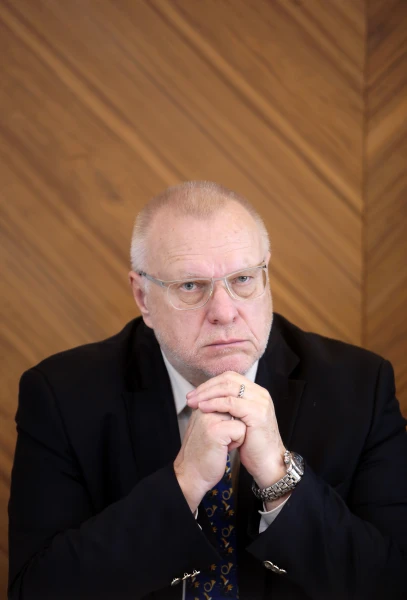
The economist commented on the failed experiment of director Hermanis.
The well-known economist Uldis Osis reacted to the "failure" of Alvis Hermanis' initiative to change the electoral system. The economist noted on his Facebook page that the problem is much deeper than just an ineffective election system, and switching to single-member districts is unlikely to fundamentally improve our democracy and, even more so, the economic situation.
Alvis Hermanis' initiative to switch to a mixed or majoritarian electoral system (personnel elections) was very much needed. It reflects the dissatisfaction of Latvian society. However, the main argument of skepticism — whether changing the electoral system would actually resolve structural state issues — remains open.
A deeper analysis of the situation in Latvia reveals that the quality of politics in the country is closely linked to economic stagnation and social stratification.
The current proportional electoral system promotes "list politics," where voters often vote for a party brand rather than for a specific person. This creates a situation where deputies feel accountable to party leadership rather than to voters. Even if the system initiated by Hermanis improves the "quality" of the parliamentary composition (more well-known, locally authoritative leaders), it will not solve the political fragmentation of the Saeima.
The biggest problem in Latvian politics is the inability to agree on long-term goals, not even fully understanding what they should be, as forming coalitions among small, ideologically similar yet conflicting parties consumes all energy.
As a result, stagnation in the economy deepens, growth slows, and Latvia falls behind its neighbors — a long-standing accumulated problem.
All of this is based on structural obstacles: a high tax burden on labor, especially in the low wage group, a weak investment attraction mechanism, and bureaucratic barriers, especially in construction approvals.
So, would changing the electoral system address this issue? It is clear that economic and social decisions are made not so much by "bad deputies" but by a weak executive power — ministries, other state bodies, and non-governmental organizations that are "regulated" by the interests behind party financiers. Without strong, professional reform of public administration, merely changing the election model would not provide an immediate boost for growth.
Social inequality and the demographic crisis have placed Latvia among the leaders in the European Union in terms of income inequality. Social tension is rising, contributing to the depopulation of regions, and the "two-speed Latvia" (Riga versus the rest of the country) creates a general alienation from state power.
Returning to the electoral system — personnel elections could give regions a stronger voice in the Saeima, but there is a risk that this would rather foster "local selfishness" (struggling for budgetary resources for their region), as there is no longer a strategic vision for the country's development.
Another important aspect: under current conditions, any discussion about fundamental changes to the Constitution is evaluated through the lens of stability. But there is a risk here: a majoritarian system could create "local rulers" and increase the opportunities for populists to penetrate power through a single charismatic leader, which in the context of an escalating hybrid war could be dangerous for the country's security.
Hermanis' initiative was not a failure. It showed that Latvia's problems are much deeper; they are institutional and substantive, not just related to electoral procedures. To address economic backwardness and social injustice, it is necessary not just to elect the "best people" but to have a vision for the country's development, which the current fragmented political elite is unable to articulate regardless of the order of elections.
Victor Hugo said: "Revolutions are prepared by philosophers, realized by fanatics, and their fruits are enjoyed by rogues." Perhaps we have not yet transitioned from the era of rogues to the philosophical period. Then it is time to start doing so!