
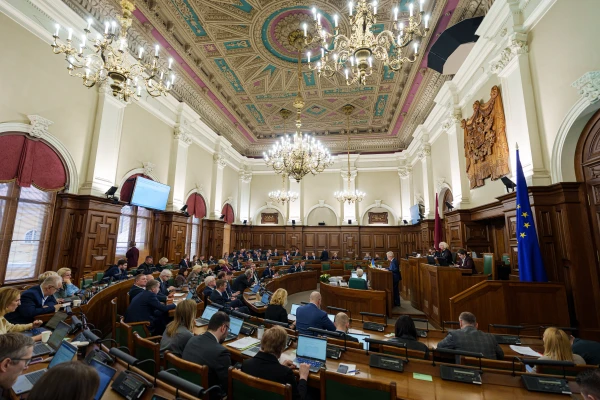
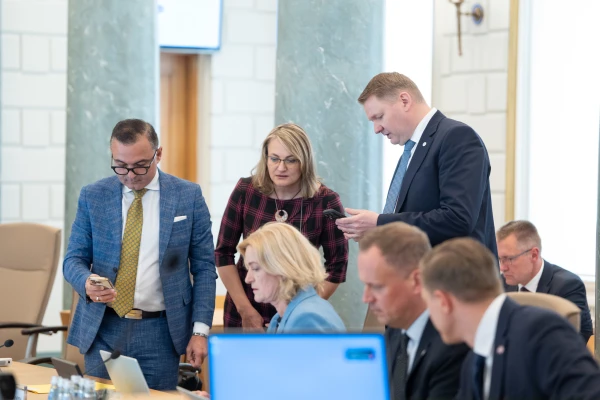
“You started too early!” - the president recently stated, lamenting the prematurely started election campaign in the Saeima. But that is the reality: indeed, the servants of the people unusually early arranged a pre-election fever — in fact, the entire autumn session of the Saeima passed under the sign of “pre-election anticipation.”
It is understandable: today, with just over 10 months until the elections, MPs are thinking about how great their chances are of being re-elected to parliament.
Political Atmosphere and Internal Competition
Moreover, MPs are not so much afraid of competition from other parties as they are… concerned about internal competition, that is, competition within the list. There won’t be enough places in the sun for everyone… This is especially true for the ruling parties, as in these parties, alongside MPs, ministers will also occupy places on the candidate list — with greater recognition among voters and the ability to make themselves known more often. In general, all of this only creates uncertainty and nervousness among politicians, forcing them to act tougher, louder, and more actively…
This year, MPs have practically completed their tumultuous activities and have gone on vacation — the servants of the people will return next year, in early January. Therefore, it is the right time to summarize the results of this parliamentary session.
It was expected that the key event of this session would be the adoption of the 2026 budget and the budget package. The opposition secretly hoped that the government would stumble over this budget, considering the slim majority of the ruling party in the Saeima.
Main Events of the Autumn Session
However, once again, the pre-election fever shuffled all the cards, and the loudest event of autumn 2025 was the saga surrounding the Istanbul Convention — more precisely, the attempt to withdraw from it.
Let’s not revisit this topic, as it has surely become tiresome for our readers. Let’s just say a few words about the results of this saga. First — those parties that ultimately abandoned their initial position have already begun to rapidly lose popularity (according to party ratings for November), second — the quarrel in the coalition over the Istanbul Convention has long poisoned the atmosphere in the government, and the consequences of this will be felt at least until these elections. And third — if necessary, the government or at least the main ruling party, “New Unity,” can even organize protests, actions, and rallies, pulling in public organizations and the media.
But after the Istanbul Convention, there was the budget, which was ultimately adopted, almost in the form in which it was supported by the government. I think our readers remember not so much the budget itself as one of the related bills, which — for the first time in modern Latvian history — linked taxes, that is, fiscal policy, with language policy! Namely: Russian media and books in Russian were deprived of the preferential VAT rate! Those experts who pointed out that the authorities decided to apply taxes not based on the content of the media or books, which would still be strange, but based on the language are right! Amazingly, but true: the state decided to “punish” not only foreign publishers but also domestic ones, that is, the same legal entities as those that publish Latvian literature.
As for the budget itself, one of its “features” is the continuation of the attempt to live on credit. Expenses exceed revenues by almost 2 billion euros. And although the ruling party reassures us that in a number of other EU countries, the external debt is much higher, the trend is still very alarming: by 2029, the volume of public debt could reach 55% of GDP! It should not be forgotten that every year the amount we, taxpayers, pay for servicing the debt increases — again, by 2029, it could reach 1 billion euros!
And one more result of the budget saga. One could even say, the echo of the adopted, in the words of the Prime Minister, the best budget of all possible! It turned out that MPs “blindly” supported the introduction of a fee on commercial vehicles weighing from 3 to 3.5 tons. The parliamentarians thought this was some kind of technical amendment! In reality, it could hit both farmers and merchants hard, who transport small but important loads for most consumers. As the president later noted, who returned the bill for revision to the Saeima, the introduction of the fee could raise prices for products and services. And inflation this autumn is already hitting hard…
And Again About Language
The autumn session of 2025 continued the tradition of “attacks” on the Russian language — unfortunately, the proximity of the elections leaves no hope for an end to such attacks until the very elections. If we are talking specifically about the autumn session, then, alongside the mentioned story about the increase in VAT, it should be noted the amendment approved in the second reading to the Education Law, which effectively prohibits teachers from communicating with each other and with students in any language other than the state language while performing their official duties. The amendment is promised to be revised by the third reading. But based on the options that have already been submitted, it is clear that the essence of the amendment will not change. Moreover, the Ministry of Education proposed to place the responsibility for the implementation of this amendment on the head (read — director) of the educational institution. It is clear that such a language ban is difficult to enforce, it is detached from real life, and most importantly — it will certainly not benefit the educational process. But the elections dictate their own terms, and MPs, especially those seeking the votes of the nationally minded electorate, are afraid to show voters some “weakness,” insufficient principle in protecting the state language.
Well, what about the decision of the parliamentary majority regarding the “popular initiative” to deprive loyal citizens of Latvia of their citizenship and expel them from the country? In fact, this initiative emerged back in 2022, and only after three years was it possible to scrape together the necessary 10,000 signatures from citizens of Latvia to send it to the Saeima.
The paradox is that all the experts invited to the parliamentary commission on mandates for the initial discussion unanimously stated: the expulsion of citizens of Latvia is impossible, as citizens have the right to return to the country. Representatives of the Ministry of Foreign Affairs and the Ombudsman’s Office emphasized that deprivation of citizenship is a serious interference with a person's fundamental rights and pointed out Latvia's international obligations.
So, everything seems clear: international law, the Constitution, and European standards do not allow depriving a person of their only citizenship and even more so — expelling them somewhere. However, the absurd initiative was given the green light — it was sent for substantive consideration to the Saeima's Defense and Internal Affairs Committee. Moreover, 67 people voted for this decision!
In any case, the autumn session has come to an end, but it can already be confidently predicted that in January, the Saeima will be even hotter and more unpredictable for all of us!





Leave a comment