
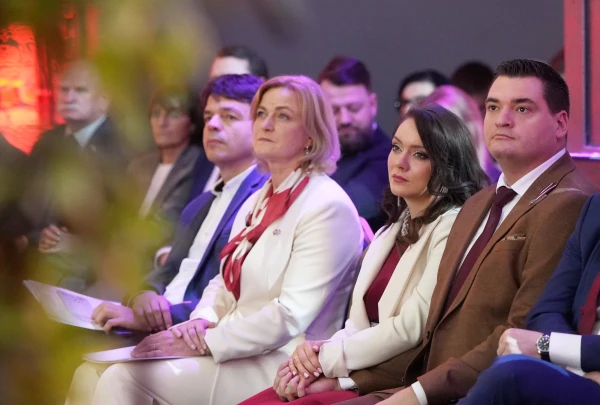
Last week at the congress of the National Alliance, the candidate for Prime Minister from this political force was announced — this is Saeima deputy, former Minister of Economics Ilze Indriksona.
Of course, this candidate is less charismatic and less known in the eyes of the national electorate than the former long-time chairman of this political force, Raivis Dzintars.
On the other hand, there is logic in this decision — Indriksona has recently become the head of the National Alliance, and after Prime Minister Silinie, it is quite possible to try to nominate a woman as Prime Minister from the National Alliance — perhaps it won't be worse.
Rise of Right-Wing Popularity
Be that as it may, the National Alliance seems to have all the prerequisites to compete for the position of Prime Minister — we see that not only in the USA but also in several Latin American countries, conservatives are celebrating convincing victories, and right-wing politicians are slowly but surely coming to power in certain European countries. Moreover, one can be confident that this trend will continue. There are several main reasons for this. The first is the growing dissatisfaction with leftist policies, which do not lead to economic progress. The second is the locals' discontent with the overwhelming presence of refugees or, more precisely, economic migrants.
If about 10-15 years ago the arrival of migrants was perceived as a necessary condition for economic growth and solving the labor shortage problem (primarily unskilled labor), now uncontrolled migration has led to such negative consequences that the labor shortage seems trivial! A sharp rise in crime, the creation of ethnic gangs, riots, and increased social tension — all of this is a consequence of reckless, unreasonable migration policies. As a result, there is a rise in popularity for those politicians in the old world countries who promise to combat the overwhelming presence of citizens from third countries.
Notably, the National Alliance has recently, while not forgetting about the "Russian question," ridden this wave — that is, the fight against the overwhelming presence of migrants. However, fortunately, it is still too early to speak of a real overwhelming presence. But the trend of increasing residence permit holders from Asia is evident. The National Alliance sees the fight against them as an opportunity to strengthen its electoral positions. However, it seems that at this stage, voters have not yet developed gratitude towards the National Alliance for this fight against migrants and are still angry at Indriksona and Co. for their concession on the Istanbul Convention.
Who Will the Latvian Voter Choose?
Let us remind you that the National Alliance initially supported the bill to withdraw from the Istanbul Convention, and then, when the president returned the bill back to the Saeima, the National Alliance voted together with "New Unity," "Progressives," and the United List to effectively prevent this bill from being considered in this Saeima. The result — the rating of the National Alliance sharply declined in November — today, 5.6% of voters are ready to vote for this party.
The United List also lost popularity for the same reason.
However, this does not mean that the rise of the right to power in Latvia is impossible. Firstly, there are still more than 10 months until the elections, and voters may well "forget" about this story with the Istanbul Convention.
Secondly, at least the Latvian voter is becoming even more right-wing — both due to general trends in global politics and due to the geopolitical situation. The Latvian voter feels "safer" voting for national and even nationalist forces — they seem not to be expected to compromise on ideals.
Moreover, right-wing voters are conservative in both a direct and figurative sense: they rarely change their favorites. For example, the recently established party Austošā saule can currently expect only 0.6% of the votes. Yes, the party is only three months old, but it is already clear that politicians with very low recognition and minimal political experience are unlikely to pose serious competition to the political stars of the National Alliance and/or the United List.
Competition on the Right Flank
Despite the obvious crisis, the right-wing centrists from the Union of Greens and Farmers have not yet said their last word.
In any case, we see that competition on the right flank is quite high. Representatives of "Latvia First" can also count on their share of the Latvian electorate, as they have clearly gained points after not changing their position on the Istanbul Convention.
It is evident that the battle for 100 mandates in the next Saeima will be very heated, but we dare to assume that a stable majority in the new parliament will be obtained by the right forces. Does this mean that Russian speakers should fall into depression and prepare for the worst, knowing the position of the National Alliance, the United List, and the "Green Farmers"? Most likely not — as it is said, almost all decisions regarding the removal of the Russian language from the public space have been made, and probably in a couple of years, conservatives will indeed focus mainly on combating migrants. There will be a very large front of work there!
It is clear that the right will, for objective reasons, only strengthen their hold on power.






Leave a comment