
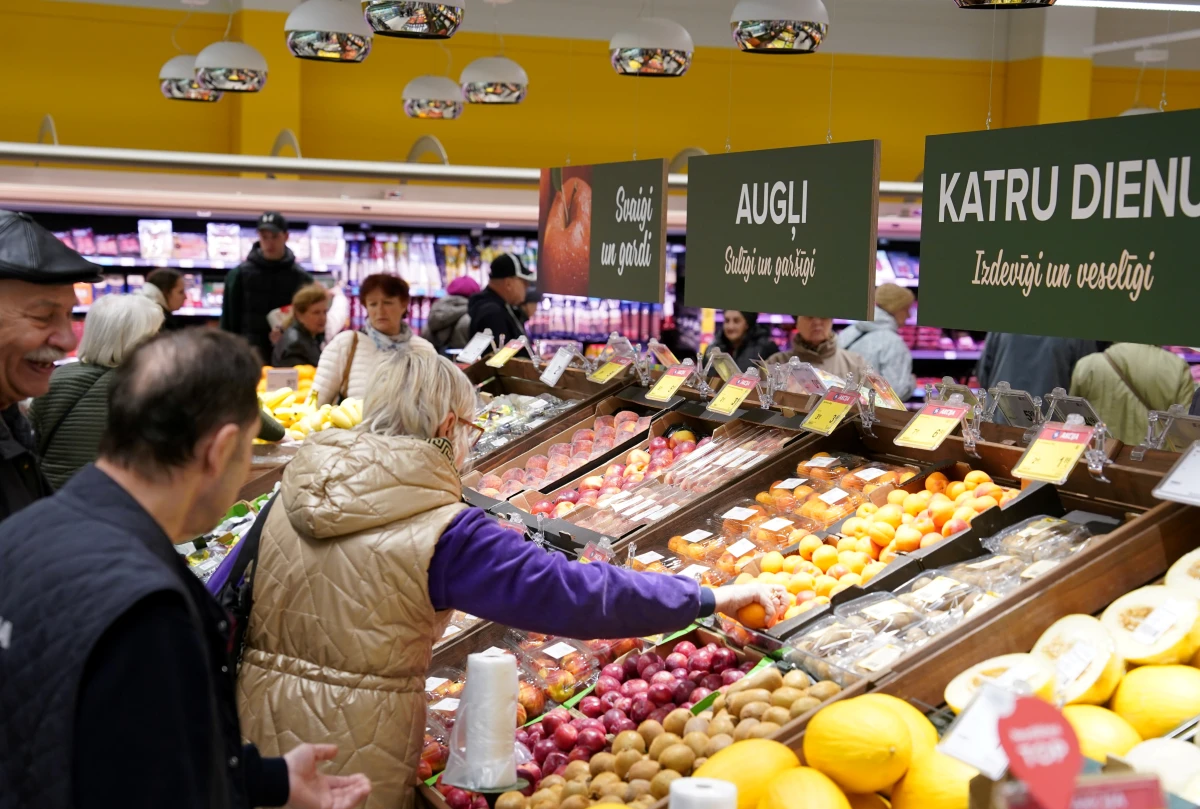
Well, that’s what the upcoming elections do! From July 1, 2026, to June 30, 2027, as part of a "pilot project" by the Ministry of Economics, the value-added tax on bread, raw milk, chilled meat, and poultry eggs will be reduced to 12%.
Memorandum – on High Prices?
Viktors Valainis (Union of Greens and Farmers), who retained his post as Minister of Economics amid government struggles, reported to his colleagues in the executive branch in June on how he fought against rising prices:
-
Amendments to the Law on Unfair Trading Practices have been proposed;
-
The Cabinet of Ministers has adopted Rules for Research and Monitoring of Price Display on Goods, utilizing price comparison tools;
-
Agreements with traders on the fair application of the reduced VAT rate have been signed since May 22;
-
An action plan in the trade sector has been approved.
According to the Central Statistical Bureau, moderate inflation in Latvia began to rise sharply, peaking at the end of 2022. By 2026, inflation reached a 57% expression in a 10-year calculation. For food products, it was even higher – 75%, and for the aforementioned basket of basic sources of proteins, fats, and carbohydrates for the population, it increased by 99%.
Therefore, government economists declare the necessity to "promote the availability of essential food products for the residents of Latvia, especially considering households with lower incomes."
This is supposed to be done in three main directions:
-
increasing the range of locally produced food products and the volume of trade in them;
-
improving cooperation between retailers and producers;
-
supporting the growth of the national economy and long-term competition in the food supply chain.
"There Are Many of You, and I Am Alone"
Interestingly, your author discovered a curious trend through personal experience. In a recently opened "Russian" (actually German, but that’s beside the point) grocery store in a residential area of Riga, I accidentally found locally produced processed cheese. Made at one of the regional dairy plants in Latvia! But for some reason, I had not encountered such a product in the renowned retail chains of the capital before. Although in terms of price/quality ratio, it is quite competitive.
The explanation is simple: products appear (and disappear) from supermarket shelves due to a combination of logistical reasons, cost changes, and commercial decisions. First and foremost, the retail chain must find it extremely profitable to sell a particular product.
An old, proven method of the Soviet saleswoman "there are many of you, and I am alone" applies to suppliers. Until prices drop below the floor, there will be no discussion. This invisible part of the iceberg is never made public, as the parties involved often balance on the edge of Article 199 of the Criminal Code – "Commercial Bribery"...
"Information of Limited Access"
This is exactly how the information in the Ministry of Economics document is characterized – who, how, and how much trades in food products in Latvia. Truly strategic information! What about the notorious transparency?
Only some figures are allowed to be disclosed. Thus: the share of local products in retail chains that signed the anti-inflation memorandum reached 47.5%; the average discount on goods is 31.35%; the markup on food from the "low price basket" is 4.25%.
At the same time, V. Valainis's department claims that Latvia has the lowest level of food prices among the three neighboring republics: in April 2026 (compared to last year), it decreased by 0.7%, while in Estonia it increased by 2%, and in Lithuania by 0.4%.
Deflation Like Butter
However, regarding product groups, fresh vegetables and fruits (which increased by 48.6% over the year!), beef (up 10.2%), and fresh berries (up 8.2%) refuse to comply with management directives.
On the other hand, the leaders in price reductions from spring 2025 to spring 2026 were: potatoes (-28.2%), salads (-25.8%), butter (-21.8%), and vegetable oil (-13.5%).
It is worth noting the appearance among the most declining prices of that very butter, which just a couple of years ago was locked in plastic harnesses with "bells" on the shelves to prevent theft. On social media, butter was compared to Bitcoin, and there were suggestions to print it on 3D printers.
And now there are cases when the price for a 200-gram pack drops below… 1 euro. The market knows no mercy – and when producers, hoping for profit, engage in overproduction, it leads to warehouse oversupply. The attempt to repeat the times of K. Ulmanis, when Latvia supplied butter to all of Europe, clearly did not succeed. Will we eat it ourselves?
Cheese Cheaper than Five Euros per Kilo
Due to the emergence of the so-called "low price basket," which was officially signed together with the authorities by Maxima, Rimi, Lidl, Top!, Aibe, and Elvi, the Ministry of Economics suggests focusing on what supermarkets, in old terms, are putting on the shelves.
"Observations indicate that the low price basket includes 10 or more products," said the observing economists. Yes, in a country with an average price level of 12 euros per 1 kg of cheese, there were also significantly cheaper options. They are even evidenced by price tags… at empty store shelves. For example, that cheese which costs 4.99 euros/kg is snatched up immediately. The "92% availability" reported by the Ministry of Economics is simply not happening.
Thus, the high indicators of the population's purchasing power – almost 111% at the end of last year, compared to July 2024 – seem somewhat strained. The problem is that to find the entire necessary assortment of reduced prices for a household, one must visit several points of sale – one chain has promotions on one item, another on another. There are simply no "cheap stores" in Latvia by definition!
Where Does the Meat Go
The food industry also appears indifferent:
"Organizations representing producers did not provide information for the evaluation of the memorandum, nor their work to promote local products and their sales. Also, no proposals from producers and their representing organizations have been presented to improve the situation to stimulate the dynamics of local product sales."
And, of course, the unexpected blow was the closure of the Meat Pavilion at the Central Market. Due to its unique specificity, it provided both premium product groups and the most budget-friendly options. From halal lamb to pork bones – it had everything. And, notably, it was specifically Latvian farms that were the suppliers.
How is the voluntaristic decision of the "fathers of the city" related to concern for the buyer and the producer?









Leave a comment