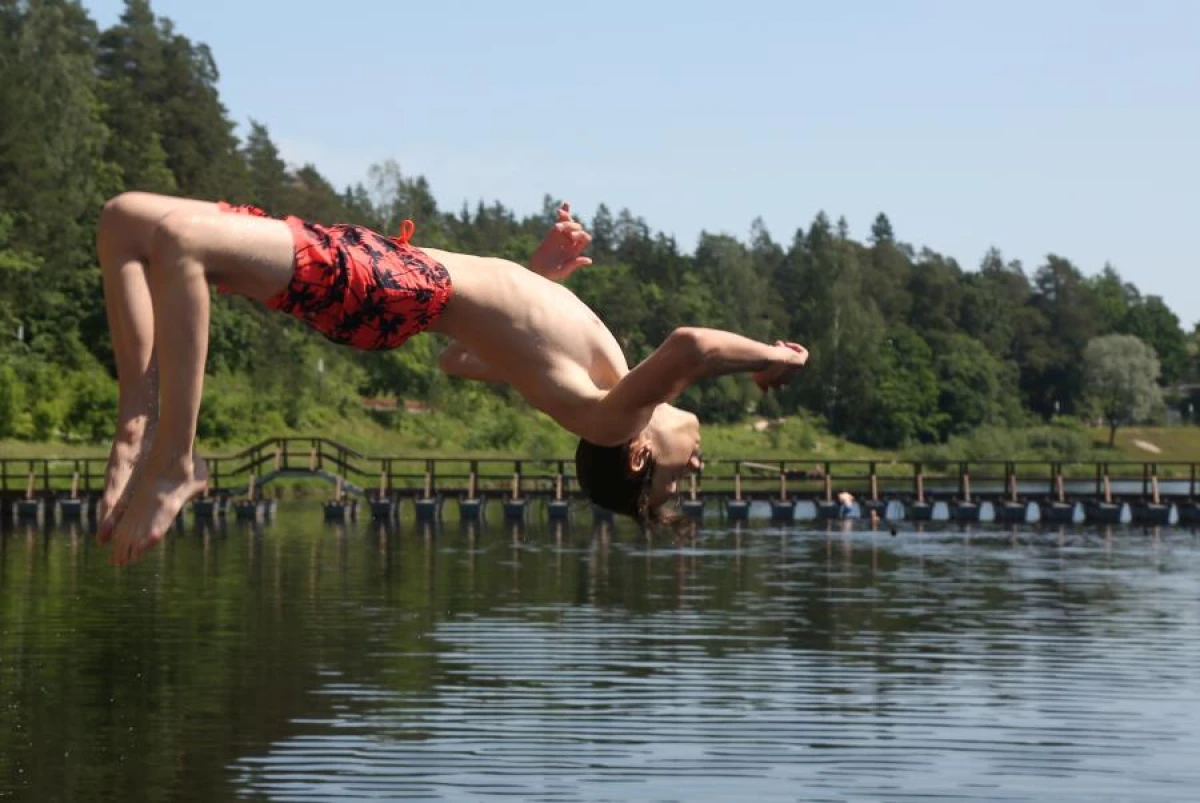
In Latvia, 15 to 25 people are paralyzed for life each year after jumping headfirst into water, reported medical center representative Agnese Baumanis, citing certified spine surgeon Artis Gulbis.
According to Gulbis, most often such injuries are sustained by young men of average age around 27 years. Such cases frequently occur during leisure time by the water in the company of friends, so those around can prevent a reckless act.
The doctor emphasizes that the consequences of such a jump can be irreversible. He recounted a case where a young man was admitted to the hospital's emergency department after diving headfirst into the water. After surgery, it became clear that he would never be able to walk again. Initially, about 20 friends, acquaintances, and relatives visited him, but after a week in intensive care, only three or four close ones came to see him.
Gulbis explains that the cervical spine is very vulnerable, as it is not protected by ribs or massive bones. Upon impact, a person does not necessarily break their neck but can sustain ligament damage, tissue tears, dislocations, vertebral fractures, and spinal cord injuries.
The clinic explains that if a person jumps and hits a rock, branch, or the bottom of a body of water, they often cannot swim out on their own. Due to the impact, loss of consciousness may occur, and spinal cord damage can cause paralysis of body parts.
If it is evident that a person who jumped into the water does not surface, they need to be rescued and pulled from the water, even by their hair, specialists advise. In such a situation, one should not be afraid that this will worsen the injury. After extracting the victim, it is advisable to lay them on a cloth — a towel, sheet, or blanket, rather than directly on the ground or sand, as the arriving medics will need to move them anyway.
The clinic emphasizes that even if a person is not breathing, they should not be turned on their side or seated to "cough out" the water. The victim should remain in a horizontal position. Artificial respiration and chest compressions should be performed without turning the head or moving the body. Emergency services must be called immediately.
In cervical spine injuries, minutes are crucial. If the spinal canal is not completely damaged and paralysis has not yet occurred, surgery must be performed within the next two to eight hours.
Specialists also remind that in summer, people more often sustain abrasions, small lacerations, fractures of the arms and collarbone, as well as experience knee pain after long car trips and back strain during gardening, traveling, or active recreation.
For minor wounds, the clinic advises against treating them with aggressive disinfectants. Contaminants are better washed off with cool running water, then the wound should be dried and covered with a bandage or special strips for closing the wound.
If there is a suspicion of a fracture of the arm or collarbone after a fall, one should go to the nearest trauma center or consult an orthopedic traumatologist.
Specialists note that prolonged repetitive strain, such as long periods of driving, can cause pain in the knee joint. Gardening work or sudden physical activity after a sedentary period often leads to back strain. If back pain persists for two weeks or radiates to the legs, a doctor should be consulted.