Did you think that Saturday clean-up days and the patronage of research institutes over vegetable bases remained in the socialist formation? Not at all!
“Voluntary work in Latvia is a significant element of civil society that promotes social cohesion, residents' participation, and community development,” states the document sent to the government by Minister of Welfare Reinis Uzulnieks on behalf of Andris Kulbergs.
A representative of the Union of Greens and Farmers has retained his position in the new government and now assures that volunteering "helps support community groups, improves volunteers' skills, contributes to mental and physical development, and also provides an economic contribution to the state."
Latvian Tradition Since the 19th Century
To avoid unnecessary associations with the former planned economy and its Saturday workdays, the Ministry of Health clarifies that "voluntary labor has historically served as a significant mechanism for the cohesion and mutual assistance of society." "Over time, it evolved from community initiatives to structured movements in the 19th century and institutional systems in the 20th century, especially under military conditions. After the restoration of independence, voluntary labor became the foundation of democratic participation and civic activity, creating the basis for the modern ecosystem...".
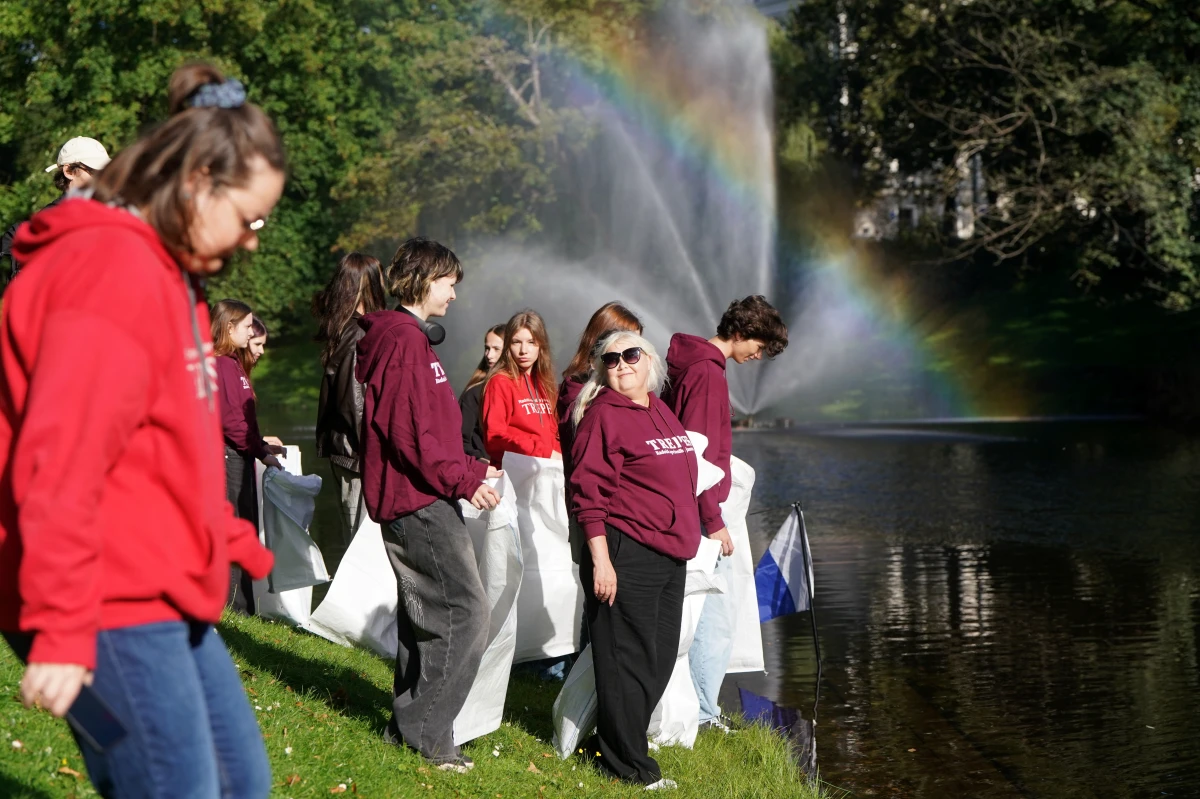
Despite the fact that Latvia has a relatively low level of participation in voluntary work – only a little over 6 percent of the population (in neighboring Estonia, it is 10%, and in the leader of the movement, the Netherlands, it is as high as 36%!), our youth participates in volunteer activities three times more often than the older generation. Residents of Riga are also highly active – about 19% have participated in free labor more than once in three years.
In general, the higher the standard of living in a country, the more significant the share of volunteering. Among the member countries of the Organization for Economic Cooperation and Development, which includes the most developed participants of the "golden billion," 1.9% of GDP is generated by volunteers. For comparison, in the OECD, the average level of defense spending is 2.5%, and on science and research, it is 2.7%.
In Latvia, the Law on Voluntary Work has been in effect for 10 years, defining who can organize and conduct such work, regulating the rights and obligations of the parties, safety conditions, and insurance.
"The law separates voluntary labor from paid work," emphasizes the Ministry of Welfare. However, the database – the Information System of Voluntary Labor – is maintained by the State Employment Agency. Of course, not for free.
Not Necessarily with a Shovel
Voluntary work in Latvia is diverse both in terms of sources of initiative (formal in various non-governmental organizations and spontaneous) and in type. There is physical work – cleaning territories, delivering goods. There is also an intellectual component – consultations, training, project development, translations.
As a member of the Riga City Council's Committee on Communication and Transport, I recently reviewed the results of the work of a group of young urbanism enthusiasts who presented a study on the neighborhoods of Riga – what residents want from local authorities. To do this, they had to walk a lot and talk to people who, to be frank, are not always responsive to various initiatives, the essence of which they do not fully understand for themselves.
I will not delve into the essence of the proposals now, but it is characteristic that in this case, the young men and women essentially performed the work of local administrations, which previously existed before the "coalition of change" and had quite significant powers in each administrative district of the capital. Furthermore, earlier, all of Riga, divided into 6 districts, had its own elected administration (district council) and local management (district executive committee) in each. By the way, the population of certain districts of the city currently exceeds the population of Daugavpils or Liepaja, which, of course, have their own authorities.
In our case, all of this is left to volunteers. Similarly, activities with youth are now considered voluntary work. Moreover, there is an emphasis on the younger generation "with limited opportunities," "with cultural differences" (primarily those who have arrived from Ukraine), as well as various types of sexual minorities. This is the youth policy in the country – for although it is considered public, it is still governmental: to search at the address jaunatneslietas.gov.lv.
In total, in the country in 2024, there were 3,133 non-governmental organizations that ensured the participation of 251,000 people in voluntary work. Since this significantly exceeds the aforementioned share of volunteers in our society, it means that some particularly active individuals worked on ideological fuel repeatedly.
Growing Old Together Joyfully
The Ministry of Welfare listed the main areas of volunteering in Latvia:
- social protection and social welfare;
- education; health and disease prevention;
- environmental and nature protection;
- animal protection and welfare;
- culture and art;
- sports;
- assistance in disasters and emergencies;
- execution of criminal penalties and probation;
- civil defense and security;
- youth work;
- community and outskirts development;
- democracy, civil society, human rights protection.
Volunteering knows no age limits. By spending their retirement days in voluntary work, seniors over 60 gain, in the words of the Ministry of Welfare, "a tool for active aging that helps maintain mental health, reduce the risk of loneliness, and support physical activity while strengthening the sense of belonging to the community."
Golden words! A familiar lady, at the age of 56, being a piano teacher by profession, came to the State Employment Service, where she was simply yelled at – what does she want at her age, what vacancies, when there are so many young people wanting jobs in the country? They did give her some forms to fill out – and registered her as unemployed (without money, of course). But she could have simply accompanied somewhere for her own enjoyment. Perhaps even for food...
Herein lies the fundamental difference between our volunteering and that of the Dutch. Their society has become so saturated that it even feels somewhat guilty and is ready, for example, to go to Africa to help those in need. In the conditions of Latvia, there is a lack of ordinary work, which leads to the invention of a palliative for employment, the same notorious social enterprises.
However, the compensation allocated for voluntary work has not changed since... 2010. According to the Cabinet of Ministers' regulations, no more than 6 euros per day can be allocated for food, 57 euros per day for accommodation, and 200 euros per year for training. All of this is not subject to VAT, but it is so little.