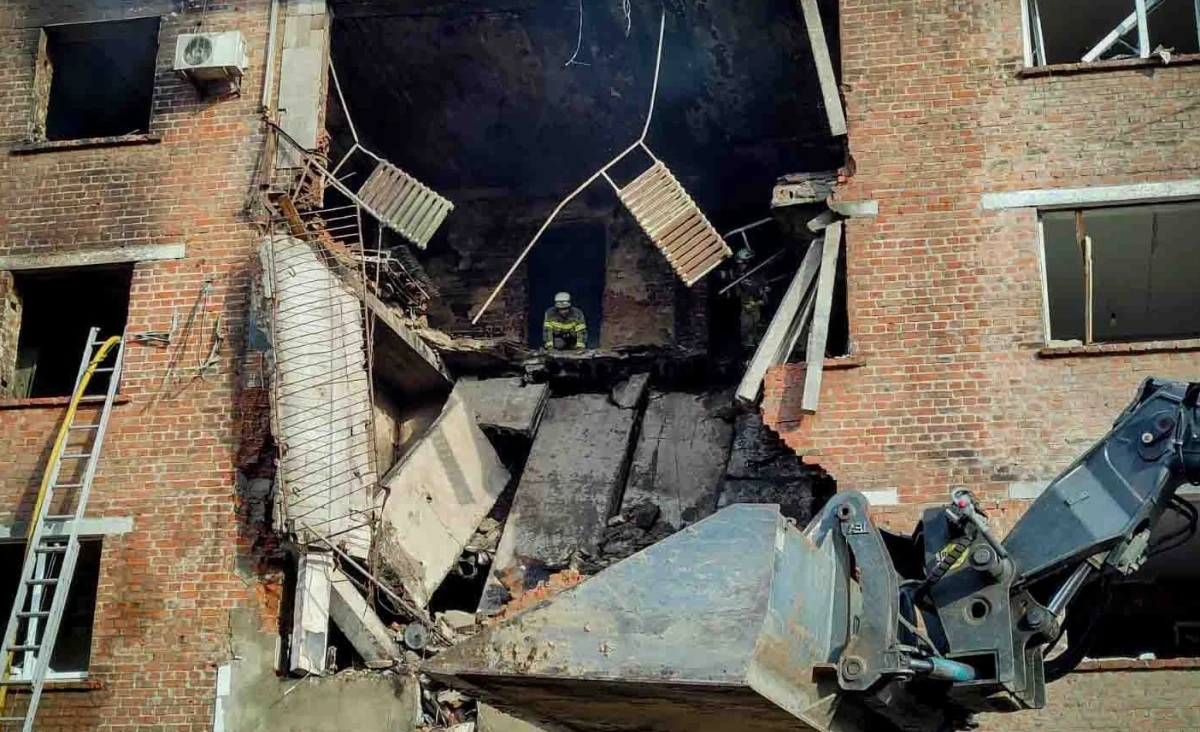
After a series of incidents involving drones in Latvia, the question is increasingly raised: who compensates for the damage if a drone damages housing or property. As the program "4th Studio" of Latvian Television found out, there is currently no clear and guaranteed mechanism for payments.
Amid the increasing incidents involving drones in Latgale, residents are increasingly asking the question — what to do if a drone damages a house, car, or other property.
This topic became particularly acute after the explosion of a drone on May 7 at the oil depot in Rezekne. Looking at the city map, the incident site is located near residential areas and the center.
As reported by the Latvian Television program "4th Studio," the Ministry of Finance confirmed that such cases currently do not fall under the standard damage compensation mechanism.
Ministry representative Alexis Jarockis explained that a person must first report the incident to the emergency services and contact their local municipality. After that, the municipality can conduct an initial assessment of the situation and provide urgent assistance if necessary. However, if the damage turns out to be serious or the incident is related to national security issues, further consideration may move to the state level.
At the same time, automatic compensation is not provided in such cases.
"Providing compensation in such cases is not automatic and may require a separate government decision," emphasized the Ministry of Finance.
This means that even in the case of serious damage, residents are not guaranteed payments in advance.
A similar situation exists at the municipal level. Theoretically, municipalities can help those affected, but the law does not obligate them to pay compensation in such cases.
Insurance remains a separate problem.
The head of the Latvian Insurers Association, Janis Abashins, explained that standard insurance policies do not cover damage from military drones. According to him, if a regular civilian drone falls on a house, the insurance will likely apply. But if it concerns a military drone — whether it is Ukrainian, Russian, or any other — compensation is not provided.
"This is a standard practice almost worldwide: insurance does not work if it is war or events similar to war," noted Abashins.
He added that military risk insurance exists, but is mainly available only to large companies and enterprises. For ordinary residents, such policies are practically inaccessible.
Against the backdrop of Russia's war against Ukraine and the increasing incidents involving drones near the borders, the issue of property protection is gradually ceasing to be theoretical and is becoming a real problem for residents of border regions.
Currently, discussions continue in Latvia about how the state should respond to such threats — not only from a security perspective but also regarding possible assistance to people in case of damage.