
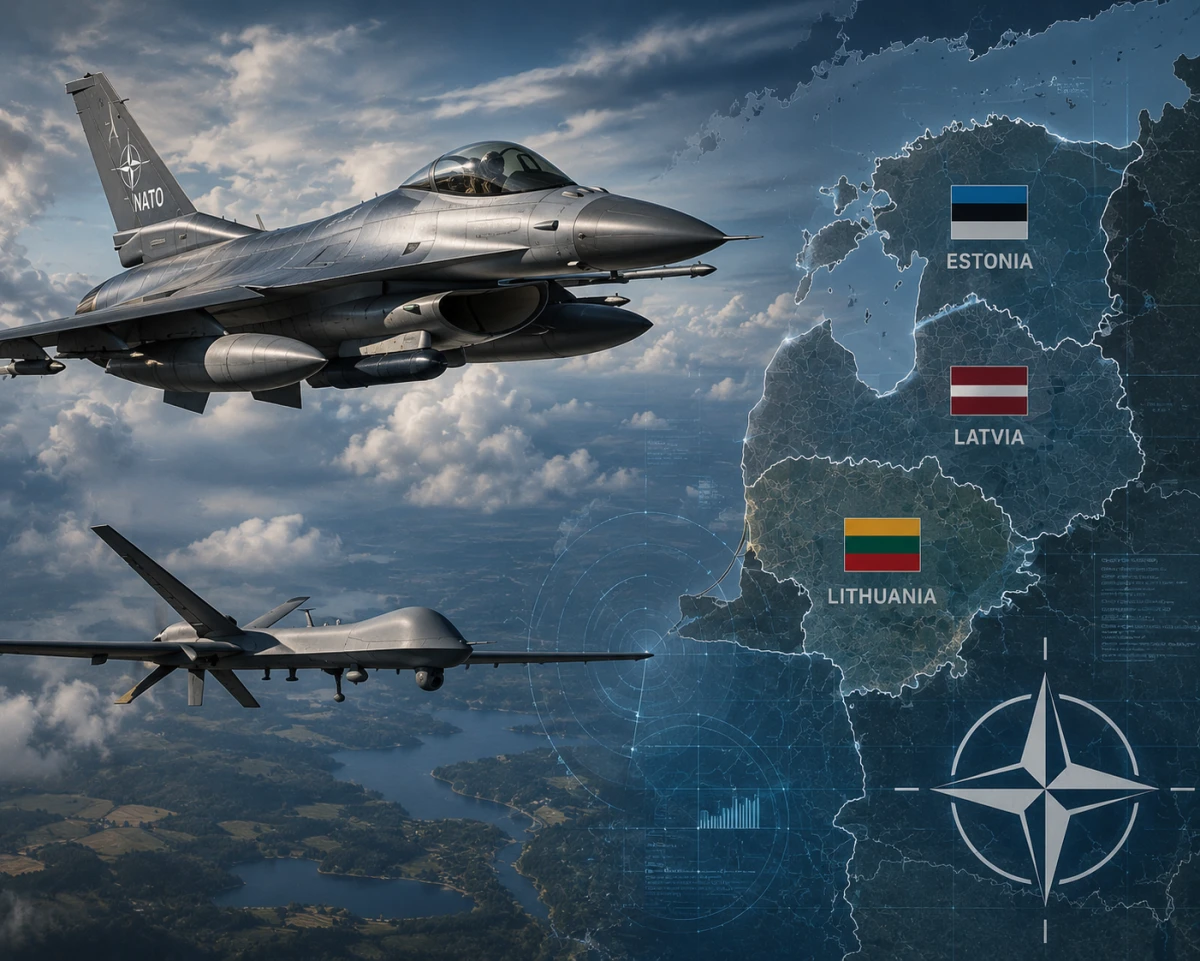
A series of air alarms in Lithuania and the incident with the downed drone in Estonia have become the largest test of civil defense systems in the Baltics in recent times. The events showed that residents receive warnings in a timely manner, but shelters, communication, and information still raise questions.
This week, the Baltic states faced a series of alarming incidents related to threats in the airspace. In Lithuania, residents of Vilnius had to descend into shelters, while Estonia shot down an intruding drone for the first time with the help of a NATO air patrol mission fighter jet, reports TV3 News.
In Lithuania, the alarm began on Wednesday morning. Residents of several regions received warnings about a possible aerial threat, and about half an hour later, messages reached the residents of Vilnius. Initially, a yellow level of danger was declared, followed by a red level, which indicates the need to take shelter in bunkers.
The residents' reactions varied. In some places, measures were taken quickly: a city bus driver took passengers to an underground parking lot, and shopping mall security demanded that shoppers stop their purchases and proceed to safe zones.
However, some people continued to behave as if nothing was happening. One resident, for example, refused to leave without his ordered pizza.
Additional problems arose with the digital infrastructure. Due to the large number of users, the emergency service app "LT72" stopped functioning properly, through which residents were trying to get details about the situation.
Classes had to be interrupted in schools. However, as the head of one gymnasium, Rimantas Remeika, noted, the children perceived the situation more calmly than in a panic.
"Most of the children are in the basement, but the ventilation is poor and the conditions are very primitive," he pointed out.
It turned out that the school shelter could not accommodate all the students at once, so some children were placed in other rooms.
Although the threat itself lasted only a few hours, the situation revealed serious gaps in the civil defense system. Some residents faced closed shelter doors and could not get inside. Following this, the Prime Minister of Lithuania demanded that local governments ensure round-the-clock access to shelters.
Meanwhile, in Estonia, another illustrative incident occurred. A drone intruding from the south of the country was shot down — for the first time with the involvement of a NATO mission fighter.
Local residents reported that they first heard a loud explosion and then saw passing fighter jets.
The elder of the Petsamaa municipality, Taavi Aas, stated that residents received alarming messages in a timely manner — first through the alert system and then through local information channels.
"At first, there was great outrage that they weren't being shot down, and now we have to worry about the fact that they were? No, on the contrary. Everything was done correctly," he said.
In Estonia, the speed of warning distribution was generally positively assessed. However, one of the main problems was identified as the lack of clear information about how real the threat was and how close the dangerous object was. As a result, the crisis hotline became overloaded.
The recent events served as a kind of test for the Baltic states' readiness for crisis situations — and showed that the alert systems work faster than the shelter infrastructure and the communication of information to people.







Leave a comment