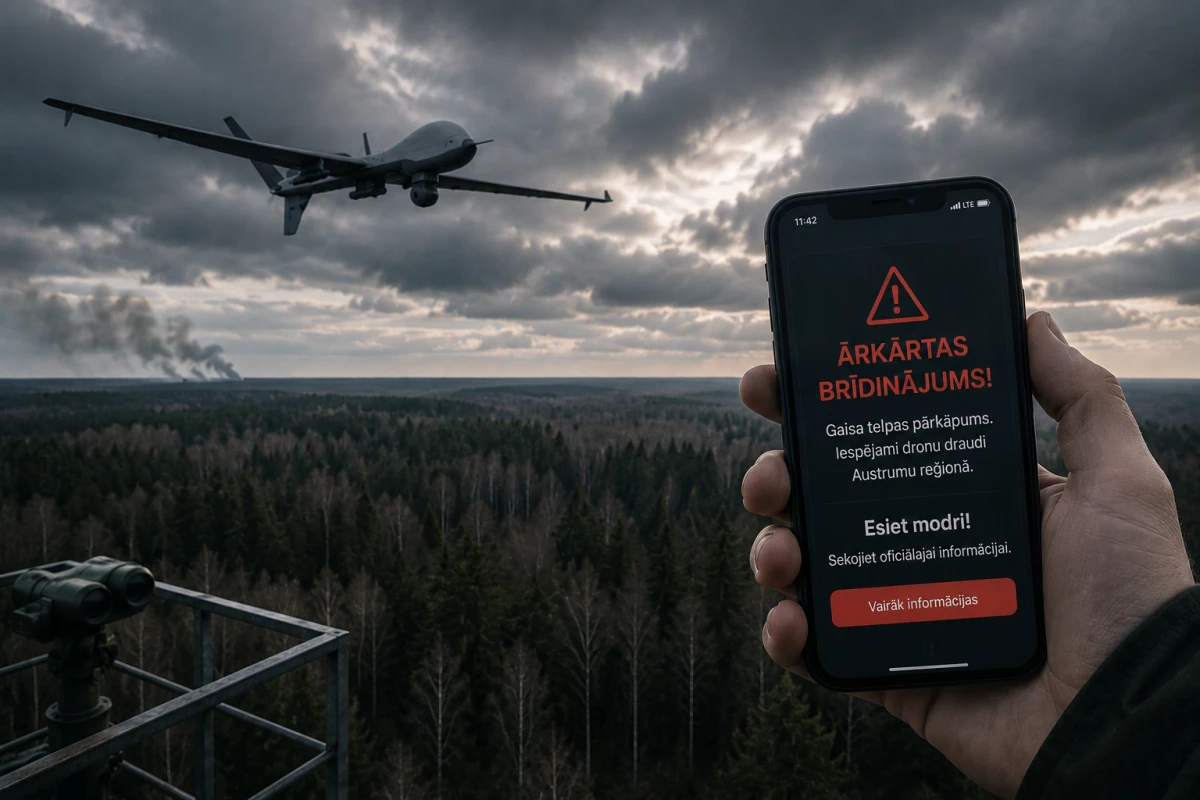
Latvian authorities have begun discussing changes to the threat level system after large-scale warnings about potential dangers in the airspace. The Crisis Management Center believes that the country needs to adapt to the new reality associated with military drones.
Latvia may reconsider its current threat level system and incident response algorithms regarding drones. This was stated by the head of the Crisis Management Center (CMC) Arvis Zile after large-scale alerts were issued on Tuesday to residents in several regions of the country.
According to Zile, the current system was created for a different situation, whereas now military drones used in the Russian-Ukrainian war are increasingly approaching or accidentally entering Latvia's borders.
On Tuesday, warnings about a potential threat in the airspace were sent to residents of Latgale and Vidzeme through the cellular alert system. This became the largest such case in the history of the system's use — notifications were received by residents of several municipalities.
As a result, the alarm affected the daily lives of thousands of people. In several places, school activities, transportation, and business operations were disrupted. That is why the authorities are now discussing how to respond to such situations more accurately and without completely halting public life.
In fact, this is an attempt to find a balance between security and the normal functioning of the country. The CMC admits that in the future, restrictions may be more targeted — for example, only for high-risk facilities.
At the same time, Zile emphasized that the threat from drones cannot be underestimated. Modern drones are capable of carrying significant amounts of explosives, and the consequences of possible strikes can be extremely serious.
What is important to know: the authorities have not yet confirmed that a drone actually entered Latvia's airspace on Tuesday, as it was not visually identified. The National Armed Forces (NAF) reported that sensors may have reacted to weather conditions or other factors, but the investigation is still ongoing.
The head of the Information Analysis and Management Department of the Joint Staff of the NAF, Maris Tutins, stated that there are no final conclusions yet, but society should still take such warnings seriously.
Such incidents in Latvia are not new. In recent months, residents of Latgale have repeatedly received notifications about potential threats from drones. Several drones have previously fallen or exploded on the territory of the country.
The incident on May 7 in Rezekne was particularly resonant, where a drone exploded at a rarely used oil depot. No one was injured at that time, but the situation triggered a serious political crisis.
This was followed by the resignation of the Minister of Defense and then the entire government of Evika Silina. Negotiations are currently ongoing in the country regarding the formation of a new cabinet.
Against the backdrop of the increasing number of such incidents, the authorities are increasingly discussing the need to adapt the civil security system to new threats that seemed unlikely just a few years ago.