
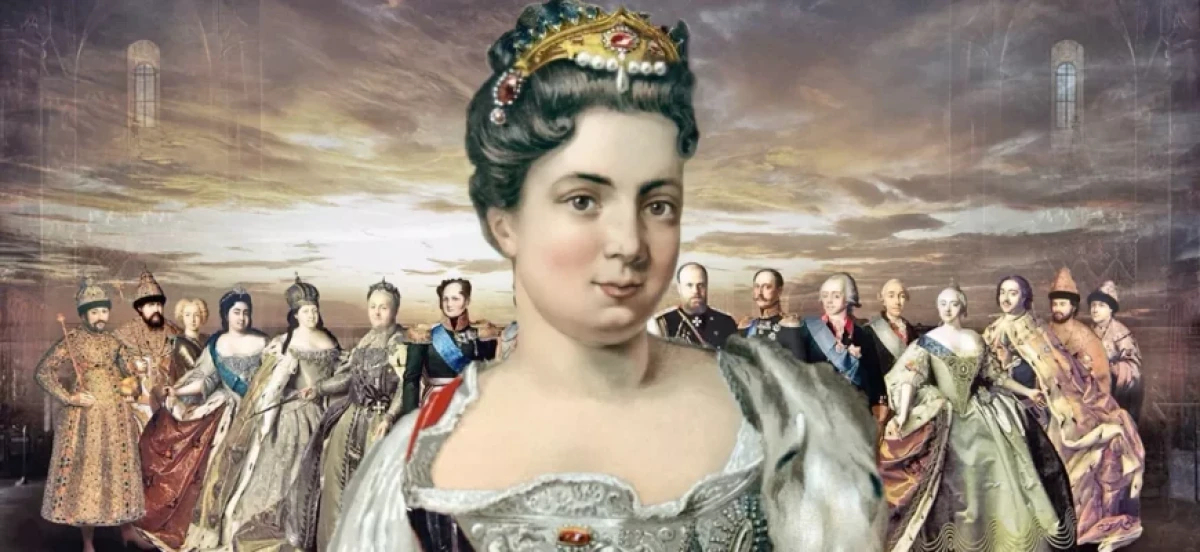
Is it true that Empress Catherine I was a servant in the family of Pastor Gluck, captured by Russian troops under the command of B. P. Sheremetev at the fortress of Marienburg (now Alūksne, 20 kilometers from the Russian border) during the Northern War in 1702?
It is now impossible to determine...
It is unknown who her parents were: according to one version, her father Johann Rabe was the quartermaster of the Elfsborg Regiment, and her mother was Elizabeth Moritz, a native of Riga. According to another version, Martha was born in Livonia to a peasant named Samuel Skavronsky.
Even her native language is unknown: she understood Polish, German, and Swedish.
The exhibition at the Hermitage, curated by Sergey Nilov, head of the "Winter Palace of Peter I" sector, presents a story of love and mutual care spanning two decades: the meeting place, the story of the birth and upbringing of children (including the future Empress Elizabeth Petrovna), the gifts he brought her (or even made with his own hands, like the wedding chandelier), a tapestry about the love of two hearts.
"She went through a very difficult path because she always measured herself against her husband and at some point truly became worthy of occupying the Russian throne," says Nilov. "And Peter the Great did everything to elevate her to his level: first as a mistress (in the literal translation from French, a keeper — editor's note) after meeting with Menshikov. Then in 1712, he took her as his wife as a shautbenacht, a rear admiral (because as a tsar he could not marry her) — she became Catherine Alexeyevna Mikhailova. And only in 1724 did he elevate her to his level and make her empress; she became Catherine Alexeyevna Romanova. Of course, he did not relinquish the scepter from his hands, meaning he did not transfer power to her, but she did become a Romanova, thus entering the ranks of the rulers of Russia."
There are few memorial exhibits related to her — the Hermitage does not even have a single dress of hers. When the museum held the first exhibition about the empress in Yekaterinburg — a city named after her (yes, indeed, named after Catherine I, not Catherine II) — they gathered a hundred exhibits. However, upon seeing the result, Mikhail Piotrovsky decided to dedicate an exhibition to Catherine I in St. Petersburg as well. It turned out to be a grand project, encompassing 450 items!
"The exhibition at the Hermitage boasts not only the quality of the items but also the fact that they belonged personally to the empress herself," emphasizes the curator. "During the preparation, many artifacts were restored, and here you can see unique works of applied art and drawings from 1717 made by a Dutch master literally 'from life' of Peter and Catherine. And, of course, at the exhibition, we tried to tell the story of the woman who created a homey atmosphere on one hand, and on the other hand, was a battle companion. After all, she went through all the stages of Peter's wars, which he waged, and was always by his side, being that very rear on which he could always rely. And, of course, she knew his taste well — both in food and in household items. And she was indeed an extraordinary woman."
Catherine accompanied Peter on foreign trips — thus, at the exhibition, you can see a 15th-century painting (by an unknown master) "Christ at the Last Judgment with Mary and John the Baptist," which adorned the town hall of Elbing (now Elbląg), but was so liked by Catherine Alexeyevna that the local magistrate gifted it to her.
The halls feature plans and projects of gardens and buildings that Peter built for her — for example, the Three Summer Gardens and the Great Meadow, Yekaterinhof. Catherine was also gifted the Tsarskoye Selo estate (from the Finnish "high place") — now Tsarskoye Selo.
According to Sergey Nilov, contemporaries claimed that Catherine I could speak with peasants in their language and be completely a peasant herself, and could be completely a ruler of a great power when with rulers and the powerful of this world, behaving in a most dignified manner. And Peter certainly valued that.
"It is clear that it was hard for her," the curator recounts. "She was 12 years younger than Peter, but apparently was so exhausted by this life — giving birth to 10 children (and how many more miscarriages...)... And always with him, in military actions, and the living conditions, of course, were field-like. And yet, she matched Peter. She could drink more than any guard, dance, and was physically strong..."
"I was always told, 'This will be an exhibition about Peter,'" Sergey Nilov shared with journalists before the opening of the exhibition. "How else could it be? It is clear that it reflects his life, on one hand, and on the other hand — she was a very independent, strong-willed, and very dignified woman, without whom Peter would not have existed. You know, they say that 'a man is made by a woman' — well, she allowed him to do what he would hardly have accomplished without her...
For the women of Latvia!













Leave a comment