
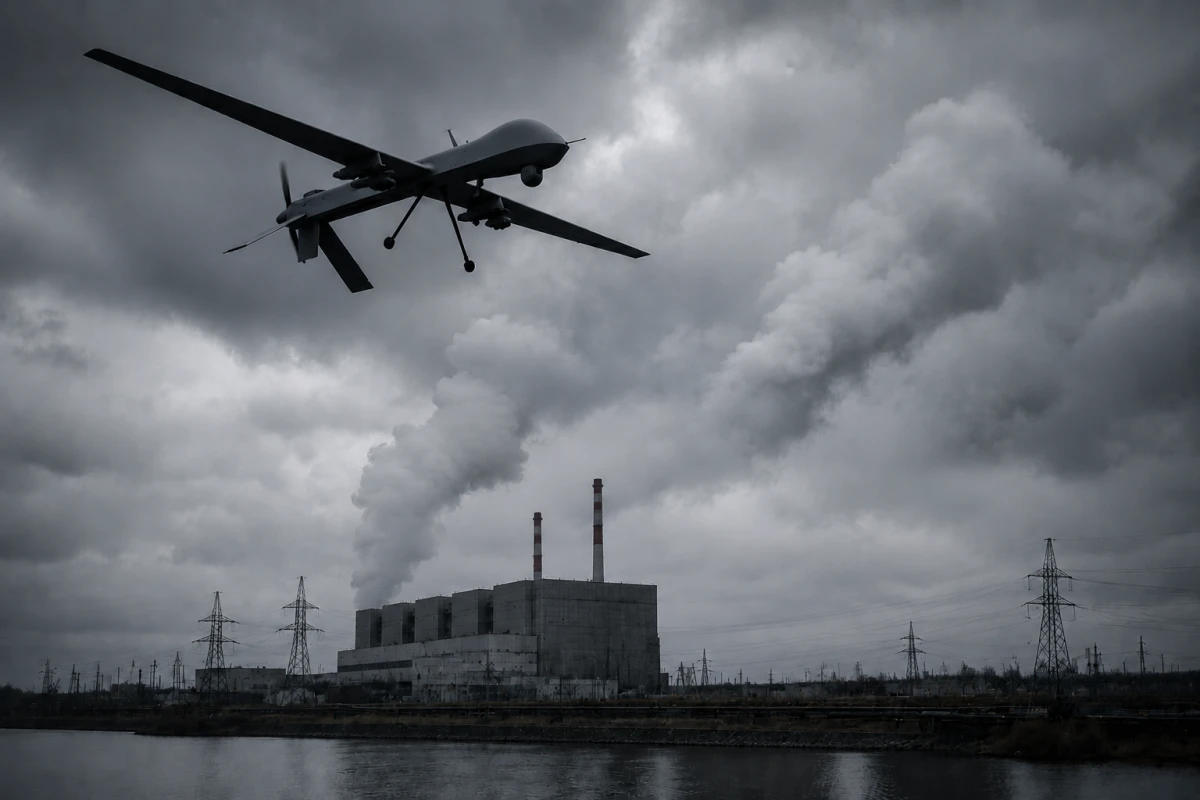
After the drones fell at the oil depot in Rezekne, the Ministry of Defense of Latvia acknowledged serious problems in the airspace surveillance and public notification systems. The agency stated that the main task now is to understand why the threat was not detected in a timely manner and why residents received warnings too late.
The Ministry of Defense of Latvia acknowledged that on the night of May 7, the airspace control systems did not function as they should have. At that time, two drones crossed the border and fell on the territory of an oil depot in Rezekne.
“Unfortunately, that night our airspace surveillance systems did not work as they were supposed to,” said Guna Gavrilko, the director of the military public relations department, on the air of the program TV3 “900 Seconds.”
According to her, the operators were unable to identify the threat in a timely manner.
The Ministry of Defense is currently analyzing the incident and modeling various scenarios to understand how to improve the response to similar incidents in the future. At the same time, Latvia is still awaiting the delivery of several previously purchased air defense systems.
“There are definitely systems that we are still waiting for,” Gavrilko admitted.
She emphasized that the country is currently forming a multi-layered air defense system, which should include radars, sensors, mobile units, and airspace patrols by NATO forces.
One of the most pressing issues after the incident was the delayed notification of residents. Gavrilko admitted that warnings through the cellular broadcasting system were received by people only after the explosion, calling it an unacceptable situation.
“The fact that residents were not warned in a timely manner is certainly an unacceptable situation,” said the Ministry of Defense representative.
She explained that alert messages should be sent as soon as a potential threat arises, not just after the actual crossing of the border.
“If we wait until a specific drone reaches our airspace, it may already be too late,” Gavrilko noted.
According to her, that is why sometimes residents receive warnings even in cases when the object ultimately does not enter the territory of Latvia.
The Ministry of Defense representative also explained how the army operates if a drone is already detected.
“At the moment we detect and identify this drone, a sort of hunt for it begins,” she said.
After that, mobile units receive the coordinates of the object’s presumed movement and head to the necessary area.
In practice, this means that the response often begins only after the border has been crossed. Gavrilko urged residents in such situations to remain calm and not go outside. If the characteristic sound of a drone, resembling that of a moped, is heard, people are advised to adhere to the “two walls principle” — to stay indoors where there are at least two walls between the person and the outside environment.
Separately, the Ministry of Defense commented on the publication of photos and videos of drones on the internet. Although there are currently no sanctions for filming drones in Latvia since the country is not in a state of war, the agency warns that such materials could provide potential adversaries with information about the capabilities of Latvia's defense.
The incident in Rezekne has become one of the most serious tests for the Latvian air threat response system in recent years and has already triggered a political crisis that resulted in the change of the Minister of Defense.
After the events in Rezekne, the authorities effectively acknowledged that the detection and response system for air threats in Latvia remains vulnerable.











Leave a comment