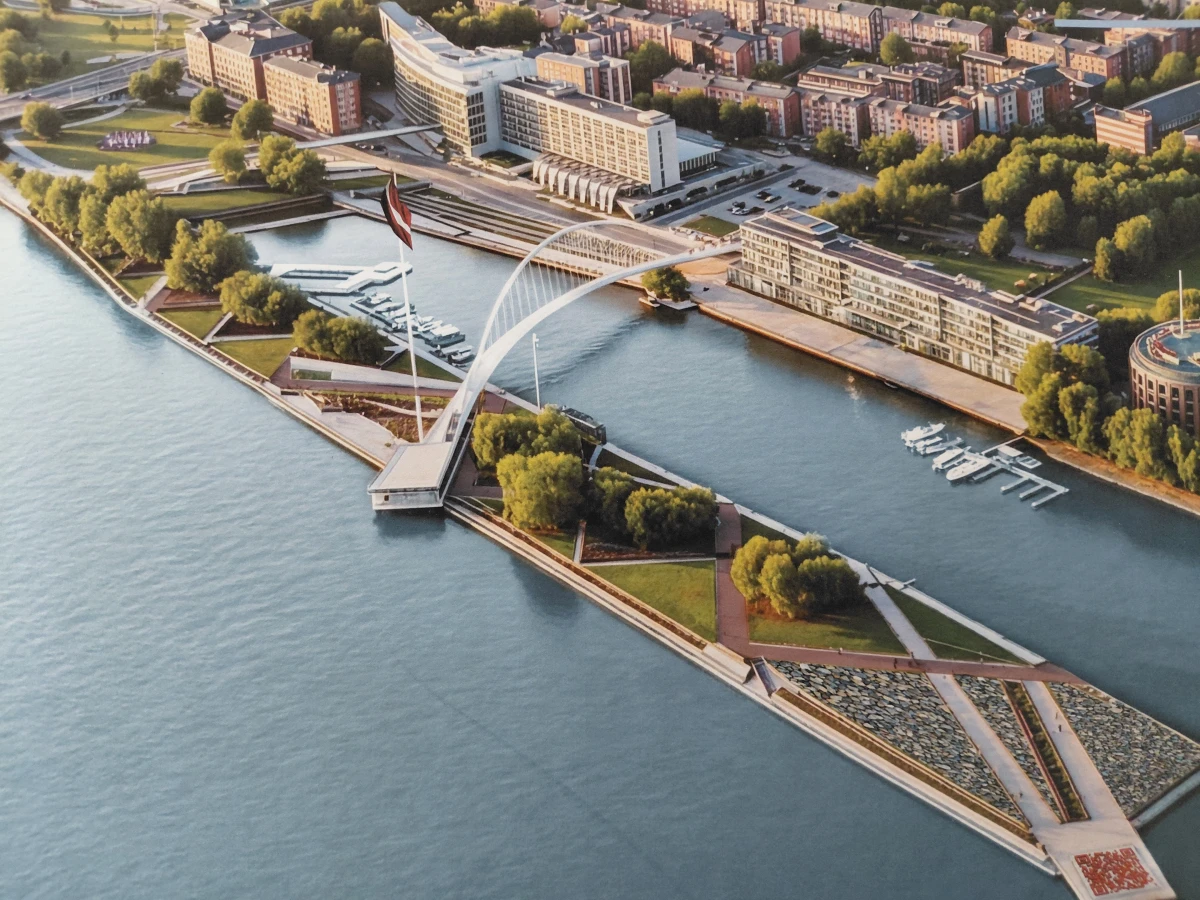
These days, the hall of the Town Hall features an exhibition of architectural projects representing the vision of one of the most desirable pieces of real estate in Riga – the AB peninsula.
Three hectares – is that a lot or a little? It depends on what you compare it to: the area of Vermanes Park is over five, while Bastion Hill with its adjacent greenery near the city canal is about two. In any case, in monetary terms, at current prices, such a plot would cost between 10 and 30 million euros. After all, it offers a view of the entire Vec Riga, and there is also the largest flag of Latvia there.
Imperial Heritage
Every time I strolled in this place, I was left with a sense of some sort of Sovietness, if you will. And this dates back to the times of Alexander III! The AB dam (AB dambis) is one of the hydraulic structures built in the 19th century along the left bank of the Daugava in Riga to ensure the stability of the shoreline and to create harbors. It was constructed near the former Kliversala Island in 1886-87. The left bank protection system was also formed by the CDE dam and the FG dam, which can still be seen today along the eastern shore of Kipsala, from the Cable Bridge to Podrags.
Initially, the width of the dam was 42.6 meters; the length, according to various sources, is either 745 or 1058 meters. The dam consisted of parallel rows of wooden piles, with gaps filled with boulders. On the side facing the main river channel, there was a gentle paved slope, while on the side of the left bank, there was a steep quay wall for mooring ships.
In the early years, the wooden surface of the dam was submerged during floods, but in 1891-95, the dam was raised and became flood-proof. In the 1920s, the wooden decking was replaced with reinforced concrete. The harbor between the dam and the current Kugu street served for the mooring, loading, and unloading of river vessels. During the ice drift, the dismantled Floating Bridge was sheltered here. In the 1920s and 30s, coal warehouses were located on the dam.
During the retreat in the autumn of 1944, the Germans blew up the dam; and during the restoration in the 1950s, it was reinforced with concrete structures and received a symmetrical profile on both sides – its current appearance.
In Soviet times, the AB dam was recognized as a technical monument, and in the late 1980s, it was briefly named after Krišjānis Valdemārs – but it did not stick. The old floating dock NOASS has long been moored there – named after the biblical Noah, this cultural ark was named by enthusiast Dzintars Zilgalvis.
With the name Čakste on our lips
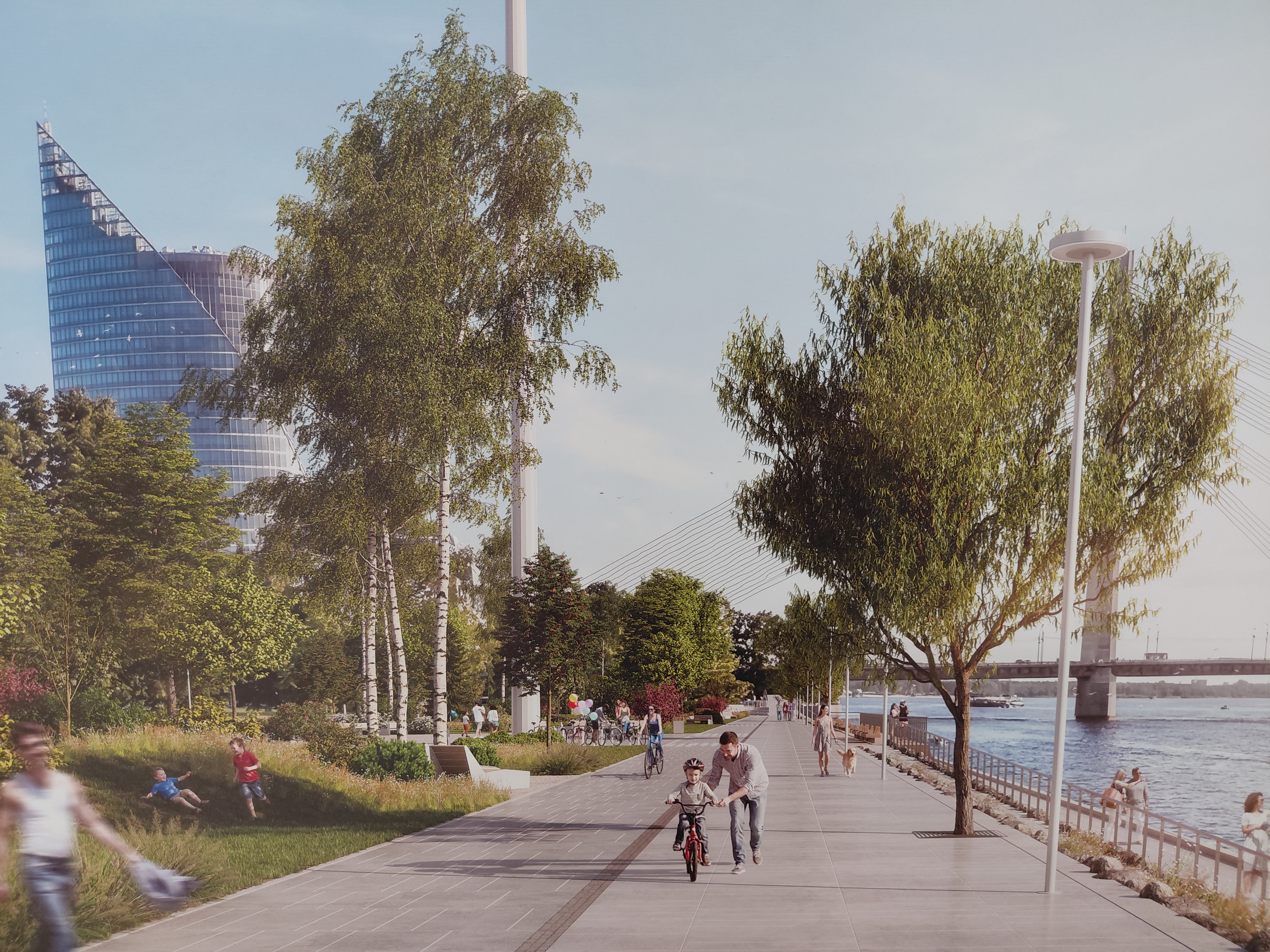
The jury of the competition evaluated the sketch under the motto "ABČ" (ABČ – AB dam plus Čakste) the highest – the work of several architectural firms and architects Oskars Vāvere, Aivars Berziņš, and Vineta Alekna was recognized as "a thoroughly thought-out proposal with a clear concept and convincing landscape logic." The authors of the dam reconstruction are offered various opportunities for recreation near the water – and on the water.
The second place was awarded to the sketch under the motto "DU 414," developed with the participation of Dutch designers, including Dagņa Smilga. The jury characterized the work as "a balanced spatial composition and a clear vision of the AB dam as a cultural direction."
The third place went to the project "Čakste Trail." The jury noted that the main advantage of this sketch is its simplicity and purity, which resonate with the first president – "and encourage each visitor to reflect on their potential as a statesman." The authors also "managed to create a tastefully Latvian landscape."
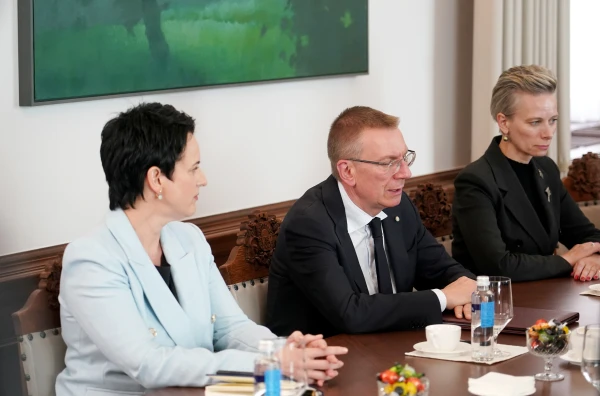
Chairman of the Riga City Council's Urban Development Committee Edgars Bergholcs ("United List") commented: "We have started work to gradually strengthen and tidy up the AB dam and make it a place that Riga can truly be proud of. Our next task is to find funding."
The great-granddaughter of the first president, a representative of the "Krišjānis Čakste House" foundation, jury commission member Kristīne Anna Čakste (born in Stockholm, lawyer) believes that the authors of all sketches have done a wonderful job.
It looked smooth on paper
The most straightforward, in my opinion, is the greening of the AB dam – planting bushes to create a portrait of J. Čakste is indeed not that difficult. But at this point, paper architecture exhausts its resources, and technology begins.
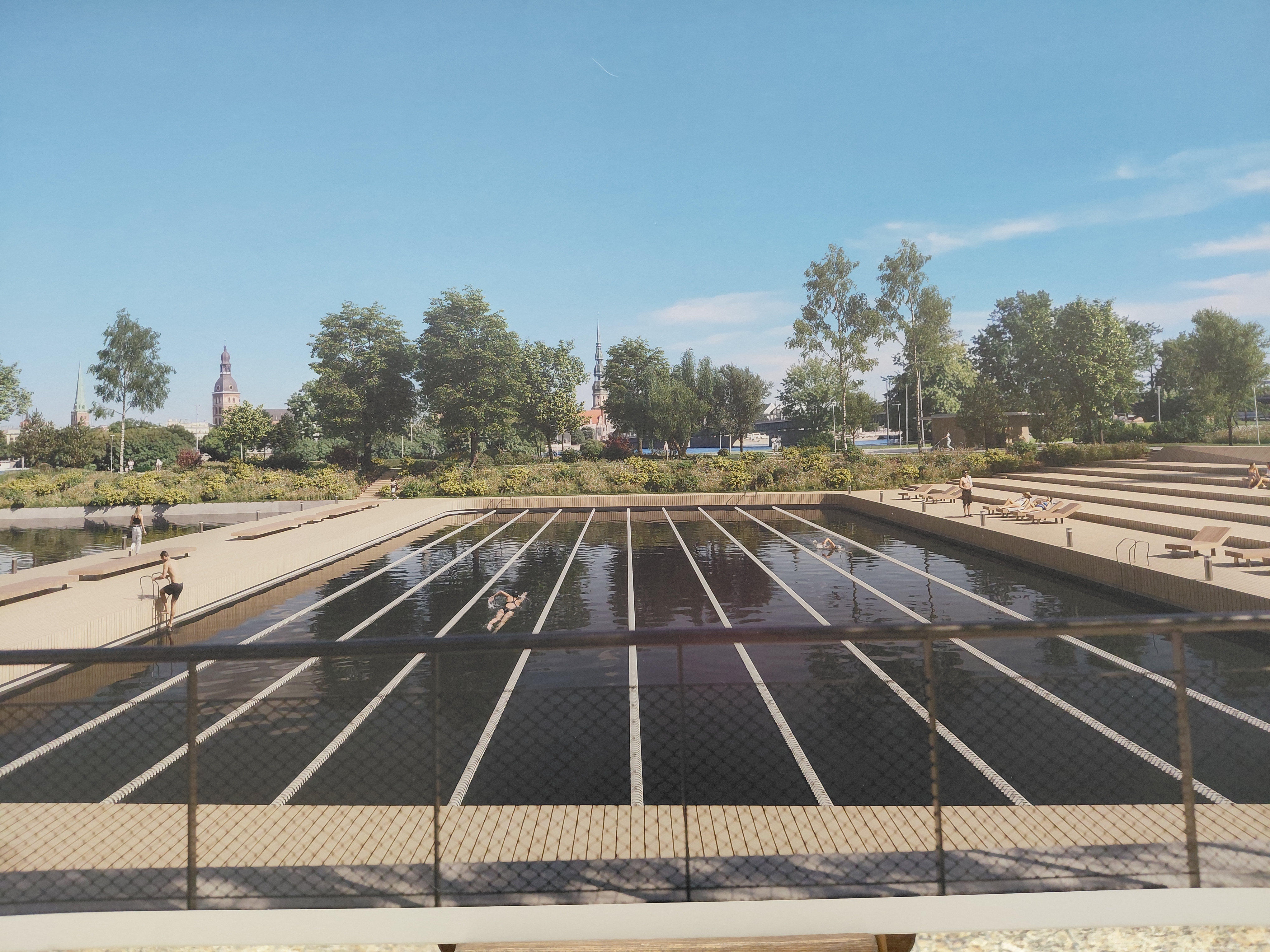
Carefully studying the exhibited stands, your author noticed that almost all options propose the creation of open swimming pools.
On one hand, of course, the idea is self-evident – bathing facilities on the Daugava appeared back in the 19th century. But in Paris, which has a significantly warmer climate, open pools by the Seine operate only from July to September. The year-round Josephine Baker maintains a temperature of 27-28 degrees due to heating. All this is further complicated by water filtration systems, which, however, do not allow pools to be used after heavy rains when bacterial contamination increases, and the water has to be additionally purified.
In our meteorological conditions, with the changeable Baltic climate and insane energy prices, such beauty looks, alas, as it was said in the late 1950s, like architectural excesses. Even if such a pool is eventually arranged – it will most likely become strictly paid. Otherwise, how to recoup the costs? Thus, it will turn out to be yet another elite spot – far from the democratization of J. Čakste.
Just like the very charming-looking bridge over the harbor – it alone will cost millions of euros, and the overall project budget is already terrifying to discuss, it’s tens of millions. And considering the recent sad experience of the Mukusalas promenade, doubts arise whether the local construction business is capable of combining three components of work: quickly, qualitatively, and at a reasonable price. One of these criteria will definitely be absent...