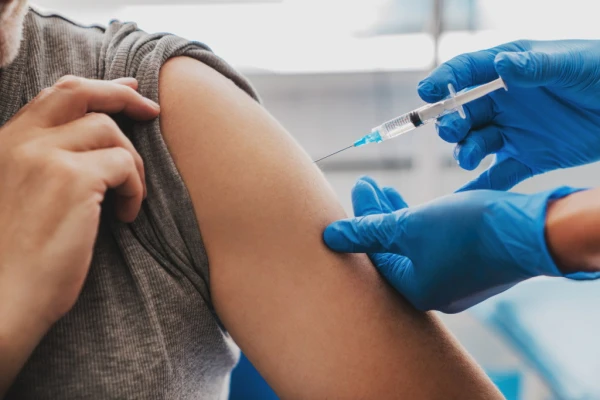
Three pharmacist organizations have appealed to the Saeima, urging them not to support the initiative to exclude the provision from the Law on Epidemiological Safety that allows them to administer vaccinations in pharmacies.
Here’s the thing: in 2021, at the height of the COVID epidemic, the Saeima adopted amendments to the Law on Epidemiological Safety, allowing pharmacists to administer vaccinations — against coronavirus, as well as against influenza and tick-borne encephalitis. At that time, doctors, overwhelmed by the influx of patients, did not object at all; on the contrary, they welcomed this measure: it helped to alleviate their workload.
But time has passed, everything has settled down. And now doctors have changed their minds: vaccination is a lucrative business (one tick-borne encephalitis vaccine alone costs more than 40 euros per patient, and a patient needs three of them).
As a result, the Association of Family Doctors and the Latvian Medical Society, slapping their foreheads in unison, recalled that "pharmacists are not medical professionals" and that "performing procedures outside medical institutions contradicts the Health Care Law." Relatives, why didn’t you object during the COVID pandemic?
And now there is an initiative in the Saeima demanding to take away pharmacists' right to administer vaccinations in pharmacies, removing the provision introduced in 2021 from the Law on Epidemiological Safety. They say, they helped at the time — and that’s enough. From now on, let only doctors profit from vaccinations.
Of course, pharmacists are categorically opposed. Three industry associations — the Latvian Pharmaceutical Society, the Association of Pharmacies, and the Association of Pharmaceutical Services — have appealed to the factions of the Saeima, urging them not to support this initiative.
They present arguments: "Changing a provision that has been in effect for several years is shortsighted, especially at a time when vaccination rates in our country are still insufficient, particularly among at-risk groups, such as the elderly. The goal of the entire healthcare system is common — to increase vaccination coverage and accessibility of services for the population, as well as to improve public health."
There is nothing to argue against: all logic and common sense require that this right be retained for pharmacists. After all, there is a shortage of medical professionals in Latvia today, especially in the provinces. Residents of rural areas often have to travel fifty kilometers or more to see a doctor. Pharmacies are much more accessible; they exist even where access to medical services is limited. Moreover, pharmacies operate longer hours, and their schedules are more flexible than those of family doctors.
In general, getting vaccinated at a pharmacy is very convenient for people, and it allows reaching even those who would not specifically travel from their village to a clinic. So why deprive Latvians of such an opportunity?
"International experience also confirms the advantages of vaccinations administered by pharmacists. In particular, the World Health Organization notes that to strengthen preventive strategies, such services should be included in healthcare systems worldwide," the pharmacists state. They provide examples: today, vaccinations can be administered in pharmacies in 16 European Union countries, including France, Germany, Belgium, Portugal, Italy, Spain, Poland, as well as neighboring Lithuania and Estonia.
In general, this is one of those cases where the actions of doctors cannot help but astonish. One hopes that the parliament will listen to the pharmacists and, in making a decision, will primarily be guided by the interests of patients.