
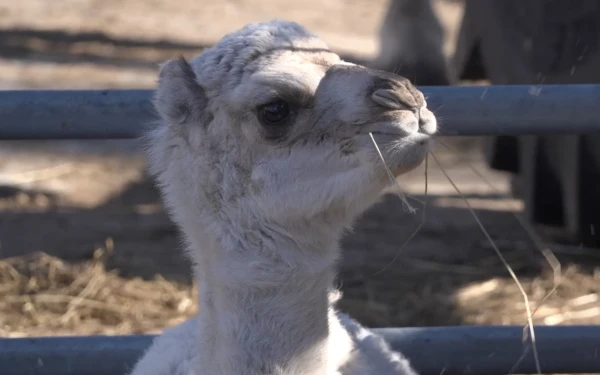
This year, a rare event occurred in Latvia — two camel calves were born in zoos. Experts note that this is a special case, as the breeding of these animals in captivity does not happen often.
In mid-March, a female camel was born at the Riga Zoo, and just recently — shortly before Easter — another camel calf was born at the zoo in Nice, which is particularly rare as it is white. The new offspring has already attracted the interest of other zoos, reports TV Kurzeme.
The white camel calf was born at the "Atomi" zoo and is now two weeks old.
The director of the "Atomi" zoo, Svetlana Pashkovskaya, said:
"On Palm Sunday, we came to the enclosure in the morning to check, and a little white boy — the camel calf — was already waiting for us. This is a real miracle for our zoo; we waited for it for a long time. The father, Marko, is six years old, and the mother is five years old."
The first hours of life and maternal milk are crucial for the survival of the camel calf, so the owners sought advice from specialists. Additional concern arose as this is the second offspring for this family — the first one died shortly after birth.
Svetlana Pashkovskaya added:
"We had to express milk, which is not so easy because the animal is large, it resists, of course, there is stress, and it protects the baby, but everything worked out. On the second day, we came and saw that the mother was already feeding."
Adult camels do not require particularly diverse nutrition. In their natural habitat, they are adapted to harsh desert conditions. In other environments, they feed on hay, and minerals are also important. In Latvia, there are only four dromedaries and 20 Bactrian camels registered, so the birth of a camel calf is a rare event. However, this year is special as a female camel was also born at the Riga National Zoo this year.
A representative of the Riga National Zoo, Maris Lielkalns, noted: "You could say that this year is, in a sense, the year of camels. You also had a camel calf born, and two camels in one year is already quite a lot. The gestation period for camels is very long — 13–15 months; this does not happen every year, about once every two years."
The light, unusual coloring of the calf is also not accidental.
Maris Lielkalns explained: "In many species, the young are somewhat different from the adults because, as they grow, to avoid conflicts with fathers — if the young is of the same species and it is a male, the father may perceive it as a competitor and start to chase it away."
In about a year, the young camel calf will move to another location. Other zoos have already shown interest in it.















Leave a comment