
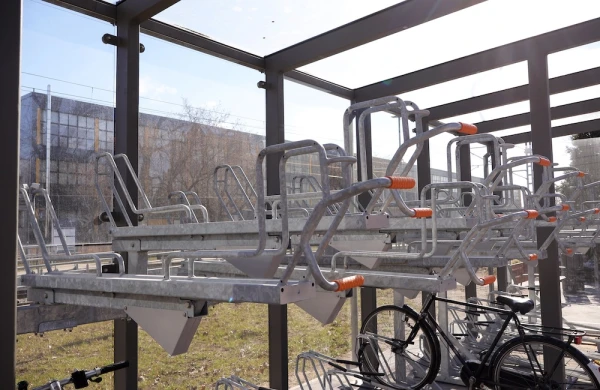
The criticized two-level bike racks cost the Riga municipality 300,000 euros, the LETA agency has found out.
An active discussion has unfolded among activists on social media regarding the two-level bike racks that have appeared in certain locations in Riga. Cyclists point out that they are "useless" because it is impossible to securely lock the frame — only the wheel can be secured, which is not sufficient protection against theft. There is also a noted lack of instructions on how to properly use the second level. Additionally, concerns are expressed that in winter, a mixture of salt, snow, dirt, and oil will drip down from bicycles placed on the upper level, covering the bicycles below.
Other social media users are puzzled as to why single-level bike racks could not have been built, for example, under nearby transport overpasses, so that a roof would not need to be erected while still protecting the bicycles from precipitation. There are also doubts about whether such spacious bike racks at railway stations are truly necessary, as passengers can take their bicycles with them on the train. Critics question whether consultations were held with organizations representing the interests of cyclists before installing such racks.
As explained to the LETA agency by the Riga City Council, the two-level bike racks were purchased as part of projects to create mobility points, and a specific supplier was chosen by the construction contractor.
The cost varies across different locations; however, one bike rack with a roof averages just over 30,000 euros. Currently, such racks have been installed at ten mobility points.
The local government notes that the goal of the mobility points is to make everyday travel more convenient and encourage residents to choose public transport and bicycles more often. Experience from other cities shows that convenient and well-thought-out infrastructure, especially the ability to comfortably combine bicycles with public transport, influences people's choices. This means fewer trips in personal cars, less traffic congestion, and a cleaner and quieter urban environment.
The council also reported that various types of bike racks are being installed during the implementation of the projects, including single-level ones. In places where it is technically feasible and where a greater number of cyclists are expected in the future, two-level solutions are chosen to ensure greater capacity.
When planning mobility points, a balance is sought between convenience, safety, and available space, according to the local government. Bike racks are created according to a unified principle whenever possible, so that residents can easily recognize and conveniently use them throughout the city.
The local government acknowledges that simpler solutions may be appropriate in certain locations; however, at mobility points, it is important to ensure a sufficient number of spaces and an organized environment.
To make it easier for residents to use the bike racks at mobility points, plans are in place to provide simple and clear instructions for their use. This is especially relevant for the two-level racks, which are a new solution for Riga and may initially require some adjustment.
Additional improvements are also planned for the bike racks, including the implementation of features that allow for more convenient and secure locking of the bike frame.












Leave a comment