
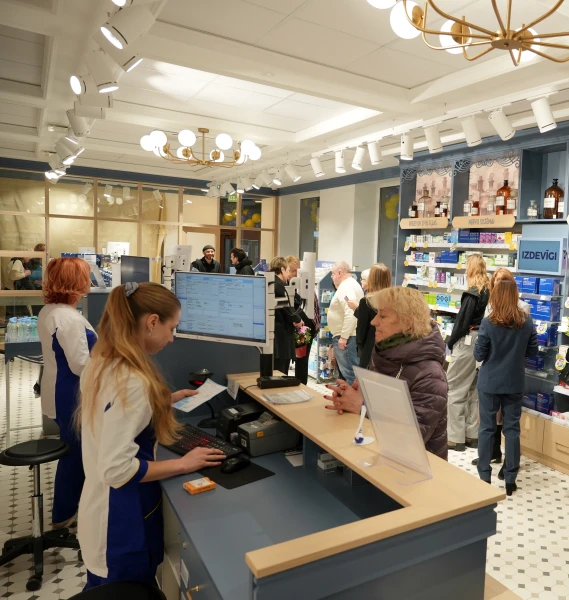
Since the beginning of 2025, our Latvia has been purchasing medications in pharmacies, paying for each prescription. The patient contributes 0.75 euros for the "pharmacist's service" – and the National Health Service adds, respectively, 0.75 euros in large cities and 1.75 euros in sparsely populated areas. Exempt from surcharges are: minors, low-income individuals, and asylum seekers.
3635 Medicines with Declared Prices
The overall sales volume slightly decreased: last year, 30.23 million packages of prescription medications were sold in Latvia (in 2024 – 31.16 million). It is unlikely that the residents of Latvia have become less ill. Rather, their overall number has decreased, along with the number of unhealthy citizens and non-citizens.
The main effect of the reform introduced by Health Minister Hosam Abu Meri ("New Unity") was the actual regulation of drug prices, which is, in general, unprecedented for a country with a free market economy. Nevertheless, the medical department reports:
- the differences in markups and prices of prescription medications between the Baltic states have been reduced;
- a unified pricing mechanism for reimbursable and non-reimbursable medications is applied;
- a fixed markup for the packaging of medications has been introduced;
- the costs for purchasing expensive medications have decreased by 15-20%;
- the division of markups between wholesalers and pharmacies has been reduced in favor of pharmacies;
- the pricing principle for pharmaceutical care services has been introduced;
- the availability of information on the prescription and use of medications has improved;
- support for single pharmacies in populated areas has been ensured;
- the volume of compensation for reimbursable prescription medications has increased from 50% to 75%.
As a result, from December 31, 2024, to February 2, 2026, prices decreased for 3285 or 90% of all prescription medications in the country; prices increased for 344 medications or 9.5%, and remained unchanged for 6. "Analysis of both the price data of medications in various segments and the total costs for one patient for a randomly selected 'basket' of medications indicates that with the change in the markup model, personal expenses of residents for purchasing prescription medications have decreased."
Analysis of TOP 200
The department of Hosam Abu Meri also conducted a study of the two hundred best-selling medications in the country. Conclusions:
- no significant changes in prices were noted; in 2025, the decrease affected a larger range of medications, and no price increases from manufacturers were observed;
- medications in the price range of 5-10 euros generally became cheaper, on average by 0.92 euros;
- medications priced at 10-25 euros decreased by 3.27 euros;
- medications costing more than 25 euros decreased by 12.61 euros;
- on average, the price of a medication package in 2025, compared to the previous year, became cheaper by 17%;
- the price of medications costing up to 5.04 euros increased.
At the same time, the medical-pharmacological authorities noted that for patients prescribed 6 or more medications, the overall decrease reached even 32%.
The digitization of paper prescriptions has made the pharmaceutical turnover more transparent and reduced cases of incorrect prescriptions and medication use. The pricing reform did not affect the availability of medications in pharmacies or the number of actual points of sale.
The Main Thing – Not to Catch Inflation
Nevertheless, the Ministry of Health points out that the pharmaceutical market is experiencing general pressures due to the economic situation in the country: "overall inflation may affect the real cost of medications." Therefore, the new model will be continuously improved:
- by November 30, 2026, the wholesaler markup model will be reviewed, reducing it for the cheapest medications (in the category up to 5 euros) and increasing the markup for the most expensive (over 100 euros);
- by July 1, 2027, the application of a surcharge for the pharmacist's service will be reviewed, applying it for EACH dispensing of medications (including for previously filled prescriptions), while the one-time price of the service will be reduced;
- every 3 years, or annually if the price index increases by more than 10% in a year, an analysis of the impact of inflation on the real cost of markups will be conducted, with proposals for markup revisions submitted to the Cabinet of Ministers.
"The volume of patient contributions for purchasing reimbursable medications tends to increase annually unless significant changes are made to regulations to reduce these contributions," the Ministry of Health's information message further states. However, in the first 10 months of 2025, it was possible to reduce costs for reimbursable medications by 6% – from 12.61 million euros to 11.85 million euros.
But at the same time, the same patients, when purchasing reimbursable medications, contributed 4.04 million euros for pharmacist services. Therefore, the overall effect for this category still amounted to a 7% increase.
And There Was a Case
A random case is presented of a patient with a cardiological diagnosis and 4 prescribed medications: in 2024, he purchased the cheapest Doxy-M-ratiofarm for 3.84 euros/package, and in 2025 for 4.51 euros.
However, the most expensive medication in the package, Rosulip N 90, changed in price from 31.35 to 27.89 euros. Considering that several packages of each medication were purchased, the total package decreased in price from 82.29 euros to 55.92 euros.





Leave a comment