
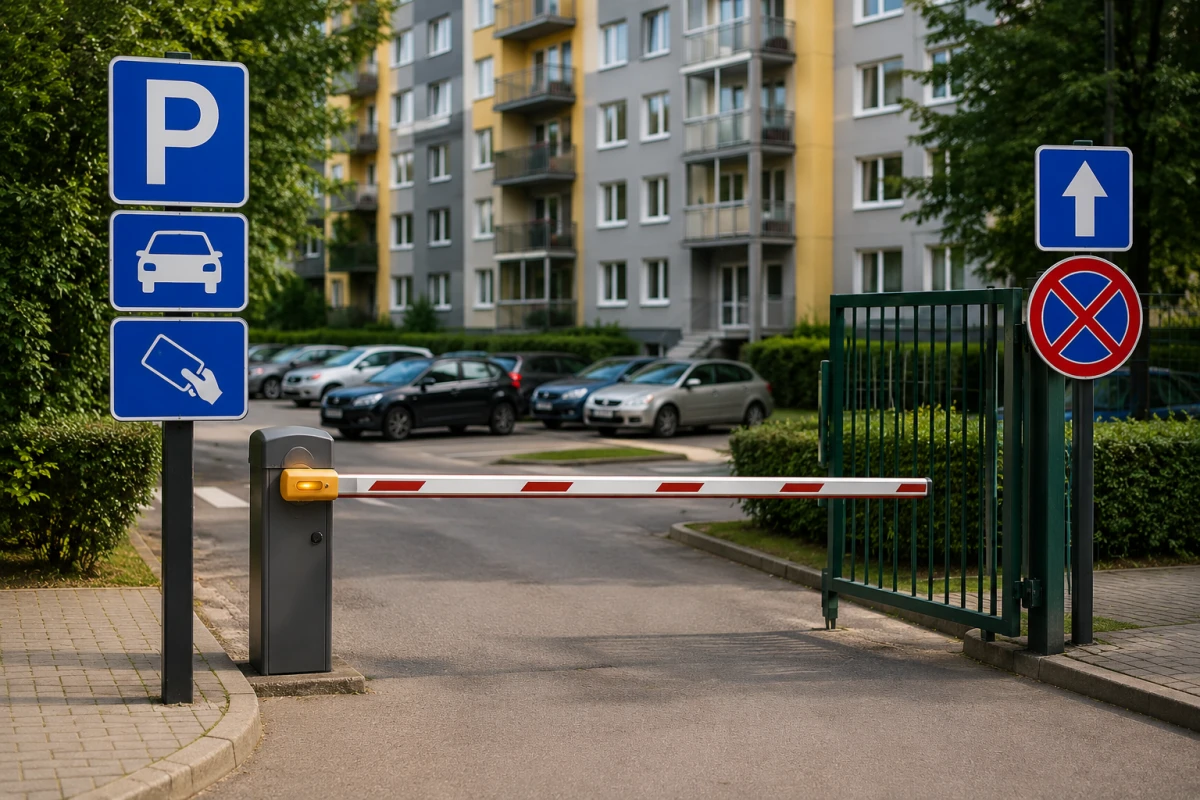
At the end of May, important amendments to the Apartment Ownership Law came into force in Latvia. As a result, the rules of life in many Latvian multi-story buildings may change significantly.
One of the practically useful consequences: the division of parking spaces in yards, storage rooms, basements, etc. is simplified. But that's not all: now apartment owners in certain situations have the right to go to court with a demand to recognize the decision of the homeowners' association as adopted. It is also possible to demand the creation of a parking space for people with disabilities.
How to Obtain a Storage Room
The most important innovation of the law is the introduction of a completely new chapter titled "Rights to Use Part of the Common Property."
As is known, previously the attempt to secure a specific parking space in the yard, basement, or storage room turned into a torturous process. Gathering the consent of all apartment owners for this was unrealistic.
Now the rules of the game have changed. The community of apartment owners (dzīvokļu īpašnieku kopība) still decides who, where, and how parks their cars or stores bicycles. But lawmakers have made concessions and significantly lowered the threshold for making this decision — the so-called quorum.
To officially approve the rules for using common property, it is no longer necessary to chase after every resident. It is sufficient for the owners representing at least two-thirds of all apartment properties in the building to vote "in favor."
What is also important: repeated surveys and meetings are limited. Now repeated meetings or surveys of residents can only be held on issues that are decided by a simple majority of votes.
If a qualified majority is required for a decision (for example, two-thirds of the votes), a repeat vote cannot be held.
Another innovation: for the installation of traffic signs or the organization of parking for electric vehicles with a charging station, a majority of more than 50% of votes is now sufficient.
Disputes About Repairs
If the community of apartment owners is chronically unable to reach an agreement, and a decision is objectively necessary for the normal maintenance of the building, any dissatisfied owner now has the right to go to court.
It is now possible to file a lawsuit against one's own homeowners' association demanding that a decision be recognized as "adopted" by force. However, three things must be proven:
-
the issue is within the competence of the building,
-
the repair is indeed critically important,
-
residents have already attempted to vote at a physical meeting or through a survey, but it did not work out.
Lawyer Ieva Keterliņa, in a conversation with the state portal lvportals.lv, acknowledged that such a norm will add work to the judicial system of Latvia, but it will shift the communal paralysis from a dead point. However, the expert doubts that Latvians will rush to litigate over every pipe.
Lawsuits are not cheap, and initially, the plaintiff will have to cover the costs out of pocket. But even if the court is won, and expenses are recovered from the defendant (the homeowners' association), it means that partially they will also have to be paid by the plaintiff, who is a participant. They will have to pay regardless of the outcome of the lawsuit.
But the mere fact of having such an opportunity should make neighbors more accommodating. After all, if the court recognizes the decision as adopted, it will become binding for everyone.
About Parking for People with Disabilities
Another important innovation concerns the rights of people with disabilities. The law now clearly establishes their right to demand the arrangement of a special parking space in the yard of the building.
Moreover, for such a decision of the community to come into force, there is no longer a need to wait for weeks — it comes into effect literally the day after it is announced.
This process can be initiated through the Building Information System (BIS) electronically from November 1, 2026. However, gathering meetings or sending surveys on paper can already be done right now.
However, the law also left plenty of loopholes for refusal. It will not be possible to arrange a space for a person with a disability if the land around the house is already legally divided among other owners, leased to third parties, or if there are other "justified technical reasons" for this.










Leave a comment