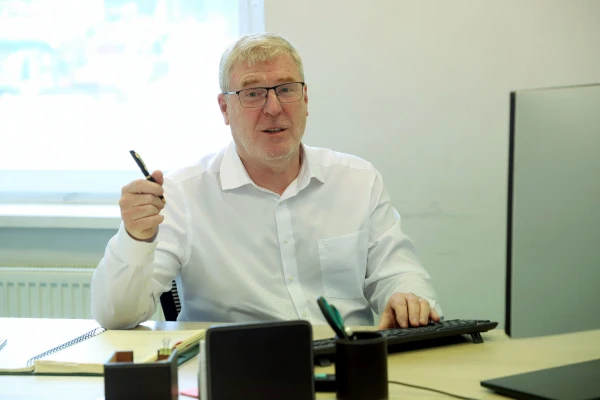
Although it may seem to a layperson that the collection and recycling of paper and film packaging is one of the simplest areas of waste recycling, in reality, it is quite the opposite: it is one of the most complex and labor-intensive fields, says Maris Baltrums, a board member of SIA "Ekobaze Latvia."
A whole range of factors creates problems in this area — both the huge volume of such waste and the actual composition of modern "paper" or "film" packaging, its condition upon arrival at sorting and processing facilities, the level of motivation for separate collection among both companies and residents, as well as the fragmentation of the packaging collection market.
In 2023, the European Union generated 79.7 million tons of packaging waste, or 177.8 kg per resident, according to Eurostat data. This is 8.7 kg less than in 2022 but 21.2 kg more than in 2013. Of all types of packaging waste, 40.4% was paper and cardboard, 19.8% was plastic, 18.8% was glass, 15.8% was wood, 4.9% was metal, and 0.2% was other materials.
In absolute terms, that year Europe generated 32.2 million tons of paper and cardboard packaging and about 15.8 million tons of plastic packaging, including films. This corresponds to 71.8 kg of paper and cardboard packaging and 35.3 kg of plastic packaging per EU resident.
One could boast that 83.2% of paper and cardboard packaging in the EU is recycled, and this figure has not fallen below 80% since 2008; however, this data is misleading — both the EU and Latvia only account for the recycling of packaging generated by households and retail. Packaging arising in industry, construction, and other sectors (such as paper bags for cement, packaging cardboard on construction sites, etc.) is not separately identified or accounted for. Therefore, the actual volume of paper and cardboard waste is greater than the official data, and the recycling rate is lower.
In the field of plastic packaging, including films, there is even less to be proud of — in 2023, only 42.1% of collected plastic packaging was recycled. According to estimates from European industry organizations, industrial and commercial packaging accounts for 50–60% of the total packaging volume by weight, while household packaging accounts for 40–50%, meaning there is no reliable data for at least half of the volume.
According to the State Environmental Service, in 2022, more than 47,000 tons of plastic packaging were released into the Latvian market, of which 24,000 tons were collected and sent for recycling or energy recovery. In 2023, Latvia ranked second in the EU for plastic packaging recycling with a rate of 59.2%, just behind Belgium (59.5%). Latvia and Belgium became the only EU countries to achieve the 2030 goal of recycling at least 55% of plastic packaging already in 2023.
However, there exists a "paradox of plastic bags" — in 2023, an average of 209 lightweight plastic bags were consumed per resident in Latvia — the highest rate in the EU. This indicates that the sorting and recycling system works relatively well for the packaging that enters it, but there is a significant unorganized flow of plastic bags.
However, the large volume of packaging and the lack of reliable data are just the tip of the iceberg. A huge problem is that modern paper packaging is often no longer purely paper, and plastic packaging often consists of several types of plastic.
Increasingly, paper packaging consists of laminated paper — with a glossy coating and adhesive layer. If such layers cannot be separated manually, the packaging cannot be recycled as paper — it can only be burned for energy recovery. A similar problem exists with plastic packaging: if different types of plastic cannot be separated, such packaging also has to be burned.
Currently, about 300 different types of plastic are used, each with its own recycling rules. Therefore, recycling facilities specialize in certain types of plastic. It is not surprising that certain types of plastic waste may be sent for recycling to France or Spain, while French or Spanish plastic is sent to the Baltic States or Poland.
Another problem is contamination of the packaging. While households, given their motivation to sort, can be held to a lesser degree of accountability, industrial and construction packaging is often contaminated with residues of cement, gypsum, chemicals, etc. Such packaging is unsuitable for recycling as it damages equipment and degrades the quality of the final product. As a result, it is also burned.
Although strict extended producer responsibility regulations are in place in the EU, they are often circumvented in the construction sector — packaging is not accounted for as a separate waste stream. Economic factors create additional difficulties: recycling is often more expensive than burning or landfilling, the market for recycled film is unstable, recyclers are reluctant to accept low-quality material, and sorting increases costs for construction companies.
Collected paper, cardboard, and film packaging is sent to various locations. Plastic materials are mainly recycled at plants in Europe, while paper and cardboard can be sent even further — for example, to Vietnam or India. Non-recyclable material is most often sent to the "Gren Klaipėda" waste incineration plant.
Despite the aforementioned problems, the sorting of paper and plastic packaging in Latvia is developing quite steadily. Retailers and printing houses actively sort packaging, recognizing the environmental benefits and the opportunity to receive payment for a sufficient volume of sorted material. Producers are motivated by a reduction in the natural resources tax when participating in the recycling system.
Moreover, non-recycled packaging is becoming less profitable due to rising landfill fees. Public awareness is also gradually increasing — public pressure and economic motivation are at play: the more one sorts, the less the volume of unsorted waste and the lower the bill for its removal.